




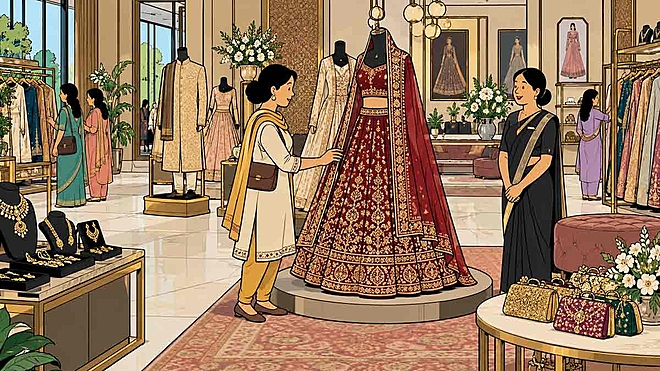
 Anand Kumar/AI-Generated Image

Summary: A year before asking the public to pay Rs 575 a share, the founder quietly sold a chunk of his own stock for less. The celebrity names on the shareholder list took all the attention on listing day. The detail worth sitting with is a few pages deeper in the prospectus, and it reframes the whole offer.
Purple Style Labs, the owner of the luxury fashion platform Pernia's Pop-Up Shop, listed on September 7, 2026, at Rs 535, nearly 7 per cent below its Rs 575 issue price. The Rs 680 crore issue was subscribed only 1.36 times overall. For an investor hunting exceptional businesses at fair prices, the weak debut matters less than what sits underneath it.
What Pernia's actually sells
Abhishek Agarwal founded Purple Style Labs in 2015 and bought the Pernia's Pop-Up Shop website for about Rs 12 crore in 2018. He turned it into a chain of large "experience centres" in India, London and New York, selling wedding and occasion wear, jewellery and accessories from more than a thousand independent designers. A customer can shop online or walk into a store, and the company then sources the item on back-order, on consignment, or from its own limited stock, which keeps the inventory bill lower than a conventional multi-brand retailer.
The company frames itself as a platform connecting designers with affluent shoppers. But a platform should get stronger as it grows, and this one is not. Active designer brands on the site have fallen every year, from 1,910 in FY24 to 1,312 in FY25 to 1,109 in FY26. The top ten designers now supply nearly a third of gross sales, up from about a fifth two years ago, a network meant to widen with scale instead narrowing around fewer big names. There is no obvious switching cost stopping a shopper from buying straight from a designer's own boutique, and no clear cost advantage over a rival aggregator.
Who is backing it, and who is running it
The shareholder list reads like a red-carpet guest list: Shah Rukh Khan, Salman Khan, Madhuri Dixit and Sachin Tendulkar. It makes for good headlines but should do no work in an investment case. The real capital came from five funding rounds between 2018 and 2023 and a Rs 306 crore anchor book at the IPO.
Agarwal, an IIT Bombay engineer, has run the company for a decade. He held 26.1 per cent of it before the IPO, a stake now diluted to 22.3 per cent. But he privately sold about Rs 45 crore of his own shares in August 2025 at Rs 500 apiece, below even the IPO's Rs 546 floor. Asking new shareholders to pay more than he himself accepted a year earlier is not disqualifying by itself, but it is not the mark of an owner we would back without reservations. A permanent employee attrition rate of 46 per cent in FY26, in a business built around personal styling, adds to that unease.
The numbers behind the ‘premiumisation’ story
| Metric | FY24 | FY25 | FY26 |
|---|---|---|---|
| Revenue from operations (Rs crore) | 504 | 490 | 558 |
| EBITDA margin (%) | 6.3 | 8.6 | 5.4 |
| Net loss (Rs crore) | 48 | 188 | 285 |
| Customers | 92,672 | 70,651 | 66,713 |
This was once a much faster business. Revenue grew from about Rs 45 crore in FY20 to over Rs 500 crore in FY24, a pace that has since stalled to about 5 per cent a year. Management's defence is that it deliberately dropped lower-value designers and products to chase richer customers, and the average order value backs this up, rising from Rs 45,513 to Rs 75,505 in two years, with Indian stores earning more than double the ticket size of the website.
But the outcome has not followed the intent. Losses have widened every single year rather than narrowing as the business matured. Gross margin slipped from about 42 per cent to 38 per cent, and the EBITDA margin nearly halved even as sales grew, because employee costs rose faster than revenue. Working capital tied up in the business roughly doubled over the same period, as new stores were stocked and staffed ahead of the sales they were meant to generate.
What it is worth
At the issue price, the company was valued near Rs 4,600 crore, about eight times FY26 revenue, with losses instead of a P/E to anchor the multiple, and no comparable listed business in India to check that multiple against, a fact the company itself admits in its prospectus. Work backwards instead: even a generous eventual 10 per cent net margin and a 30 times P/E would require revenue near Rs 1,530 crore, close to three times today's level, alongside a full swing from heavy losses into consistent profit. That is not a price on the business Purple Style Labs is today. It is a price on the business it might become.
The risks, honestly
Set the accounting loss aside and the structural risks still stack up. Of the Rs 680 crore raised, Rs 371 crore goes to settling lease liabilities on stores already built, and Rs 139 crore to marketing, leaving little for anything genuinely new. Four large stores opened in FY26 alone and still need to prove they can earn their keep. The top 10,000 customers, barely 15 per cent of the base, already generate more than half of all sales, so the business depends on a narrow, wealthy cohort staying loyal.
Our verdict
The business and management pillars fail before valuation even enters the conversation. The designer network is shrinking rather than widening, the founder sold personal stock below the price he now asks the public to pay, and profits have moved further away every year, not closer. A newly listed, loss-making retailer priced for a transformation that has not yet begun is exactly the kind of story we would ask readers to sit out.
Also read: Why is one Birla entry rattling India's cable makers?
Ask Value Research 
 New episodes every Friday











 New Process Alert
  Seems like you've uploaded a wrong QR code. Please upload the QR code downloaded from MF Central platform.


