




 Anand Kumar/AI-Generated Image

Summary:Horizon Industrial Parks has strong rental economics, rising margins and a large portfolio, but heavy debt still consumes its operating cash and keeps it loss-making. The IPO will repay a chunk of that debt, bringing the company closer to breakeven, but investors are paying a full valuation before the turnaround is proven.
Horizon Industrial Parks, India's largest developer of industrial and logistics infrastructure, opened its IPO (initial public offering) for subscription today (August 17, 2026). The entire Rs 2,600 crore issue is a fresh issue, with proceeds earmarked primarily for debt repayment.
Here's an in-depth look at the company's financials, track record, strengths and weaknesses to help you make an informed investment call.
About the company
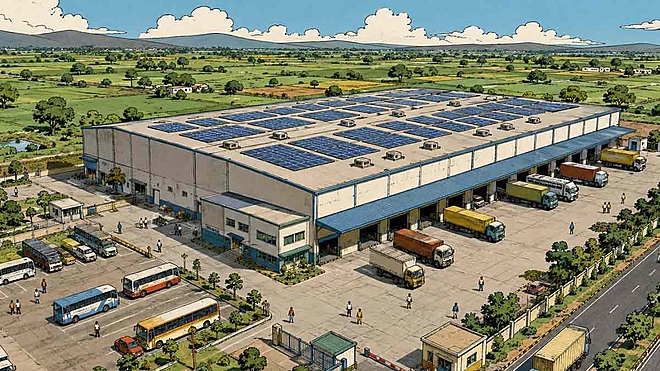
Horizon Industrial Parks buys land, builds industrial facilities, leases them to corporate tenants and collects rent, usually in advance. Rent accounts for 94 per cent of its operating revenue. The rest comes from maintenance, fit-outs, cold storage, rooftop solar and worker housing.
The network spans 58.6 million square feet across 45 assets. Just 49 per cent of it is operational. The other 51 per cent is still under development and earns nothing yet, which is the single most important fact about this company. The portfolio runs across three segments.
- Fulfilment centres: These are the large warehouses that e-commerce firms, retailers and logistics companies use to hold stock in bulk, built outside cities where land is cheap.
- Industrial facilities: These are factory shells built to order for automotive, EV and aerospace manufacturers.
- In-city centres: Only three of Horizon's 17 centres are running, serving quick commerce and last-mile businesses.
What the business gets right
#1 High margins are turning into cash
A finished, leased warehouse needs security, insurance, some repairs and very little else, leading to running costs rising to Rs 160 crore against Rs 691 crore of rent, and the operating margin climbing from around 68 per cent to over 79 per cent in two years. Cash from operations was Rs 464 crore in FY26, against Rs 119 crore two years ago.
#2 Existing assets keep getting more valuable
Horizon does not need to add new warehouses to grow rent. Its leases build in 4.5 to 5 per cent annual increases, while every renewal gives it a chance to reset rents closer to the market. Across the 4.8 million sq ft it re-leased from FY24 to 31 May 2026, new rents were nearly 12 per cent above the previous contracts.
#3 Customers expand rather than shop around
Nearly 41 per cent of all new space contracted since FY24 came from customers Horizon already had, so growth arrives without the cost of chasing new ones. Twelve customers have taken space in more than one park, and about 54 per cent of committed operational area is leased to Fortune 500 companies or their logistics partners. Once a tenant has fitted out a warehouse or a factory floor, moving is expensive and slow.
What the business gets wrong
#1 The rent still doesn't cover the loan
This is the single number that explains the loss. In FY26, Horizon generated Rs 464 crore of cash from operations and paid Rs 548 crore of interest. Finance costs alone equalled 78 per cent of operating revenue. The company is not inefficient, and it is not short of tenants. It is carrying about Rs 6,900 crore of debt against a portfolio where half the capital sits in land and half-finished buildings that pay nothing. Until that changes, every rupee of rent is spoken for before it arrives.
#2 The build-out will require more debt
Horizon plans to fund 80 to 90 per cent of construction through borrowings. With capital spending running at about Rs 1,570 crore a year, interest and depreciation will rise as new projects come online, potentially keeping profits under pressure. That also means the deleveraging from the IPO may be temporary. The debt being repaid today could start building up again as Horizon funds the next phase of its expansion.
Horizon Industrial Parks IPO details
| Particulars | Details |
|---|---|
| Total IPO size (Rs cr) | 2,600 |
| Offer for sale (Rs cr) | - |
| Fresh issue (Rs cr) | 2,600 |
| Price band (Rs) | 57-60 |
| Subscription dates | August 17 - August 19, 2026 |
| Purpose of issue | Repayment or prepayment of debt taken by the company and the subsidiaries |
Post-IPO
| M-cap (Rs cr) | 17,297 |
|---|---|
| Net worth (Rs cr) | 8,264 |
| Promoter holding (%) | 75.4 |
| Price/earnings ratio (P/E) | - |
| Price/book ratio (P/B) | 2.1 |
Financial history
| Key financials | 2Y CAGR (%) | FY26 | FY25 | FY24 |
|---|---|---|---|---|
| Revenue (Rs cr) | 73.8 | 691 | 390 | 229 |
| EBITDA margin (Rs cr) | 98.5 | 531 | 290 | 135 |
| EBIT (Rs cr) | 188.7 | 265 | 147 | 32 |
| PAT (Rs cr) | - | -198 | -143 | -159 |
| Net worth (Rs cr) | - | 5,664 | 1,008 | 645 |
| Total debt (Rs cr) | - | 6,904 | 7,017 | 3,698 |
| EBITDA is earnings before interest, taxes, depreciation and amortisation EBIT is earnings before interest and taxes PAT is profit after tax |
||||
Key ratios
| Key ratios | FY26 | FY25 | FY24 |
|---|---|---|---|
| ROE (%) | -5.9 | -17.3 | -24.6 |
| ROCE (%) | 2.5 | 2.3 | 0.7 |
| EBITDA margin (%) | 76.9 | 74 | 59 |
| EBIT margin (%) | 38.4 | 37.6 | 13.9 |
| Debt-to-equity (times) | 1.2 | 7 | 5.7 |
| ROE is return on equity ROCE is return on capital employed |
|||
Breakeven is in reach. Staying there isn't.
Start by setting aside the headline financials, because they flatter the business.
On paper, Horizon Industrial Parks looks like a business getting many things right. Its operating margin has climbed to nearly 79 per cent. Yet all that operating profit still did not translate into a profit for shareholders. Horizon lost Rs 198 crore in FY26, weighed down by the cost of its large asset base and the debt used to build it. The question is whether that gives Horizon enough room to turn its strong operating economics into actual profits.
Further, the company bought 32 of its 45 assets from Blackstone entities over two years, so reported revenue tripling reflects what it purchased, not what it earned. On a like-for-like basis, which treats the whole portfolio as owned throughout, revenue grew 13.5 per cent last year and the loss has narrowed steadily: Rs 275 crore, then Rs 239 crore, then Rs 191 crore. The direction is right.
The IPO helps the arithmetic. Repaying about Rs 2,250 crore of debt takes borrowings down to roughly Rs 4,634 crore and saves around Rs 190 crore of interest a year at the current average cost of 8.4 per cent. Against the FY26 loss of Rs 198 crore, that takes Horizon close to breakeven.
What the price is asking
At the offer price, Horizon is valued at an enterprise value near Rs 19,000 crore, about 31 times FY26 EBITDA. That is a full price for a business that still loses money at the bottom line. There is no listed pure-play industrial and logistics park developer in India to set the comparison against.
The economics underneath are strong. Horizon has real scale, land already bought and paid for, rent that rises by contract and resets higher on renewal, and a pipeline that could roughly double its earning area. But much of that earning capacity is still in the future. If the new space comes online on time, rents hold up and occupancy stays high, the current losses could give way to much better returns. If debt starts rising again before that happens, the IPO's benefit could prove short-lived. For now, the business has the ingredients for a better outcome, but investors are paying before it has been delivered.
Also read: How to win the IPO game: IPO handbook
Ask Value Research 

 New episodes every Friday












 New Process Alert
  Seems like you've uploaded a wrong QR code. Please upload the QR code downloaded from MF Central platform.


