




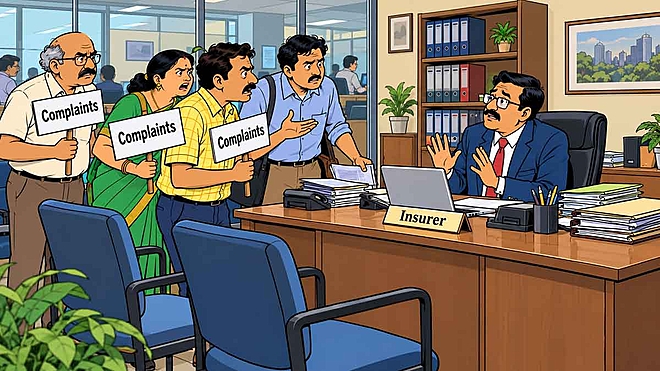
 Anand Kumar/AI-Generated Image
Summary: A paragraph in IRDA’s consultation paper that nobody noticed shows policyholders won 63% of complaints on the Bima Bharosa portal, 75% at the ombudsman and 54% in consumer forums and courts. Yet grievances keep rising, because losing costs insurers little. If your claim is denied, complain.
In the overview section of insurance regulator IRDA’s recent consultation paper on distribution, there’s a paragraph that has drawn, unlike the commission tables, zero public attention. However, it could be more immediately useful for most policyholders.
In FY26, 63% of complaints disposed of on the Bima Bharosa portal were decided in the policyholder's favour. Those who were dissatisfied could then escalate to the ombudsman, and at that stage, 75% were decided in the policyholder's favour. Cases that went even further to consumer forums and courts were decided in favour of the customer 54% of the time.
This surprised me, and I’m sure it has surprised most of my readers too. The reason is that in general, we expect that any grievance process, especially that in insurance, would lean towards the party being complained against, and only those with a lot of time, resources and persistence to fight their way to the courts might stand a chance.
Why do customers win?
So let me conjecture why the data in the IRDA shows us the opposite. One possible reason is that regulators and ombudsmen simply sympathise with the weaker party in an unequal relationship. However, this explanation, although comforting, is weakened by what happens at higher levels. Consumer forums and courts are more formal and adversarial venues, where lawyers challenge the consumer’s arguments more formally and more intensely, and sympathy matters less, if at all. One would expect customers' win rate to be lower, but it is hardly lower, and still above half. This kind of win rate for customers can only exist if the underlying facts are in their favour.
My own idea, and I think it fits with the data of all stages of the complaints, is that insurers’ conduct must have been appallingly bad. Their conduct in these cases must have been so far outside acceptable and reasonable standards that no process, even if procedurally difficult for the complainant, could have defended it. The misconduct must have been truly indefensible.
Here’s a great example of this from just a few weeks back: The Economic Times reported on a case from Ahmedabad where New India Assurance denied a Rs 1.06 lakh claim from a man hospitalised for a stroke, on the ground that his own vegetarian diet was responsible for the vitamin B12 deficiency which may have contributed to his condition. A consumer commission eventually ordered the insurer to pay the full claim with interest, plus compensation for the distress caused, saying a general medical observation about vegetarians could not be stretched to deny any individual cover that he had been sold. Are you surprised by the data when insurers behave this way?
Losing costs insurers little
What troubles me most in the IRDA data is that none of this is improving insurer behaviour. Grievance volumes in general insurance rose from 78,347 in FY23 to 1,37,361 in FY25. That’s double in two years, and about 68% of these were claim-related. My argument is that if losing most disputes carried a real cost, we would expect the number of disputes to go down. Instead, disputes are rising much faster than the business. The explanation must be that losing a case to a complainant costs companies very little compared with the gains from the underlying behaviour that gives rise to disputes. Most customers must be putting up with ill-treatment instead of complaining, so there is no real pressure to behave better.
The paragraph everyone missed
There’s another lesson here about reading documents like the IRDA consultation paper. Most coverage has gone to the commission tables because that’s the obvious story. One paragraph about complaint outcomes, without any policy proposal, is easy to ignore, yet it tells us more about policyholders’ current experience than future commission rates.
So if you have been denied a claim, or given a paltry one, you must complain. Don’t let them get away with it; your chances of victory are pretty good.
Also read: Only 7% of life insurance payouts are death claims
Ask Value Research 
 New episodes every Friday











 New Process Alert
  Seems like you've uploaded a wrong QR code. Please upload the QR code downloaded from MF Central platform.


