 Widely read:




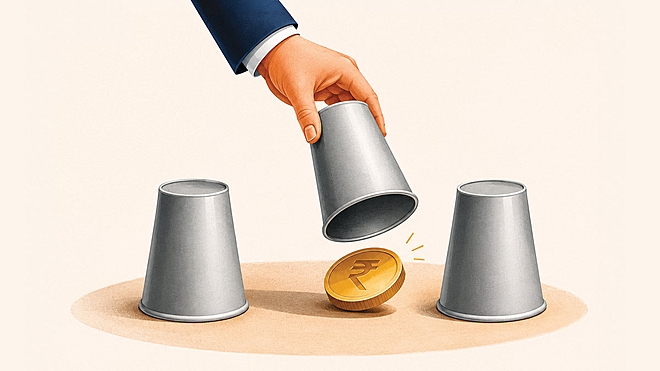 Yogesh Sharma/AI-generated image
Summary: A tiny annual fee can look harmless, but over decades, it can quietly take a huge bite out of your wealth. This story shows why the cost of investing deserves far more attention than most investors give it.
Every mutual fund factsheet includes a number most investors glance at and immediately forget. It sits in a small box, expressed as a percentage that rarely exceeds 2. It is called the ‘expense ratio’. And over the course of a long investing life, it is quietly one of the most consequential numbers in your financial world.
The termite in your portfolio
You already understand compounding in the direction that feels good. A Rs 10,000 monthly SIP growing at 12 per cent per year becomes Rs 22 lakh in 10 years, Rs 92 lakh in 20 years, and over Rs 3 crore in 30 years. The numbers grow faster as time passes; the last decade does more work than the first two combined. That is the celebrated magic of compounding.
What almost nobody talks about is that costs compound in the same way but in reverse. Every percentage point of annual expense does not simply subtract a fixed amount from your returns each year. It removes money from your corpus that would have itself compounded for the remaining years of your investment horizon. The return you lose in year five never compounds in year six. Or even in year 15.
What you actually pay
Before showing what costs do to a corpus, it helps to see what you are actually paying.
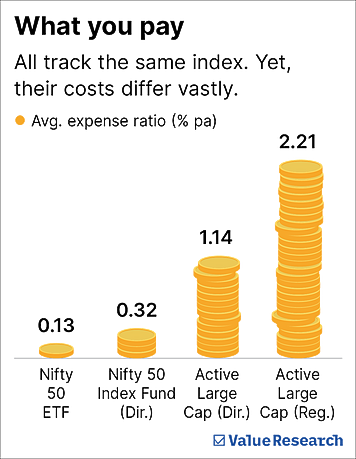
Across large-cap funds in India, the average Nifty 50 ETF charges 0.13 per cent per year. The typical active large-cap fund on the direct plan charges 1.14 per cent, about nine times the cost of an ETF. On the regular plan, the same fund charges around 2.21 per cent.
The expense ratio is not a single fee. It contains the fund manager’s salary, operating costs, brokerage, transaction charges and statutory levies. In the regular plan, it also contains the distributor’s commission, typically around 1 per cent per year paid to whoever sold you the fund, every year, for as long as you stay invested.
The numbers that matter
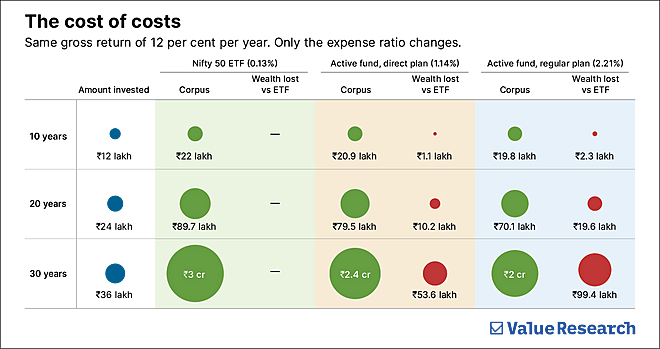
Consider three investors, each putting Rs 10,000 a month into equity funds. All three earn the same gross return (12 per cent per year), broadly in line with India’s long-run equity market performance. The only difference is what they pay in expenses.
The first invests in a Nifty 50 ETF index fund at 0.13 per cent. The second uses an active large-cap fund on the direct plan at 1.14 per cent. The third uses the same active fund through a distributor on the regular plan at 2.21 per cent. In 10 years, the difference is noticeable but not alarming. The ETF investor has Rs 22 lakh. The regular plan investor has Rs 19.8 lakh. A gap of Rs 2.3 lakh, meaningful but very easy to rationalise.
By 20 years, the gap has become Rs 19.6 lakh. The regular plan investor has given up a corpus equivalent to nearly 16 years of their own SIP contributions.
At 30 years, the ETF investor has Rs 2.97 crore. The regular plan investor has Rs 1.98 crore. The cost of that 2 per cent difference in annual expenses, compounded over three decades, is Rs 99.4 lakh, nearly a crore of wealth, consumed not by a market crash or a bad stock pick, but by a percentage that seemed too small to matter.
What active managers must do to justify the cost
The gap between an ETF and an active fund is not just the cost of administration. It is the price of the fund manager’s attempt to beat the index. For that attempt to be worth paying for, the manager must clear the cost hurdle first.
A typical active large-cap fund manager on the direct plan must beat the index by at least 1.14 per cent every year, consistently, just to break even on costs for the investor. On the regular plan, that hurdle rises to over 2 per cent every year.
Over any five-year monthly rolling period starting January 2013, on an average, 47 per cent of the active large-cap direct funds failed to beat the index. In the regular plan, the odds are even lower.
The honest conclusion is not that active management never works. It is that most investors paying regular-plan expenses have never sat down and asked whether the outperformance they may be receiving justifies the cost they are paying, let alone calculated what that cost actually amounts to over a decade.
The one number worth checking for
Somewhere in the documents for every mutual fund you own is an expense ratio. For funds held in the regular plan, that number contains a commission that is being paid annually to a distributor, whether or not that distributor has spoken to you since the day you invested.
The move from regular to direct cuts approximately 1 percentage point from your annual cost. The move from an active direct fund to an ETF cuts a further 1 percentage point.
Together, the gap between the most expensive common option and the least expensive is roughly 2 percentage points per year.
Costs are the one variable in investing that you control completely. Not the market, not the fund manager, not the economic cycle, but costs. They are certain, they are continuous, and they compound in exactly the direction you do not want. The investor who understands this and acts on it has already made one of the most reliable decisions available to them.
This article was originally published on September 01, 2026.
Ask Value Research 









 New Process Alert
  Seems like you've uploaded a wrong QR code. Please upload the QR code downloaded from MF Central platform.


