




 Yogesh Sharma/AI-generated image

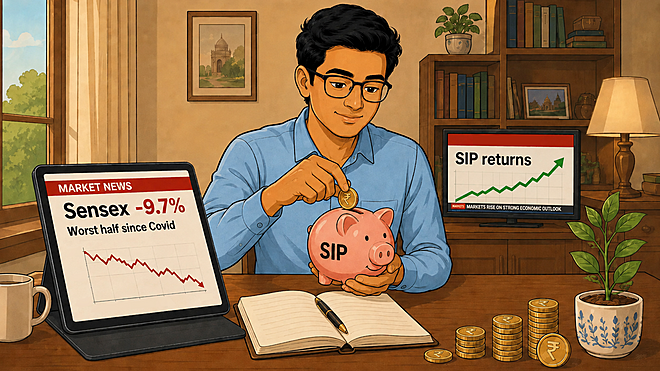
Summary: The Sensex had its worst first half since Covid. Over the same period, eight of the nine largest equity fund categories made money for investors. The index and the investor have been living two very different lives.
The BSE Sensex fell 9.7 per cent in the first six months of 2026, its worst first half since 2020 when Covid wiped out 15 per cent in the same period. That number will make some investors nervous. It should not.
Before you act on it, look at what your own money has actually earned. The index and the investor have been living two very different lives.
A slow drift, not a sudden break
The fall itself is not news. There was no single bad morning, no single event that broke the market. The Sensex peaked on September 26, 2024 and has gone nowhere since, drifting within a range. From that peak, it has returned minus 5.3 per cent a year. The first half of 2026 is only a portion of a slide that is now 21 months old.
The trailing numbers make the same point. The longer the window, the smaller the loss.
The longer you held, the less you lost
A 9.7 per cent six-month loss shrinks to just 1 per cent over two years
| Sensex | Return |
|---|---|
| 6 months | -9.70% |
| 1 year | -7.50% |
| 2 years | -1.00% |
| Sensex TRI absolute returns as of June 30, 2026. | |
What your money actually earned
The honest test is not what the index did. It is what reached your money.
An index return assumes a lumpsum invested on day one and left untouched. In practice, money goes in every month through SIPs, sometimes in lumps and occasionally comes out. The return on that actual stream of money, the XIRR or the annualised return on each rupee, is the number that matters.
We measured it across the nine largest equity fund categories, which together hold over Rs 34.3 lakh crore. Each fund's monthly assets and NAVs show how much money entered and left each month. The XIRR on that entire stream is the closest one can get to the return of the average rupee invested.
Investors earned while the index sank
Over the past year, the Sensex lost 7.5 per cent. Investors in eight of the nine pure equity categories made money. Even large-cap fund investors, the category closest to the index, ended roughly flat.
Over two years, the Sensex went nowhere. Every single category delivered a positive realised return.
Eight of nine categories made money over one year
Over one year, eight of nine categories made money. Over two years, all nine did.
| Fund category | 1-year investor return (% p.a.) | 2-year investor return (% p.a.) |
|---|---|---|
| Mid Cap | 10.4 | 7 |
| Small Cap | 9.7 | 6.5 |
| Multi Cap | 6.4 | 5.1 |
| Large & MidCap | 5 | 4.7 |
| Sectoral & Thematic | 5 | 4.4 |
| Flexi Cap | 2.2 | 4.3 |
| Value Oriented | 2.3 | 3.5 |
| ELSS | 0.7 | 2.9 |
| Large Cap | -0.6 | 2.6 |
| Sensex | -7.5 | -0.5 |
| Investor return is the pooled XIRR of all funds (active direct plans) in the category as of May 31, 2026. | ||
Even the worst six months spared you
That still leaves the freshest wound. Surely the half that mauled the index also mauled investors?
It did not. Weight each fund's six-month return by its size, and not one of the top nine equity categories lost as much as the Sensex's 9.7 per cent. The average rupee in small-cap funds gained 7.9 per cent. In mid-cap funds, 3.4 per cent. The worst category, large cap, fell 5.2 per cent, about half the index's fall.
This is not an average concealing stragglers. The 10 largest large-cap funds hold about 90 per cent of the category's money, and not one fell as hard as the index. Even the worst of the 10 lost 8.2 per cent, against the Sensex's 9.7 per cent.
Not one fell as hard as the index
The worst performer lost 8.2 per cent. The Sensex lost 9.7 per cent.
| Fund name | AUM (Rs cr) | 6-month return (%) |
|---|---|---|
| ICICI Prudential Large Cap Fund | 76,297 | -6.6 |
| SBI Large Cap Fund | 53,527 | -2.5 |
| Nippon India Large Cap Fund | 51,660 | -4.6 |
| HDFC Large Cap Fund | 37,808 | -5.4 |
| Mirae Asset Large Cap Fund | 37,692 | -5.7 |
| Axis Large Cap Fund | 30,005 | -4.4 |
| Aditya Birla Sun Life Large Cap Fund | 28,640 | -7.1 |
| Canara Robeco Large Cap Fund | 16,323 | -5.9 |
| UTI Large Cap Fund | 11,852 | -8.2 |
| Kotak Large Cap Fund | 10,516 | -5.5 |
| Ten largest large-cap funds (direct plans) by AUM (as of May 31, 2026). Fall is the absolute point-to-point return from December 31, 2025 to June 30, 2026. | ||
What to do now
Nothing dramatic.
The headline says the market had its worst half since Covid. Your money says you earned positive returns through it. When the two disagree, trust your money.
The only real mistake available now is stopping the SIP that protected you. Keep going.
Knowing whether your specific funds held up as well as the category, and whether the ones that didn't deserve a second look, is where Value Research Fund Advisor comes in. It tells you exactly what to keep, what to drop and what to buy next.
Stay the course with the right funds.
Ask Value Research 

 New episodes every Friday




 New Process Alert
  Seems like you've uploaded a wrong QR code. Please upload the QR code downloaded from MF Central platform.


