




 Ujjal Das/AI-Generated Image

Summary: Manufacturing funds have been among the best performers recently, riding India's industrial boom. But does that make them a smart long-term investment? This story looks beyond the recent rally to reveal what history says.
Manufacturing has been one of the market's brightest spots. Over the last one year to June 30, 2026, the Nifty India Manufacturing Index gained 12.5 per cent while the broad Nifty 500 was flat. The median manufacturing fund returned 11.5 per cent, placing the category among the year's best performers.
The optimism is not without reason. India is seeing a revival in capital expenditure (capex), defence and electronics companies have multi-year order books, and global supply chains continue to shift away from China.
But a compelling story does not automatically make a compelling investment.
The category itself is tiny. Its 12 active funds and seven passive funds together manage just Rs 33,255 crore, less than 1 per cent of equity fund assets. More importantly, nine of the 12 active funds were launched only in 2023 or 2024, during the very rally now being used to sell them.
So the real question is not whether India's manufacturing story is attractive. It is whether a manufacturing fund deserves a place in your portfolio.
You may already own the theme
Most investors already have significant exposure to manufacturing without buying a thematic fund.
Around 35 per cent of the Nifty 500 is invested in manufacturing-related industries, including oil and gas (at 6 per cent), pharmaceuticals (at 5.3 per cent), machinery & equipment (at 4.9 per cent), automobiles (at 4.8 per cent) and metals & mining (at 2.6 per cent). If you own a Nifty 500 index fund or a diversified equity fund, you already participate in India's manufacturing story.
A manufacturing fund changes that exposure in two ways. It raises manufacturing from about one-third of the portfolio to almost all of it, while largely removing financials, the market's biggest sector.
That concentration is intentional. It is also the biggest risk.
The label hides the real portfolio
So how different are manufacturing funds from the diversified funds you already own? The answer isn't obvious from their name alone. To understand what you're really buying, you need to look beyond the label, and even beyond the benchmark they are measured against.
The benchmark tells only part of the story.
All active manufacturing funds use the Nifty India Manufacturing Index as their benchmark. On paper, it is largely a large-cap index, with about 71 per cent invested in large caps and only around 3 per cent in small caps because it draws from the largest 300 listed companies.
The funds themselves look very different.
Their small-cap exposure ranges from 18 to 49 per cent, which is between six and sixteen times the benchmark's allocation. In practice, most manufacturing funds behave much more like multi-cap funds than the index they officially track.
That makes the Nifty500 Multicap India Manufacturing 50:30:20 Index a more meaningful yardstick. It better reflects what these funds actually own and provides a more realistic picture of how they would have behaved in market cycles before they existed.
The returns are real, but recent history flatters them
The recent numbers are undeniably impressive.
Every rolling three-year period ending since January 2023 has beaten the Nifty 500, delivering a median annual return of 23.6 per cent. On that evidence alone, manufacturing looks like an easy choice.
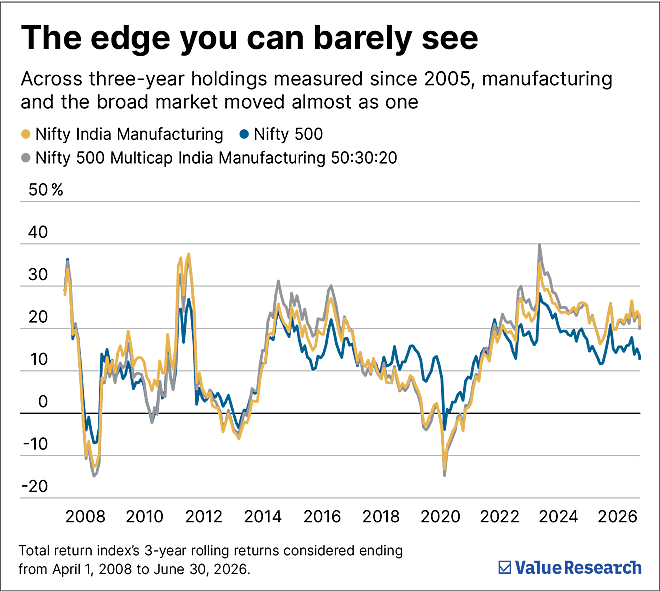
The longer history tells a more balanced story.
Across every rolling three-year period since April 2005, the manufacturing index outperformed the Nifty 500 by a median of just 1.9 percentage points a year. That modest excess return came with meaningfully higher risk. The index finished a three-year period with a loss 13.6 per cent of the time, compared with 6.3 per cent for the Nifty 500.
The picture changes even more when you look at different market phases. Between 2018 and 2022, before the current manufacturing rally gathered pace, the index beat the Nifty 500 in only one out of every five rolling three-year periods. Over the past three years, it has won every time.
The lesson is straightforward. Manufacturing funds have delivered excellent recent returns, but much of their appeal reflects where we are in the market cycle rather than a lasting advantage.
The falls are the price of admission
Manufacturing is a cyclical bet. It thrives when capital spending and industrial activity pick up, but those same forces work in reverse when the cycle turns.
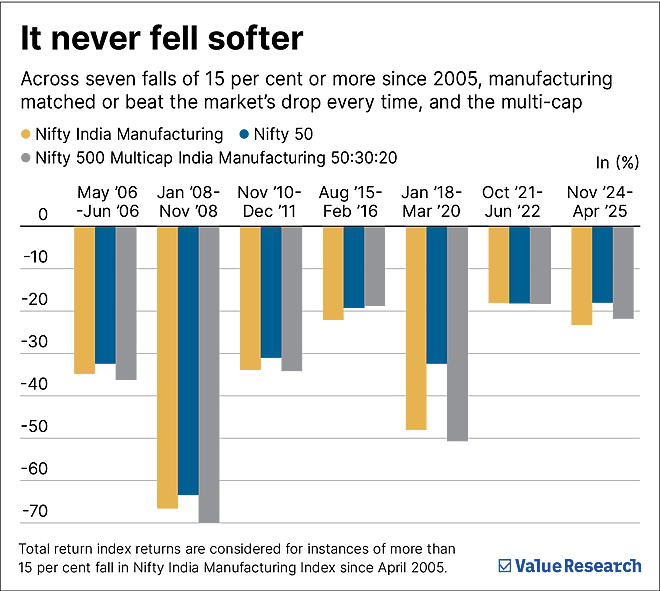
Since April 2005, the manufacturing index has fallen more than 15 per cent on seven occasions. Every time, it declined at least as much as the broader market, and often more.
The 2008 financial crisis was the worst example. The manufacturing index fell 66 per cent against a 63 per cent decline in the Nifty 500. The slump from January 2018 to the Covid market low was almost as painful, as the Manufacturing Index never touched its all-time high until the post-Covid rally. During this period, the index lost 48 per cent while the Nifty 500 fell 32 per cent.
Neither recovery was quick. The first took about two years to regain its previous peak, while the second took nearly three.
The experience of today's funds could be even more volatile. Because most active manufacturing funds hold far more mid- and small-cap stocks than the benchmark, their portfolios resemble the multicap manufacturing index, which suffered even deeper drawdowns during both episodes.
If you are investing for a goal with a defined date, such as a child's education or a house purchase, this is not a risk you should be taking with a large part of your portfolio.
If you still want one, know what to look for
Choosing between manufacturing funds is not easy. Only three of the 12 active funds have completed three years, leaving little performance history to judge.
Instead, pay attention to two characteristics.
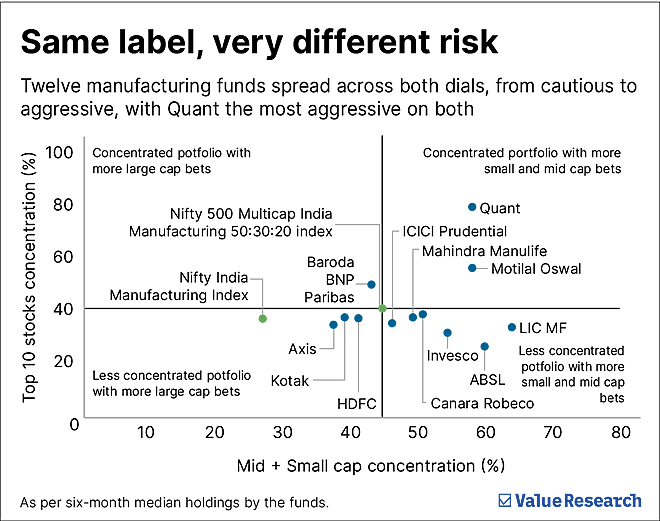
The first is the fund's allocation to mid- and small-cap stocks. This ranges from about 40 per cent in Axis to nearly 66 per cent in LIC (median holdings over the six months to June 30, 2026). The higher the allocation, the greater the potential gains, but also the steeper the falls.
The second is concentration. Some funds spread their bets across dozens of stocks, while others hold only a handful. The top-10 holdings account for just 28.8 per cent of Aditya Birla's portfolio but 78.8 per cent of Quant's, which owns only 16 stocks.
These two measures tell you far more about a fund's risk than its recent return.
So, should you buy one?
For most investors, probably not.
Even over the long run, the case is less convincing than recent performance suggests. Across every rolling five-year period since April 2005, the manufacturing index beat the Nifty 500 only 54 per cent of the time, barely better than a coin toss. When it underperformed, the gap was often substantial.
Nor do you need a thematic fund to participate in India's manufacturing growth. A broad-market fund already allocates about one-third of its portfolio to manufacturing-related businesses, giving you meaningful exposure without concentrating your portfolio in a single theme.
The case becomes even weaker for active funds. Most are too young to judge, and their portfolios differ widely in their exposure to mid- and small-cap stocks and in how concentrated they are.
The only compelling reason to own a manufacturing fund is conviction that India's industrial cycle will outperform for years to come and the willingness to tolerate deeper falls when it does not.
If that describes you, keep the allocation modest, no more than 10 per cent of your equity portfolio, and be prepared to stay invested through inevitable downturns. For everyone else, skipping the theme is not missing an opportunity. It is sticking to a well-diversified investment plan.
The harder decision isn't whether manufacturing is a promising theme. It's whether any manufacturing fund is worth adding to your portfolio, or whether you're already getting enough exposure through the funds you own. Fund Advisor helps you answer that in the context of your entire portfolio, so every new investment has a clear purpose instead of simply following the latest market trend.
Know what belongs in your portfolio.
Ask Value Research 

 New episodes every Friday




 New Process Alert
  Seems like you've uploaded a wrong QR code. Please upload the QR code downloaded from MF Central platform.


