




Summary: Consistent investing success often comes from simple principles applied with discipline over time. This conversation explores a practical framework that prioritises valuations, risk selection and long-term thinking. It highlights why sticking to a process matters more than chasing trends.
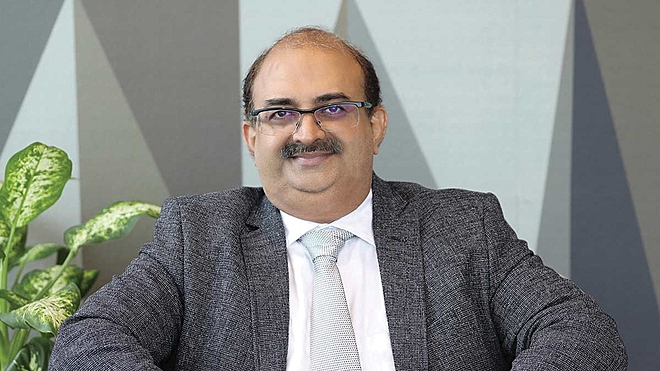
With over 27 years of navigating Indian equity markets, Sailesh Raj Bhan has seen enough cycles to know that discipline outlasts disruption. As President and CIO – Equity Investments at Nippon India Mutual Fund, he has built a reputation for doing the unglamorous but rewarding work: respecting valuations, choosing the right risks and staying the course when markets tempt otherwise. His flagship Nippon India Large Cap Fund, a five-star rated, category-topper, is proof that a simple, repeatable framework, executed consistently, can compound quietly into something extraordinary.
In this conversation, Bhan unpacks his thinking on IT stocks, PSU banks, Indian equities and what new investors must understand about surviving their first real correction.
Your large-cap fund has held a five-star rating for nearly three years now and is currently the best fund in the category over a 10-year period, returning a massive CAGR of nearly 16 per cent annually. Could you tell us what the stock-picking framework is behind those returns, and what do you think has been the single biggest driver of this fund's alpha?
The good part about India as a market is that there is a lot of alpha available across large-, mid- and small-cap categories. Interestingly, it comes down to how we approach the market, what risks we choose to take and which we choose to avoid. If we keep repeating this over many cycles, it eventually delivers the outcomes we all aim to achieve.
In the large-cap fund, over the years, our basic approach, which is common across the fund house as well, has been to respect valuations. We believe valuations are an extremely important part of portfolio construction because, over time, either mean reversion comes into play or you see disappointments in companies that were priced for perfection, often because the last couple of years were good. So, respect for valuations, or what we internally call a ‘growth at a reasonable price’ approach, is central to how we construct portfolios.
Second, we believe that to generate returns in equities, you have to take risks. There are no excess returns over the index without taking some risk. The key is to choose the right risks, those that will pay off if you get them right. That selection of the right risk is driven by strong bottom-up research, supported by a significantly large and experienced research team. This ground-up approach helps us identify opportunities, take those calls and size them appropriately within the portfolio, while ensuring that we don’t overpay for growth.
If you put these three elements together, respect for valuations, choosing the right risks and strong bottom-up research, it’s essentially a framework that we’ve been consistently following. Over the last 2 decades, we have tried to repeat the simple tenet.
The environment also plays a role in enabling returns. Over the last 10 years, markets have experienced several dislocations. For instance, around 2016-17, the market was extremely narrow, dominated by consumer companies, FMCGs and private-sector banks. In such a scenario, nearly 70-80 per cent of the market was very attractively priced, largely because the near-term outlook was not favourable. That allowed us to take the right risks, like moving into the largest PSU banks at the time, which were significantly undervalued compared to private-sector banks that were already pricing in growth.
So, markets do provide these opportunities, and it’s about being willing to act on them. At the same time, our framework ensures that we don’t throw good money after bad valuations. The idea is to buy good growth companies, but at sensible prices whenever possible.
Because we’ve seen this repeatedly, if you overpay for growth, you can end up in a difficult position two or three years down the line when valuations normalise. In fact, we’ve seen that even recently. Over the last couple of years, markets have largely been flat, and that again reinforces the importance of disciplined portfolio construction.
If we look at large-cap IT names, such as TCS, Infosys or Wipro, they hold significant cash reserves. For instance, Wipro had around Rs 54,000 crore of cash as of September. But as we move down the market cap spectrum to mid-cap IT companies, many of which have delivered strong returns over the last decade, they don’t have similar levels of cash. Do you think they are at an inherent disadvantage, especially given the kind of disruption affecting the business model? How should we look at these companies?
I wouldn’t say they are at an inherent disadvantage. Many of these companies are also generating healthy cash flows. In some cases, they may have deployed capital towards acquisitions or capability building, which may reflect in lower cash balances, but the underlying cash generation remains strong.
Also, when we talk about mid-sized IT companies, we should consider their scale; these are businesses with revenues of Rs 5,000-10,000 crore or more. At that level, they have enough manoeuvrability to compete effectively.
In fact, some of these companies may have a competitive advantage. They can go after clients of larger companies and potentially replace incumbents by leveraging newer technologies like AI. They are more agile and don’t carry the same legacy burden that large IT firms do. Large companies, by virtue of their size, have much more to protect in their existing businesses. Smaller and mid-sized firms, on the other hand, can reinvent themselves faster without worrying about disrupting a large legacy base.
So, I don’t see them as being at a disadvantage. However, very small companies, say those generating Rs 100-200 crore of cash flows, may not be relevant in the evolving landscape. They become sub-scale relative to where the industry is headed. But broadly, the top 15-20 IT companies in India have the capability to adapt and do well over time.
Given all the discussion around IT in the market right now, what portion of the risk is actually valid, and what part, in your view, is being overblown?
This happens with every new technology cycle. Initially, the acceleration is very sharp, almost vertical. It feels as if there are no constraints, no gravity. That’s where AI is today. But over time, this curve starts normalising, especially as it moves from concept to real-world implementation. Once you start deploying it at scale, you encounter practical challenges, such as data security, privacy, integration with legacy systems and regulatory requirements. All of this slows down the pace at which the technology can actually deliver outcomes.
Also, when companies are investing massive sums, hundreds of billions, even approaching a trillion dollars annually, the economics have to work. These investments need to generate returns, and that can only happen at viable pricing. So, the eventual outcomes and IRRs will take time to materialise.
So yes, while the pace of innovation in AI is still very strong, the real-world impact and monetisation may be slower than what current expectations suggest.
That’s where Indian IT services companies have an opportunity. They can help implement these solutions, enable clients to extract value, and essentially, bridge the gap between the technology promise and execution. In that sense, there is still a meaningful runway for them to adapt and stay relevant.
The other important factor is valuation. Many IT companies have corrected 25-30 per cent over the last two to three years. At current levels, you are not paying for aggressive positive outcomes. In fact, to some extent, the market is already factoring in a fairly negative scenario, almost assuming a loss of terminal value.
Thus, while some aspects of the risk are valid, especially around disruption and the need to adapt, a large part of the pessimism may be overdone. Of course, outcomes will vary. Companies that fail to execute or have weaker management may continue to struggle. But as a cohort, the probability of Indian IT companies adapting and delivering remains reasonably strong.
Many experts now say the golden era for Indian markets is behind us. However, AMFI data suggests otherwise: flows into equity funds, including mid- and small-cap categories, have remained strong. What is your stance on Indian equities from here?
The key question is, what really defines a bubble? In my view, the real risk was around September 2024, when valuations had clearly entered bubble territory.
If you had invested around that time, say September 2024 or even March 2024, you would typically expect 9-12 per cent annual returns from equities over a two-year period. In a normal market, that would translate to roughly 20-25 per cent cumulative returns over two years.
But because the starting point was so elevated, we haven’t seen those returns. In fact, returns have been flat to slightly negative. So effectively, a large part of the froth, say 25-30 per cent of expected returns, has already been taken out of the market. That leaves us in a much better position today in terms of valuations.
Of course, there is always risk. At any valuation level, markets can correct further. But that’s like saying there is always a risk when you step out on the road; it doesn’t mean you stop stepping out altogether.
The important thing is the risk-reward balance. Today, after both time and price corrections, valuations for many high-quality businesses have become sensible. That makes the risk-reward equation more favourable. Now, if there is a further external shock, say geopolitical tensions persist, or oil remains elevated for an extended period, then yes, there could be downside risks. But those risks cannot be eliminated entirely.
What investors can do is manage them through asset allocation. If you are 100 per cent in equities, you are naturally more exposed. But if you are already allocated 40-50 per cent to equities, with the rest in other assets, you have already mitigated a large part of that risk.
Beyond that, two things matter. One, your investment horizon. If you are investing with a three- to five-year view, most short-term disruptions tend to even out. Economies grow, earnings recover and markets eventually reflect that.
Second, your entry point and starting valuations matter. And today, that starting point is becoming more reasonable with each passing month. Overall, while risks remain, the setup for Indian equities is far more balanced today than it was at the peak.
What makes private sector banks consistently better than public sector banks? I understand that underwriting quality is stronger, but why haven’t PSU banks been able to catch up? Is it difficult to implement?
It’s really a question of starting advantages and structural differences. If you look at large private sector banks, they built their franchise around salary accounts and retail customers, essentially the middle class and upper middle class segments that see steady monthly income flows.
Over time, they have created a customer cohort where incomes are rising consistently. Now, if your customer base itself is seeing income growth every year, the kind of banking opportunities you can generate, lending, cross-selling, wealth products, becomes significantly larger. In contrast, many public-sector banks historically were more focused on corporate lending. It’s not that they lack capability; PSU banks are actually quite competitive in corporate banking. But they missed the large-scale retail opportunity in the early years.
Part of it was technology, part of it was prioritisation. At that time, retail banking may have appeared too small compared to the scale of corporate lending. But when the shift towards technology-enabled retail banking enabled onboarding thousands of salaried customers seamlessly, private-sector banks moved faster. Once that market share was lost, it became very difficult to claw back. Banking relationships are sticky. Most individuals have one primary account that stays with them for decades. You may have multiple accounts, but one remains the core relationship.
Private-sector banks, either by design or by strategy, captured the segment where wealth was being created. That has allowed them to cross-sell multiple products and deepen relationships over time. A few PSU banks have built similar capabilities and are competing effectively. But that advantage is not widespread across the sector. So it’s not just about underwriting, it’s about customer mix, technology adoption and strategic positioning over a long period of time.
SEBI's recent mandate allows funds to hold alternate asset classes in their residual portfolios. Will Nippon use that flexibility to dynamically cushion blows or stay true to the label and take the hits head-on?
Yes, the framework does allow for additional asset classes within equity portfolios, such as REITs, and now even gold has been discussed. There is always a possibility of allocating a small portion of the portfolio to such segments, especially if they offer attractive opportunities at a given point in time.
However, the core of the portfolio will remain equities. These are designed as equity products, and we would not want to run them like multi-asset funds. If an investor is looking for a multi-asset approach, there are dedicated products for that. So, within the available flexibility and as long as it does not alter the fundamental character of the equity product, we may selectively use these options. But the primary driver of returns will be equities, and we would stay true to that mandate.
Outside of your multi-asset fund, Nippon has no exposure to international equities, even as Indian markets have lagged global indices meaningfully. What's holding that back, and what is your stance on this, and how should investors look at global exposure from domestic shores?
A large part of this is structural. There are regulatory limits, both at the industry and fund levels, on how much overseas exposure mutual funds can take on. As a result, the availability of international investment options through domestic mutual funds has been somewhat limited. We do have funds that cover markets such as Japan, Taiwan and the USA.
From our perspective as a fund house, we operate within these regulatory boundaries. Wherever opportunities exist within the framework, they can be explored. But the core construct of our offerings, especially equity funds, remains largely domestic. For investors, however, the idea of global diversification is valid. Over long periods, different markets perform differently, and having some exposure can help balance risks. The key is to approach it in a structured way, allocate a portion of your portfolio to global equities, but be mindful of access, costs and consistency. Given the current constraints, execution may not be perfect, but the intent of diversification remains important.
You’ve spoken about being a contrarian investor, buying when others are pessimistic and avoiding crowded trades. While that’s easier to implement as an individual, how do you execute this at a fund level, where investors track performance constantly? How do you ensure they stay aligned with your strategy?
That’s a very important point. Thankfully, a large section of our investors has stayed with us across cycles. Over time, they begin to understand the framework we follow.
Our approach is simple: we try to say what we do and do what we say. That consistency helps attract investors focused on long-term wealth creation and willing to stay invested through different market phases. Even during difficult periods, when certain segments are underperforming, and we may be overweight there, we make it a point to communicate clearly why we are taking that stance. For instance, owning cyclicals around 2016-19 was not easy, but those were the very segments that eventually delivered 10x-20x outcomes. The reality is, alpha is not free. It comes from taking the right risks. So the key is to identify those risks, communicate them and stay disciplined.
At the same time, we are careful not to take extreme or outlier risks. Investor experience matters. If volatility becomes too high and investors exit prematurely, outcomes can suffer regardless of the strategy. So, we define our risk boundaries clearly, what risks we will take, what we will avoid and where we are willing to deviate. A significant part of our effort then goes into research and stock selection, and importantly, staying the course. There will always be phases where certain styles outperform. For example, there were periods when ‘growth at any price’ worked, while ‘growth at a reasonable price’ underperformed. It is tempting to shift, but if you keep changing your approach, you end up creating bigger challenges later. So, consistency and communication are critical.
Investors also understand that there is no easy money in markets. Different strategies will work at different times. Internally, we focus on what we call sustainable alpha: whether we can generate excess returns in a repeatable, disciplined manner over the long term, rather than chasing short-term outperformance. Over time, that approach builds trust, and that’s what allows investors to stay the course with you.
A large section of today’s investors has entered the market over the last 5-10 years, especially post-Covid, and many of them haven’t experienced a full market cycle. Now, as they face their first real correction, some are beginning to question equity investing itself. What would you say to such investors?
That’s a very valid point. A significant portion, maybe 50-60 per cent of current investors, have entered the market in the last five years and haven’t seen a full cycle. So, this phase is naturally more challenging for them. In every cycle, a certain percentage of investors mature and internalise the framework of long-term investing.
At the same time, some investors, especially those who entered without a clear understanding, may step away from the asset class for a while. That’s a natural part of market cycles. Not every investor has the same time horizon or risk appetite. Some come in with a one- or two-year view, some may need liquidity and others may not be comfortable with volatility. So, it’s unrealistic to expect everyone to stay the course. The key, however, is to help as many investors as possible understand the long-term nature of equity investing.
One simple way to think about it is this: in most aspects of life, people look for discounts before buying. Equity markets are one of the few places where, when prices actually fall and valuations become attractive, investors tend to pull back because of negative news. That’s exactly where SIPs play a role. The whole idea behind SIPs is to remove behavioural biases, to keep investing systematically, regardless of market conditions. If investors stop SIPs during corrections, they are effectively defeating the purpose of the strategy.
In fact, these are the phases in which SIPs work best. If anything, these are times when investors should consider increasing allocations, if they have the capacity or at least continuing their investments without interruption. There will always be some churn; investors who came in for short-term reasons may exit during volatility. But those who stay invested through cycles are the ones who ultimately benefit from long-term wealth creation.
So the message is simple: stay the course to the extent you can. Even if you adjust allocations slightly, the discipline of continuing is critical. Over time, with more education and experience, a larger proportion of investors will understand this, and that’s what will drive better outcomes.
Also read: Mid caps appear expensive, but deliver superior growth: TRUST Mutual Fund's Mihir Vora
Ask Value Research 
 New episodes every Friday









 New Process Alert
  Seems like you've uploaded a wrong QR code. Please upload the QR code downloaded from MF Central platform.


