




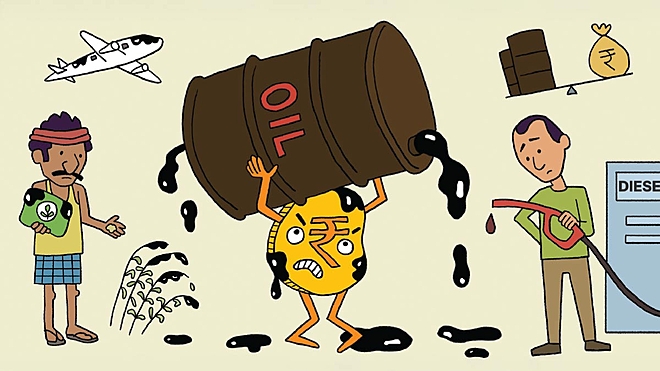
 Illustration: Anand Kumar
Summary: Sustained high crude oil prices don’t just affect fuel costs, they ripple across the entire economy. This piece breaks down how oil influences inflation, currency, government finances and corporate margins in India.
Summary: Sustained high crude oil prices don’t just affect fuel costs, they ripple across the entire economy. This piece breaks down how oil influences inflation, currency, government finances and corporate margins in India. Brent crude has been hovering between $90 and $110, and there is a growing view that this may not be temporary. For an economy importing nearly 85 per cent of its oil, even a $10 move in crude changes the macro math in ways that take months to show up but years to fully absorb. India’s oil import bill was already around $132 billion in FY24, roughly 4 per cent of GDP and larger than the combined allocation for health and education in the Union Budget. At $100 crude, India is effectively writing a $40-$50 billion additional cheque every year, roughly the size of its entire annual health budget, pushing the trade deficit from 2.5 per cent of GDP toward 4 per cent. Every $10 rise in Brent adds approximately Rs 1.1-1.3 lakh crore to the annual import bill. The last time crude stayed above $100 for a sustained period was 2011 to 2013, when India’s current account deficit crossed 4 per cent of GDP, the rupee lost nearly 20 per cent of its value over 18 months and the government was forced into emergency monetary tightening. That period is worth remembering. The rupee: Where it shows up first Oil i
This article was originally published on May 01, 2026.

 New episodes every Friday










 New Process Alert
  Seems like you've uploaded a wrong QR code. Please upload the QR code downloaded from MF Central platform.


