




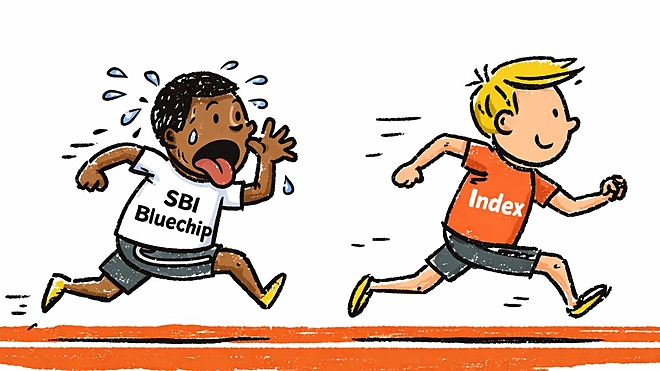
 Aditya Roy/AI-Generated Image

Summary: SBI Large Cap Fund’s underperformance in 2025 looks worrying only at first glance. However, the real question isn’t ‘why it lagged’, but whether it behaved the way you expected a large-cap fund to.
When a large-cap fund trails its benchmark, the instinctive reaction is to ask, “What went wrong?”
In reality, underperformance is rarely that simple.
SBI Large Cap Fund lagging its benchmark in 2025 is not a mystery or an anomaly. It is usually the combined outcome of three things: what the fund chose to own more of, what it consciously owned less of and the small but persistent structural frictions that an index does not face.
The first step is to set the right context. On Value Research Online, the benchmark for the SBI Large Cap Fund direct plan is the BSE 100 TRI. The fund’s one-year return is shown as 11.68 per cent, assets under management (AUM) stand at Rs 55,637 crore (as of November 30, 2025) and the expense ratio is 0.79 per cent (as of December 31, 2025).
Those numbers don’t answer whether the fund is ‘good’ or ‘bad’. They point you to the right line of inquiry: How did the fund behave relative to a broad large-cap index and why did that behaviour produce a gap?
That is what makes this a useful case study for investors in SBI Mutual Fund. Instead of stopping at “Why did it underperform?”, the more useful question is, “Which active choices explain the gap, and do those choices match what I expect from a large-cap fund?”
The index follows a rulebook. The fund makes decisions.
The BSE 100 TRI is market-cap weighted. It automatically increases exposure to stocks that grow larger and trims those that shrink. It holds no cash and has no judgment calls to make.
An active large-cap fund works differently. Even one that looks conservative on paper reflects dozens of decisions: sector tilts, stock weights and timing. In a year when market leadership is narrow or momentum-driven, those decisions can easily cause the fund to trail the index without anything having gone ‘wrong’.
Reason 1: Handful of heavyweights proved costly
SBI Large Cap Fund’s largest positions include Reliance Industries (8.17 per cent), HDFC Bank (7.37 per cent), ICICI Bank (7.24 per cent), Larsen & Toubro (5.41 per cent) and Asian Paints (4.29 per cent) as of January 6, 2026.
This is not a flaw. Large-cap funds are expected to hold large, liquid businesses. The point is that when a handful of stocks carry meaningful weights, even small differences versus the benchmark can add up quickly.
If the 2025 rally was driven by a different cluster of large caps, or by pockets where the fund was underweight, the index could easily pull ahead. The fund may have broadly read the market right, yet missed where returns were concentrated.
Reason 2: Conservatism can lag in momentum markets
Many large-cap funds deliberately avoid overheated stocks, reduce exposure when valuations look stretched or favour stability over speed. Markets do not reward that preference every year.
In momentum-led phases, the index benefits automatically because it simply follows market capitalisation. An active fund that resists chasing the hottest names, or does so gradually, will lag until leadership rotates.
This is why one-year returns are such a weak judge of skill. A fund can lag because it chose not to chase. That choice may hurt in one phase and protect capital in another. You only learn what it is by observing behaviour across cycles, not across a single year.
Reason 3: Structural drags matter when gaps are narrow
Two mild but persistent drags are visible.
First, cost. SBI Large Cap Fund’s direct plan’s expense ratio is 0.79 per cent. An index charges far less. If a fund’s active decisions add only a small edge in a given year, fees can erase it.
Second, cash and non-equity exposure. As of January 6, 2026, around 96.75 per cent of the portfolio is in equity, with about 2.90 per cent in cash and cash equivalents and 0.35 per cent in debt. That cash is usually held for liquidity, but in a rising market, even a small allocation creates a performance drag versus a fully invested index.
Reason 4: Size limits agility
With assets of Rs 55,637 crore, SBI Large Cap Fund is large. Size is not inherently a disadvantage in large caps, but it does affect behaviour. Big funds move more slowly and tend to stay within the most liquid names. That can make them feel constrained in some phases and more benchmark-like in others.
Many investors expect a large fund to behave like an index and beat it at the same time. That expectation is unrealistic. Large-cap active funds often land somewhere in between.
What to check before drawing conclusions from 2025
Before treating one year as a verdict, a simple checklist helps.
Look at a fund’s rolling returns, not just a one-year snapshot. One-year underperformance is common. What matters is whether the fund continues to lag across most three- and five-year periods.
Study the portfolio. If a few large positions explain most of the lag, that is very different from broad-based stock selection issues.
Separate style from execution. A conservative style will lag in momentum-driven markets. Poor execution is a different problem altogether.
Finally, be clear about the role you want the fund to play. If you want benchmark-like returns with minimal deviation, an index fund is the cleanest option. If you want active management and can tolerate phases of underperformance, a one-year gap should not, by itself, prompt action.
That is the real lesson here. Underperformance is not a verdict. This prompt assesses whether the fund behaved as expected and whether you are evaluating it within the appropriate timeframe.
If you want to find out whether any large-cap funds beat their benchmark in 2025, head to the category’s Fund Monitor section. Here, you can also get a comprehensive picture of each fund’s long-term and short-term performance, as well as information about its key metrics such as AUM, expense ratio, holdings and so on.
Also read: Only 9 of 26 large-cap funds beat their benchmark. Own any?
Ask Value Research 
 New episodes every Friday









 New Process Alert
  Seems like you've uploaded a wrong QR code. Please upload the QR code downloaded from MF Central platform.


