




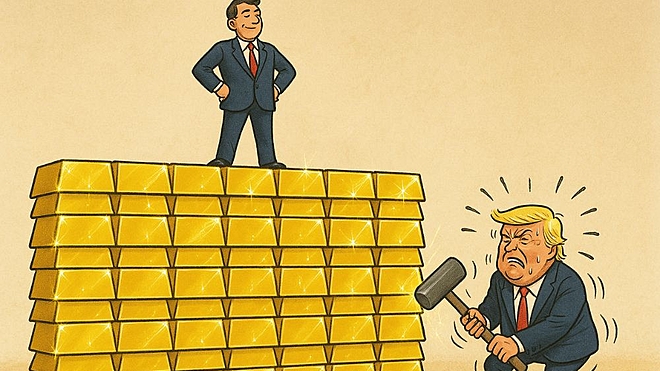
 AI-generated image


Summary: Central banks are buying gold like never before, reflecting doubts about the long-standing dollar-dominated system. Even for sceptics, this changing landscape suggests gold deserves a modest place as a hedge — not for returns, but for protection. The message: stay diversified, stay disciplined.
I've long been a gold sceptic. Following the wisdom of investors like Warren Buffett, I've viewed gold as an archaic relic - a shiny metal that produces nothing, pays no dividends, and merely sits in vaults, accumulating storage costs. "It has no utility," Buffett famously quipped. "Anyone watching from Mars would be scratching their head."
This perspective made sense in a world where the US dollar reigned supreme as the global reserve currency. But the financial landscape is shifting beneath our feet, and even the most ardent sceptics may need to reassess.
In our recent analysis on whether now is the right time to invest in gold, we explore central bank buying trends and portfolio implications.
Suggested watch: Investors' Hangout: Is now the right time to invest in gold?
The gold story has transformed multiple times throughout history. For centuries, gold was money - real, physical currency that people carried and nations used to settle debts. The 1944 Bretton Woods agreement formalised the dollar's link to gold, with other currencies pegged to the dollar. Each dollar was theoretically exchangeable for a specific amount of gold, giving the system credibility.
This arrangement collapsed in 1971 when President Nixon severed the dollar's tie to gold, ushering in the era of pure fiat currencies - money backed only by government decree and faith in institutions. This system functioned reasonably well for decades, with the dollar cementing its position as the world's reserve currency.
Suggested read: A twist in the gold story
Recent geopolitical developments, however, have triggered what may be a fundamental shift. The freezing of Russian central bank assets following the Ukraine conflict sent shockwaves through the global financial system. Nations suddenly faced a stark reality: dollar reserves, previously considered the ultimate safe asset, carried unexpected political risk.
The response has been telling. Central banks worldwide have accelerated gold purchases to historic levels. China, Russia, India, and numerous other countries have systematically reduced their dollar exposure while increasing their gold holdings. This isn't just diversification - it signals a deeper erosion of trust in the post-1971 monetary order. Gold prices have responded accordingly, reaching record highs in dollars and virtually every currency. While critics may dismiss this as speculation, the sustained central bank buying suggests something more structural is occurring. Our latest video breaks down gold's surge due to these central bank trends and why it acts as a hedge.
Suggested read: Are gold's golden years coming?
Does this mean you should rush to convert your savings into gold bars? Certainly not. The principles of diversification and prudent risk management remain as valid as ever. Gold produces no income, comes with storage costs (or management fees for paper gold), and can experience significant price volatility.
Yet dismissing gold entirely may no longer be the correct position it once seemed. A modest allocation - perhaps 5-10 per cent of your investment portfolio - might be a reasonable hedge against currency debasement and geopolitical instability. Think of it as insurance rather than a growth investment. If you decide to include gold in your portfolio, consider whether physical gold (coins, bars), gold ETFs, sovereign gold bonds or gold mutual funds best suit your needs. Each has distinct advantages and disadvantages regarding liquidity, costs and security.
Suggested read: Gold ETF vs gold mutual fund: There's only one right choice!
The key, as with all investments, is moderation. Avoid the apocalyptic narratives often attached to gold by its most fervent advocates. History teaches us that financial systems evolve rather than collapse completely, and diversification across asset classes remains your best protection against uncertainty. For deeper insights into gold ETF mechanics and risks, check this detailed explainer.
I remain sceptical about gold's role as a primary investment vehicle. My fundamental investment principles haven't changed - focus on productive assets, maintain adequate diversification, and avoid emotional decision-making. Yet, in a world where traditional financial assumptions face unprecedented challenges, it's worth considering whether a modest gold allocation might serve a purpose within those established principles. Read our comprehensive guide for balanced allocation advice.
The choice ultimately rests with you, the investor. If, after thoughtful consideration of the changing landscape, you believe a small adjustment to your asset allocation makes sense, that's your prerogative. Just ensure that any decision aligns with your broader financial strategy rather than represents an abandonment of sound investment discipline. The world changes, but the core principles of prudent investing remain remarkably constant.
Also read:
Volatile market hack: Should you invest in gold or debt for stability?
Gold price is up 23%. Will it go up further?
Ask Value Research 

 New episodes every Friday










 New Process Alert
  Seems like you've uploaded a wrong QR code. Please upload the QR code downloaded from MF Central platform.


