




 Aditya Roy/AI-Generated Image
Summary: Neha’s father had steadily built wealth over the years, thanks to his equity mutual fund investments. However, once he retired, the same portfolio began giving him sleepless nights. We find out why his strategy needs a rethink.
Neha couldn’t understand why her father seemed so worried about money. After all, the family had always been financially comfortable. But there was her father, Ashok, 62, sitting in front of his laptop, his hands trembling as he scrolled anxiously through his mutual fund statements.
"The market's down 18 per cent this month," Neha’s father said quietly. "That's nearly Rs 25 lakh wiped out from my portfolio."
This was a conversation Neha was hoping to avoid. Her father had built an impressive portfolio during his working years, almost entirely invested in equity mutual funds. It had served him well through the 2000s and 2010s. But now, six months into retirement, every market dip felt like a personal crisis.
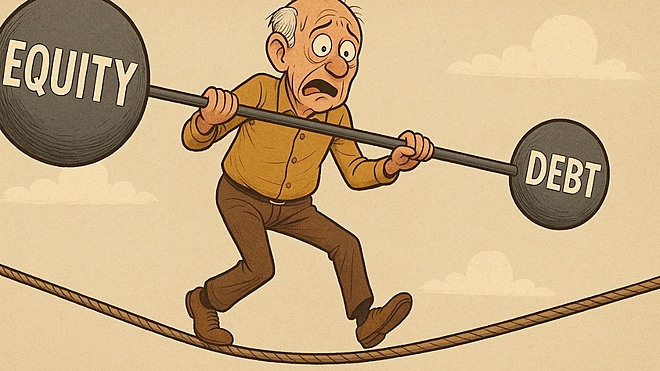
When the safety net becomes a tightrope
"Papa, you're looking at this the wrong way," Neha began explaining, pulling up a chair. "The strategy that made you rich isn't the same one that'll keep you comfortable any longer."
Ashok looked puzzled. "But why not? I have always invested in high-performing equity funds. They've given me almost 15-18 per cent returns over the last two decades."
"That’s true. But at 35, when you had 25 years to retirement and a steady salary, a market crash was just noise. You could wait it out. But this approach won’t work now. You need money for your monthly expenses, Mom's diabetes medication and other things. So, you can't afford to wait five years for the market to bounce back."
The psychological weight of watching his retirement savings evaporate wasn't something Neha’s father had anticipated. Market downturns, which once presented opportunities to invest, now kept him awake at night.
Finding the ideal asset allocation
Over the next few weeks, Neha helped her father rework his portfolio. They weren’t giving up on equities. At 62, Ashok could easily live another 20-25 years, and inflation would keep chipping away at purchasing power. However, the original 80:20 equity-debt split had to go.
“Papa, the key isn’t to abandon risk completely,” Neha explained. “It’s to take the right kind of risk.”
Here’s the approach she suggested:
- Keep the next 12 months’ expenses in a liquid fund. This would ensure that her parents’ monthly needs were met without worrying about market conditions.
- Invest the rest in a 35:65 mix of equity and debt funds. While equity would continue to help the portfolio grow and beat inflation, the debt portion would provide stability and act as a shock absorber during periods of volatility.
“So, should I withdraw a major portion of my equity fund investments all at once?” Neha’s father quipped.
“No Papa”, Neha reassured him. “What you need to do is set up an SWP (systematic withdrawal plan) from your equity funds and keep transferring a fixed amount every month into debt funds, such as a short-duration debt fund. This way, you will not only be safeguarding your capital, but the remaining portion of your investments in equity funds will continue to grow.”
“Understood”, Neha’s father replied, heaving a sigh of relief.
Watching her father's shoulders relax as they mapped this out, Neha realised how much anxiety the old strategy had been causing him.
The peace-of-mind portfolio
Six months into the new strategy, Ashok was a different man. His SWP deposited money like clockwork. The debt funds provided stability that he could see in his statements. And yes, the equity portion still fluctuated, but it was the money he wouldn't need right away, so the volatility no longer kept him up at night.
"The strangest thing," he told Neha over a Sunday breakfast, "is that I check my portfolio maybe once a month now. Earlier, it was three times a day."
"That's not strange, Papa. That's the goal. Your portfolio should let you enjoy retirement, not give you a second job monitoring the markets."
The move that changed everything
Looking back, Neha realised the transformation wasn't really about specific funds. It was about acknowledging a fundamental truth: her father’s relationship with money had changed the day the salary stopped.
During accumulation, you optimise for growth. During retirement, you optimise for reliability, safety and peace of mind. The portfolio that built wealth isn't always the one that preserves it.
Ashok still reads the financial papers daily. But now, when he sees headlines screaming about market crashes, he turns the page calmly. He has five years of expenses covered in debt funds, a medical emergency buffer that has already proven its worth and equity investments he won't touch for a decade.
"You know what's funny?" he said to Neha last week. "I'm actually earning less than before. But at least I'm sleeping better than I have in years."
That, Neha thought, was the real measure of a successful retirement portfolio.
Want a portfolio that earns calmly, not anxiously?
The strategy that helped you create wealth isn’t always the one that preserves it. That’s where Value Research Fund Advisor comes in.
With Fund Advisor, you can realign your investments for the life you desire to live once you retire: regular income, lower stress, lasting peace. What’s more, it also helps you track your portfolio, so that you know when to switch, redeem or rebalance.
Also watch: How to Plan SWP from ₹10 Lakh for Regular Income?
This article was originally published on October 10, 2025.
Ask Value Research 
 New episodes every Friday








 New Process Alert
  Seems like you've uploaded a wrong QR code. Please upload the QR code downloaded from MF Central platform.


