




 Aditya Roy/AI-Generated Image

Summary: After a red-hot run in 2023–24, factor funds have stumbled. This story breaks down why they are underperforming, what’s cyclical versus structural and how investors should position them now.
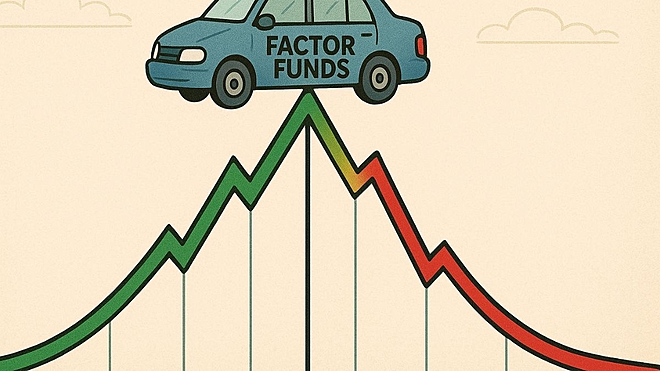
Once the flavour of the season in the Indian mutual fund industry, factor funds—built around styles such as momentum, quality and alpha—are now facing turbulence. These funds, offered both as active products and passive vehicles like ETFs and index funds, had gained popularity by promising a scientific, rules-based alternative to plain-vanilla index investing.
But market cycles don’t stay constant. After two years of dominance, these themes are losing steam.
From hot streak to hard landing
The numbers highlight the turnaround. In 2023, the Nifty 500 TRI delivered a solid 27 per cent. But the Nifty 500 Momentum 50 TRI stole the show, soaring nearly 48 per cent. Through 2023–24, factor indices such as the Nifty 200 Momentum 30 and Nifty 500 Momentum 50 consistently beat their parent indices by wide margins.
That winning streak has reversed in 2025. As of September 15, the Aditya Birla Sun Life Nifty 200 Momentum 30 ETF was down 15.3 per cent over one year, versus –1.5 per cent for the Nifty 200. The Bandhan Nifty Alpha 50 Index Fund slipped 15 per cent. Even the DSP Nifty Smallcap 250 Quality 50 Index Fund fell 12.3 per cent, underperforming the broader Nifty Smallcap 250 Index, which lost 6.3 per cent.
Managers see it as cyclical
Fund managers caution against reading too much into the slump.
“Momentum as a strategy has gone through a breather in the last eight to nine months, but this comes after two good years,” says Karthik Kumar, fund manager at Axis Mutual Fund. “Momentum naturally takes a pause after strong phases. While the recent drawdown feels painful, it is part of the strategy’s nature—momentum tends to deliver sharp gains in rallies but sharper corrections.”
Quality, too, has seen a softer patch, though not as rough as momentum. “Against the broader Nifty Small Cap 250, quality lagged because investors were chasing all small caps, not just high-quality ones,” notes Anil Ghelani, Head of Passive Investments and Products at DSP Mutual Fund. “Each factor goes through a cycle. Quality has underperformed recently but is gradually turning.”
Investor takeaway
The lesson is clear: factor funds are cyclical. Momentum thrives when markets rise steadily. Quality performs best when investors grow more selective. Alpha strategies shine when there’s a clear divide between winners and laggards.
For investors, this means factor funds should remain satellite holdings, not the portfolio core. Broad-based index funds or diversified equity funds should continue to be the foundation. Factor strategies can add flavour, but only in small doses.
Patience is also critical. Judging factor funds on one-year returns misses the point. These strategies need to be evaluated over three to five years, since short-term underperformance is baked into their design. The trick is to size allocations modestly, accept the cycles, and let them play their supporting role over time.
Need help building a portfolio where each fund has a clear, well-defined role? Value Research Fund Advisor can help. With goal-aligned fund recommendations and disciplined frameworks, it helps you stay grounded through all market phases.
No hype. Just clarity.
Ask Value Research 

 New episodes every Friday









 New Process Alert
  Seems like you've uploaded a wrong QR code. Please upload the QR code downloaded from MF Central platform.


