




 Aditya Roy/AI-Generated Image

Summary: Small-cap mutual funds may be long-term stars, but in the last 12 months, half of them have lost money. Even some of the best-rated and most popular schemes are in the red. So, find out if you invest in one of these funds…
Small-cap mutual funds have been the darlings of retail investors in recent years. Their long-term performance dazzles on paper, and understandably so. The five most popular small-cap funds today collectively manage close to Rs 200 crore in assets, riding high on investor enthusiasm and past returns.
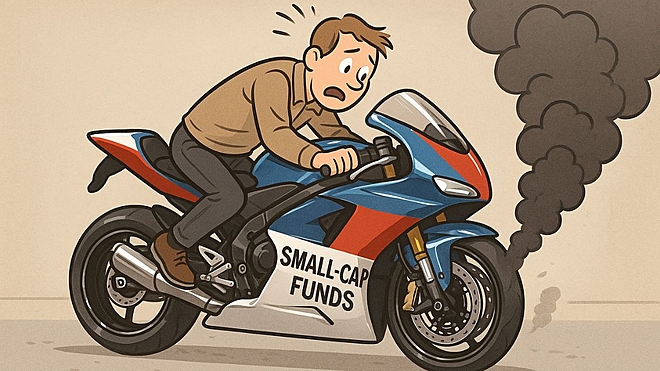
But here’s the sobering truth: half of all active small-cap funds have delivered negative returns in the last 12 months (as of August 5, 2025).
The long-term dream
Over the last decade, small-cap funds have made investors wealthier. The category has delivered a 30.96 per cent annualised return over five years, and a 16.18 per cent annualised return over 10 years.
SIPs have been even more rewarding. Of the 12 small-cap funds with a 10-year SIP track record, a middle-of-the-road fund has generated over 20 per cent annualised SIP returns. That means a Rs 10,000 monthly SIP in a typical small-cap fund over the past 10 years would have grown to around Rs 34 lakh. That’s the kind of figure that draws investors like moths to a flame.
But while long-term data tells one story, the short-term performance paints a very different picture.
The recent reality check
In the last one year alone, 14 out of 28 active small-cap funds are in the red. That’s right, half of them have lost money.
Even some of the most trusted, high-rated funds have stumbled.
- Franklin India Smaller Companies Fund, rated four stars by Value Research, is down over 6 per cent.
- HSBC Small Cap Fund, a three-star fund, has lost more than 4 per cent.
- The biggest name in the category—Nippon India Small Cap Fund, a five-star fund—has also shed over 4 per cent in the last 12 months.
- SBI Small Cap and Quant Small Cap, the third and fourth largest in terms of AUM, have fallen even more—over 5 per cent each.
There are very few outliers. Motilal Oswal Small Cap Fund has returned over 10 per cent and leads the pack. PGIM and Invesco India follow with modest 6.9 and 6.8 per cent gains, respectively. But overall, short-term performance is clearly underwhelming.
Why does this happen?
Because small-cap funds are a rollercoaster. They go through long stretches where they seem to do absolutely nothing, and then, in a matter of months, they surge.
In fact, even the top performers have had long dry spells, from one to three years, where investors saw zero or even negative returns. Take Nippon India Small Cap, for instance. Although it has been one of the largest wealth creators in the last 10 years, there was a time when it returned nothing for three straight years. Other top-rated funds like DSP and Franklin India schemes have experienced similar troughs as well.
And that’s where most investors go wrong.
Quick wins
What many investors fail to realise is this: small-cap returns are not linear. They don’t come in steady, predictable instalments. Instead, they’re lumpy. A few great years make up for several average or poor ones.
If you invest with a one-year horizon, you might very well exit disappointed. Worse, you may panic and redeem at exactly the wrong time.
What should you do?
At Value Research, we’ve always maintained that small-cap funds demand patience. They are not meant for short-term bets or tactical plays. If you choose to invest, do so with at least a 7- to 10-year horizon, and ideally through SIPs, which help even out volatility.
So, which small-cap funds do we recommend?
Join Value Research Fund Advisor and get personalised fund recommendations designed for long-term wealth, not short-term heartbreak. We have over five small-cap funds in our recommendation list.
Ask Value Research 

 New episodes every Friday









 New Process Alert
  Seems like you've uploaded a wrong QR code. Please upload the QR code downloaded from MF Central platform.


