 Widely read:




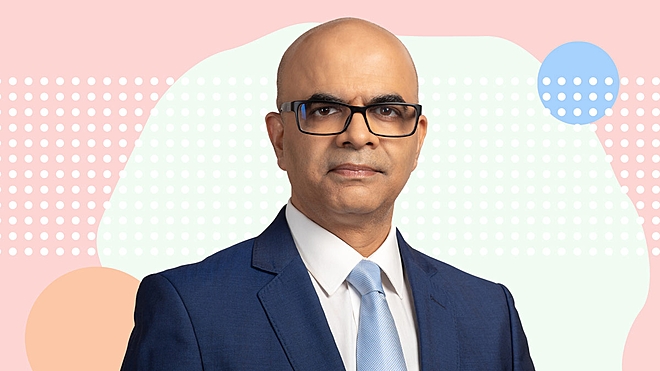

Summary: In this exclusive interview, Gaurav Misra of Mirae Asset explains why he sees opportunities across market caps despite expensive valuations, how contrarian calls in IT and banking paid off, and why a stronger research engine is key to staying ahead.
With nearly three decades of experience in equity research and investment management, Gaurav Misra, Head – Equity at Mirae Asset Investment Managers (India), brings a measured and deeply analytical perspective to navigating today’s dynamic markets. Under his stewardship, the Mirae Asset Focused and Mirae Asset Large Cap funds—with combined assets worth Rs 48,000 crore—have delivered a sharp turnaround, driven by a disciplined approach rooted in quality, valuation and contrarian thinking.
In this conversation, Misra discusses the current landscape in mid and small caps, how market narratives influence (but don’t dictate) his decisions and the strategies behind recent fund performance. He also shares how Mirae’s evolving research processes are designed to keep pace with India’s fast-changing growth story.
Mid- and small-cap stocks remain expensive, even though the broader sentiment has been muted. In your view, would a correction be healthy for long-term investors? Or is there potential value, even now, in this segment?
Of course, in aggregate, the sector has again rallied in the last couple of months, and valuations, on average, are ahead of historical levels.
When we think of the India story, an economy at $4 trillion and assuming it continues to grow at over 10 per cent annually on a nominal basis, just the growth of the overall system, crossing $6-7 trillion, means that if we keep in mind the government's thrust towards the formalisation of the economy, whether through GST (goods and services tax) or other measures, there will be growth across various industries and sectors.
I think growth will be very broad-based, right from hospitality to hospitals to other select consumer staples and discretionary items. Across these categories, or even services like financial services, where penetration levels are still very low, the scope for growth is immense and will remain so for many years ahead. The relevance of each industry will be equal. So, it's not as if the opportunity is limited to larger firms; smaller firms in smaller industries, which fall into the small-cap category, as well as mid- and large-cap firms, will all have their pockets of opportunity.
In that sense, I have a constructive outlook on opportunities that will emerge across the spectrum. However, in aggregate, right now, those two cohorts, mid and small caps, are more expensive. Having said that, when I look at some of the funds I manage, my biggest upside right now is in some of the small-cap and mid-cap holdings I have. As much as I would have liked them to, many names have not participated in this rally. These companies are across diverse industries, ranging from the QSR (quick service restaurant) category to retailers, apparel retailers and differentiated business models in ER&D, as well as contract research services, all of which fall within the mid- and small-cap segments. So, bottom-up, I can see that there's a lot of price-value gap in individual names, even if the aggregate valuations don't reflect that. I think, going forward, it's more about individual stocks and perhaps a few select industries that could perform well.
Your investment philosophy has always focused on quality and valuation discipline. With momentum and narratives taking centre stage in today's market, how has your approach evolved to stay relevant?
I believe our approach of prioritising quality growth at a reasonable price is one we will continue to pursue. However, we also employ a contrarian approach. We actively seek opportunities where the market, for some reason, may not be interested in the short term, because we believe that's where opportunities lie for medium- and long-term investors.
In the short term, of course, activity and noise are abundant, with market participants being intensely focused on the immediate term. But that leaves opportunities beyond that timeframe. By sticking to quality businesses and maintaining our valuation discipline, we have our first and second lines of defence against any permanent impairment of capital. With growth and careful stock selection, if there's a price-value gap, the upside naturally emerges. So, I think this approach remains highly relevant.
You mentioned narratives. When evaluating opportunities, we consider whether the growth story is justified and sustainable over a reasonable period. If so, we incorporate this into our assumptions for a particular company or industry. We are mindful of narratives but not swayed by them.
For example, we won't chase purely momentum-driven sectors without considering valuations or the fundamental character of the business. But we do remain open and agile. We assess all the essential attributes we want in a business before deciding.
Both the Mirae Focused and Large Cap funds have seen a sharp turnaround under your leadership over the past year. What strategies, stock picks or market calls do you think have contributed the most to this performance?
There has been consistency in our approach, which I referred to earlier, with, of course, a contrarian element in terms of selecting our stocks and the businesses we want to be in. For instance, at the start of last year, we thought that the IT pain was overdone, and some of those names where we were overweight helped, though we later reduced and went underweight at the start of this year.
Similarly, earlier last year, we had taken overweight positions in some private banks where we thought the quality and overall value proposition were very attractive. That might not have worked for some time, but in recent months, it has helped. There has also been a rerating in some of those banking names. Having said that, earnings still need to materialise, as we're currently experiencing one or two quarters of sluggish earnings. But I think when earnings do come, there will be further compounding from those names.
So, there's nothing particular I want to call out; it's spread across stocks and sectors. Perhaps some pockets were overvalued entirely, where we had previously stayed away, and that has now normalised. Additionally, bottom-up, the businesses we held or added, where we believed the character of the business was intact and the execution was strong, have evolved as expected. Better earnings have emerged, as evident in areas such as quick commerce and fintech, where companies have demonstrated strong execution and achieved market share gains.
At any given point in time, there will always be businesses that are doing well, and I would say that we still own companies that are waiting to contribute, since they're facing some headwinds. As I mentioned earlier, we expect a revival in consumption and the real estate cycle. We're also looking forward to that.
Other schemes at Mirae, such as the Midcap and ELSS funds, have also seen significant improvements. Do you attribute this to broader market trends, such as the revival of growth and quality stocks, or are there specific stock stories driving the alpha generation?
With these funds, it's not just about the past year. If you examine their performance over the past five years, it has been quite decent. If you're asking me about the immediate term, over the past year, it's not about one or two stocks. There will, of course, be some standout names, and some that the fund managers might have wanted to perform but haven't yet.
But overall, it's more spread out. I prefer not to single out one or two stocks, as their performance is often a result of a combination of factors. It's also about positioning, following the proper framework, focusing on bottom-up selection and being in the right sectors at the right time. These elements collectively have benefited the funds.
Are you saying that the performance turnaround is due to sticking to a core set of convictions during the tough market phase, rather than portfolio churn?
Yeah, I would say that. Regarding portfolio churn, whatever churn has historically been undertaken by a respective fund manager, that hasn't changed drastically, neither up nor down. They've been broadly consistent.
Regarding the points you're referring to, I might say that, in my case, there may have been some increase in churn, but only a small part of the performance can be attributed to that. This is also because, sometimes, we seize an opportunity, and the market brings it to fair value quicker than expected. In that case, we're happy to exit as well. So, the churn is more a result of how the market has behaved, rather than any deliberate, churn-driven strategy.
How would you break down the turnaround between the improved earnings visibility in your portfolio companies and the technical sector allocation?
It's a combination, though I think the bulk of the improvement has come from better earnings in some of our holdings, which has helped. However, we're still on a journey of improvement in the funds, and there are sufficient holdings where we believe the earnings outlook will improve in the months ahead. So, it's a blend, but earnings visibility has played a greater role.
On tactical calls, yes, as I mentioned earlier, we entered some positions, and they played out sooner than expected, which also helped. Markets have been quite volatile, and over the last few months, we've seen extreme price movements in stocks across sectors. So, it's less about broad sectoral calls and more about individual stock opportunities becoming attractive.
For example, we've seen volatility in capital goods as well as in some high-quality consumer franchises, and we've participated across those. Some of these have already contributed, while others are yet to play out. To sum up, the turnaround is a blend of earnings recovery and tactical stock opportunities, with a tilt towards improving earnings visibility in parts of the portfolio, although not as much as I would have liked at this point.
Looking back at the phase where these funds underperformed, were there any internal changes in your investment process, stock selection or particularly risk management that you made?
Process improvement and fine-tuning are ongoing, and we review them quarterly. We have a set of more than half a dozen key processes, and each team member acts as a gatekeeper for specific processes, ensuring that nothing is overlooked.
A separate team handles risk management and has always been an integral part of our framework. What we've additionally done is refine our sectoral approach. We've mapped sectors down to smaller sub- and micro-sectors within our universe, whether it's the Nifty 100 or NSE 500 stocks, so that no niche area or sub-sector is unintentionally overlooked.
We've also significantly strengthened our research team. Over the past two years, our team size has increased by more than 35-40 per cent, and our stock coverage has grown by nearly 50 per cent during this period. This is rooted in our belief that India presents a strong growth opportunity, and we must continually scan the spectrum for new ideas.
Lastly, while we don't directly integrate short-term market factors into our decision-making, we've become more conscious of them, especially factors that may dominate sentiment in a particular quarter or six-month period. These factors change rapidly, so we don't base investment decisions on them, but we do remain aware.
In particular, we've become even more sensitive to earnings trends. If a company's earnings visibility is strengthening, it can influence how long we hold certain positions that are already benefiting from that momentum.
Also read: 'More comfortable with mid caps, followed by large caps'
Ask Value Research 

 New episodes every Friday









 New Process Alert
  Seems like you've uploaded a wrong QR code. Please upload the QR code downloaded from MF Central platform.


