





Summary: This story breaks down how momentum funds really work, how they’ve performed, and most importantly — how much of your portfolio you should actually allocate to them. Think of this as your smart investor’s guide to chasing performance… without getting burned. So, let's get started!
Momentum was the poster child of 2023. A portfolio packed with rising stocks was the fastest way to outperform the market, and some investors couldn’t get enough of it. The fact that momentum funds’ net assets grew over 300 per cent in the past four years speaks volumes about the fanaticism.
The enthusiasm was not unfounded, either. Momentum funds gave a return of 42 per cent in 2023 and 23 per cent in 2024, while the average flexi-cap fund only gave 29 and 21 per cent, respectively.
So, it's no wonder that momentum became the flavour of the bull run.
But then came the correction. Momentum funds, once strutting at the top of performance tables, have tumbled to the bottom decile on one-year returns. Investors who bought into the hype are now facing drawdowns they didn’t sign up for. The same speed that made them rich on paper is now turning into a hazard.
What is momentum?
Momentum investing is about backing the winners. It chooses stocks that have been rising recently. For instance, the Nifty 500 Momentum 50 Index simply picks the 50 fastest-moving stocks from the Nifty 500, based on their recent price performance. It also gives more weight to stocks that are both strong performers and reasonably large in size. In short, it’s a strategy that follows trends—until they end.
When speed becomes the risk
There’s a reason momentum feels so exhilarating. You are riding stocks that are already rising. These companies have a high investor sentiment. Until they don't.
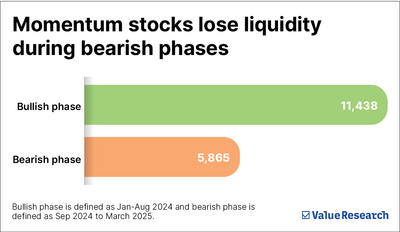
Momentum stocks don’t just fall. They unravel. And they do so with alarming speed.
When the trend breaks, the buyers disappear. These are not your long-term believers holding for fundamentals. The result? A liquidity cliff. Prices gap down. Panic sets in. And before you know it, your “top performer” is leading the losers’ board.
Further, the Nifty 200 Momentum 30 Index has a beta of 1.20 and a downside capture of 1.43. What does that mean? It means it doesn't just fall when the market does; it falls more, and faster. So, when things go south, momentum doesn't just join the party. It hosts it.
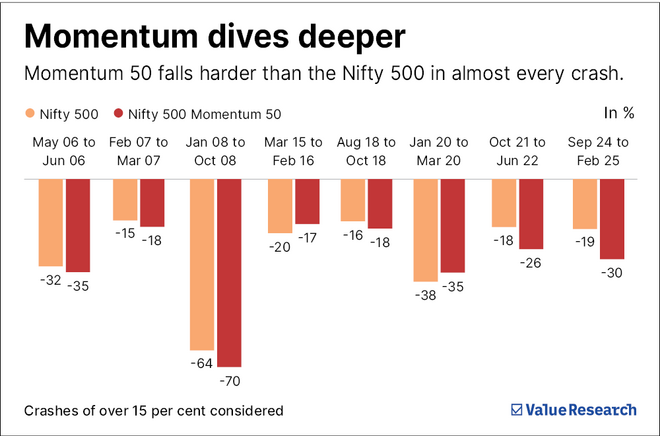
What should be the core of your portfolio?
If momentum is the adrenaline shot, your portfolio needs something calmer at the core—something that doesn’t panic when the market sneezes. Enter growth-oriented flexi-cap funds.
Unlike rigid styles, flexi caps have the agility to switch between growth and value, large and mid caps, depending on what the market rewards. And that flexibility shows. In the current downturn, 54 out of 78 flexi-cap funds have fallen less than the BSE 500. These funds pick stocks after conducting thorough market research and thus allow themselves to cushion downside blows.
Should you ignore momentum completely? Not quite.
Despite its flaws, momentum has something unique to offer—if used wisely.
Start with this: only 11 per cent of the Nifty 500 Momentum 50’s portfolio overlaps with the average flexi-cap fund. That means momentum gives you exposure to a very different basket of stocks, often early in their trend cycle. Used tactically, this can add an edge.
Now, look at what happens when you blend it.
A dash of momentum goes a long way
Even a 10–30% allocation lifts long-term SIP returns.
| Particulars | 100% flexi | 90% flexi + 10% momentum | 80% flexi + 20% momentum | 70% flexi + 30% momentum |
|---|---|---|---|---|
| Invested amount | 12 lakh | 12 lakh | 12 lakh | 12 lakh |
| Final Value | 25.6 lakh | 26.8 lakh | 27.9 lakh | 29.1 lakh |
| SIP Return | 14.6% | 15.4% | 16.2% | 17.0% |
| Note: A monthly SIP of Rs 10,000 was assumed over a 10-year period, split between the average flexi-cap fund and the Nifty 500 Momentum 50 Index for comparison purposes. | ||||
Speed with shields
If you’re tempted by momentum, don’t discard it. But do domesticate it.
First, blend it. Keep it between 10 to 30 per cent of your portfolio. Anything more, and you’re betting the house on a strategy that thrives on trends and crashes without warning.
Second, always anchor the rest of your portfolio with diversified funds such as flexi-cap or multi-cap schemes.
Want to start Rs 10,000+ SIP in flexi-cap and multi-cap funds?
Before you invest, make sure you're picking the right funds for your goals and risk profile. This is where Value Research Fund Advisor steps in. Our expert-curated recommendations don’t just tell you where to invest — we help you build a strategy that works. Whether you’re starting from scratch or fine-tuning your portfolio, we give you the insights, ratings and tools to invest smarter.
Also read: Momentum funds: Crazy highs to crippling lows
Ask Value Research 
 New episodes every Friday








 New Process Alert
  Seems like you've uploaded a wrong QR code. Please upload the QR code downloaded from MF Central platform.


