




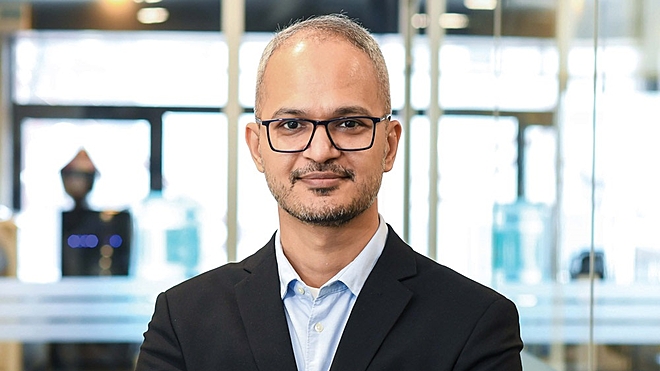
Manager of a five-star rated fund speaks about valuations, cash discipline and what’s driving DSP Large Cap Fund’s performance.
In a market where optimism runs high but earnings tell a more sober story, Abhishek Singh, Vice President and Fund Manager at DSP Investment Managers, is focused on staying grounded. Overseeing assets around Rs 20,000 crore across four schemes, including the five-star-rated DSP Large Cap Fund, Singh brings a sharp, valuation-conscious lens to his portfolios.
In this conversation, he reflects on the disconnect between market expectations and bottom-up fundamentals, the discipline behind holding cash and why true diversification isn’t about stock count alone. Singh also shares his views on what’s driving DSP Large Cap Fund’s outperformance and how he’s positioning for a market that may be due for a reality check. Below is the edited transcript of our chat.
In your view, is there a disconnect between the macro-optimism around India and what bottom-up earnings are indicating? Where is the gap most visible right now?
Absolutely, and the disconnect is quite apparent in the numbers themselves. If you look at India's nominal GDP growth for this year, it's expected to be around 9.5 per cent, so let's say in the 9-10 per cent range. Now compare that with what the market is pricing in – large caps are pricing growth of around 10-11 per cent, small caps are pricing in 14-15 per cent, and mid caps are baking in expectations as high as 20-25 per cent. That gap is stark.
One of the reasons earnings growth appeared strong in recent years was due to margin expansion. PAT margins, for instance, across the NSE 500 are near all-time highs. However, that trend may not be sustainable – emerging risks are threatening those margin levels. Some of that is already showing up. Over the last six months, we've seen broad-based earnings downgrades across indices. So yes, the disconnect exists and is already visible in the numbers. That said, the market appears to be overlooking this weakness, possibly hoping that the current earnings downgrade cycle will soon bottom out. If we start seeing signs that the downgrade cycle, so to speak, is over and that margins and earnings stabilise, perhaps even improve, the market may justify its optimism. That seems to be the pivot markets are hoping for right now.
The DSP Large Cap Fund has emerged as one of the top-performing large-cap funds over the past year. You're likely to say that one-year performance isn't everything and long-term track record matters more. But in a market where the rally has been broad-based, what has driven this outperformance? How have you differentiated your approach from that of your peers?
You're right. Within the industry, there's often an excessive focus on one-year, two-year or three-year returns. We've consistently tried to shift that conversation toward longer timeframes. Honestly, three years is the bare minimum needed to say something meaningful about a fund's strategy or philosophy. Anything shorter can be misleading.
That said, we also know that when a fund performs well, it often appears to be a matter of luck, and when it underperforms, it's assumed to be the result of poor decisions. But for most serious fund managers, the truth lies somewhere in between.
In terms of what differentiates our fund, the most significant marker is the portfolio itself. If you compare our Large Cap Fund to its peers, we likely have one of the highest active share ratios in the category. We don't own some of the largest benchmark weights, such as L&T, Bharti Airtel or Reliance. And we hold just 21 stocks, compared to over 100 in the benchmark index. So, it's a relatively concentrated and differentiated portfolio.
When such a portfolio is successful, it can lead to meaningful outperformance. But the flip side is that when things don't go as planned, the underperformance can also be stark. That's why we emphasise evaluating performance over 5-7 year horizons.
In terms of drivers, our significant overweight in healthcare, at one point, close to 18 per cent compared to the benchmark's 3 per cent, was a significant contributor. We've trimmed that for now, but it worked well. Our positions in BFSI (banking, financial services and insurance) names have also delivered and a few auto stocks, where we had relatively large allocations, performed strongly as well.
So yes, while the last year looks great, we're more focused on maintaining a consistent and differentiated approach that holds up over the long term. To date, over the past three years, the data supports the effectiveness of our strategy.
Two questions on the DSP Large Cap Fund. First, the cash levels have been rising and are currently around 12 per cent. Could you walk us through the rationale behind this? Additionally, the portfolio typically comprises around 30-32 stocks. Is this a conscious strategy that you intend to stick with, or do you plan to expand the stock universe in the future?
Let me address the stock count question once and for all. When investors allocate money to an active fund, they're not buying a portfolio; they're buying into an approach. And in our case, that approach involves running a portfolio of around 30 stocks, give or take five. In extreme situations, the count may move slightly outside this band, but 95 per cent of the time, we'll stay within it.
Frankly, it's a misconception, especially in India, that a 30-stock fund is a concentrated portfolio. True concentration is a five-stock or a 10-stock fund. Think of Bill Ackman, who runs a 12-stock portfolio, or Charlie Munger, who at one point managed just four stocks in the Daily Journal portfolio. By that standard, 30 names with 8-10 well-researched, diversified ideas offer enough breadth without diluting conviction. Beyond that, additional stocks don't add meaningful diversification.
As for cash levels, yes, we've had 3-4 per cent cash as a structural feature of the fund for some time. Around July-August last year, the cash component started rising and has now touched about 12-13 per cent. However, I want to stress that even at this level, we are 85 per cent invested, and SEBI mandates that large-cap funds must have at least 80 per cent exposure to large caps at all times.
So, this isn't a market-timing call or a macro view on valuations. It's purely driven by the opportunity set. If I find enough high-conviction ideas, I'm happy to deploy more, even if the market rallies another 10-15 per cent. Conversely, if markets correct and I still don't see compelling opportunities, I will not force deployment.
Also, let me be candid – I would personally never put money in a fund that insists on staying 99.9 per cent invested at all times. That signals a purely relative-return mindset. And in my experience, both in India and globally, such rigidity hasn't led to long-term success. To the extent possible within regulatory boundaries, we try to operate with an absolute return mindset. That requires having dry powder at all times and, occasionally, a bit more than usual.
Interestingly, over the past year, the return we generated on that cash allocation has been quite similar to the return on the Nifty. So it hasn't been a drag. This is how we manage the fund, and we'll continue to operate with this discipline.
There has been a strong turnaround in the performance of the DSP Aggressive Hybrid Fund recently. What, in your view, are some of the less obvious drivers behind this improvement?
I want to caution against the tendency to judge funds based solely on one-year returns, whether positive or negative. The Aggressive Hybrid Fund is a 25-year-old product, and upon examining the number of three-year rolling periods where it has been in the top quartile or among the top five funds, its track record is exceptional. In fact, there are very few funds in this category that exhibit such a level of long-term consistency across different fund managers, which is quite a rare feat.
Now, regarding the recent turnaround, I took over the fund about a year ago. And typically, a change in fund manager can go either way. There's always a risk that if the outgoing manager is at a low point in their cycle and the incoming one is at a high point, you could see a strong recovery. But the reverse can also be true. So some of this turnaround is certainly timing and a bit of good fortune.
Specifically, I had the opportunity to exit some holdings that I didn't want to carry forward. These were fundamentally strong businesses, but trading at valuations that, in my view, were too expensive. Fortunately, those names were still performing well at the time, so I had sufficient liquidity and a clear exit window. That's not always possible, though. I used that opportunity to redeploy into sectors like BFSI, Auto and Healthcare, many of which have contributed meaningfully to performance since.
We also reduced the stock count from approximately 51 to 39, making the portfolio more concentrated and focused. That helps with sizing decisions and conviction. However, I'll also be candid; in the past couple of months, we've given up some of the outperformance in both the large-cap and hybrid funds. And that's okay. What we're seeing in the market today is quite similar to what we experienced between January and July 2024, where conservatism tends to get questioned.
Broadly speaking, what has worked well across our funds is sticking to a relatively defensive and valuation-conscious portfolio – one that avoids overly aggressive bets where the implied expectations in the market are already too high. That's been a consistent thread. In fact, if you look at my various funds, there's a significant overlap. In essence, it's one core portfolio idea that I try to reflect across mandates. So, when it works, most of the funds do well together. And when it doesn't, they underperform together, too.
Also read: 'The Indian small-cap space is the best space to be in'
Ask Value Research 

 New episodes every Friday




 New Process Alert
  Seems like you've uploaded a wrong QR code. Please upload the QR code downloaded from MF Central platform.


