




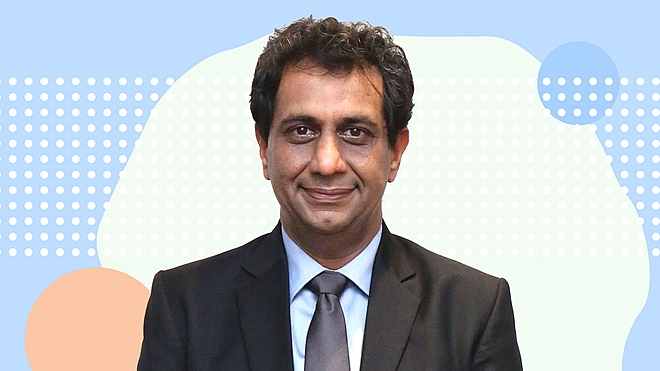

Fund manager of two five-star rated funds speaks about valuations and where he’s spotting long-term opportunities in a changing market.
The small-cap space is full of excitement. But Manish Gunwani focuses on finding enduring opportunities beneath the hype. The Head of Equities at Bandhan Mutual Fund oversees seven schemes with combined assets of around Rs 37,700 crore, including the five-star-rated Bandhan Smallcap Fund and Bandhan Large &Midcap Fund.
But Gunwani’s story goes beyond ratings and assets under management. It’s actually about a philosophy anchored in deep research, a sharp eye for structural trends and the patience to back quality businesses early.
In this conversation, he reflects on stretched valuations in small caps, the long-term promise of the manufacturing sector, the disruptive potential of technologies like AI and what’s guiding Bandhan’s equity strategy today. Here’s an excerpt from our chat.
Given current market valuations, especially in the mid- and small-cap segments, are you finding enough pockets of value, or are you becoming more selective now?
Definitely. I think a lot of stocks in the small-cap space are overvalued. But having said that, the charm of the space is the sheer variety that’s available. I mean, we fundamentally believe that the Indian small-cap space, structurally, is the best space to be in. We’ve invested heavily in research capabilities here. We’ve expanded our research team, so we now cover about 500 small caps—and I’m sure there are 200 or 300 more that we don’t yet cover but are actually worth covering.
So, when we talk about a universe of 600–700 stocks, I don’t think we can apply aggregate numbers or take an aggregate view. You can’t say all 700 stocks are overvalued. Yes, maybe two years ago, if X number of small caps were overvalued, today it’s probably 3X. So, if 100 or 200 stocks were overvalued back then, now we probably think 400–500 are overvalued. But that still leaves 200 or so that are good enough for us to build portfolios around.
Essentially, yes—on an aggregate basis, finding value is more difficult today. But the sheer variety in the space helps. We think there’s a certain set of stocks where, over a three- to five-year time frame, they can outperform the large caps. If you look at our cash limits, they’re higher than normal in the small-cap fund, so I can’t deny there’s some overvaluation on an aggregate basis. But I believe it’s up to us, as a research team—if we dig deep enough and wide enough—I think there are still opportunities.
I’m not necessarily saying it’s a very cheap space, but we’re not very defensive, either. We feel that investors with a four- to five-year time horizon should still consider small-cap funds. We believe the world is changing a lot, and the contours of the Indian economy are very different—and will remain different for the next 5–10 years compared to the last 20 years.
The last 20–30 years were very consumption-driven in a high-inflation economy. Globally, it was a period dominated by free trade and relative peace. If you look at the decades from 1990 to 2020, these factors shaped the environment. But over the next 10–15 years, domestically, consumption may not be as strong a driver. We think high-end manufacturing and services will really do well. India will export a lot more high-end manufacturing and services.
Globally, it’s clear that free trade won’t dominate the way it did, and unfortunately, we’re unlikely to see as peaceful a time as we had before. There have been more wars in the last 3–4 years than in the previous 30 years. And beyond geopolitics, there’s also very rapid change on the technology front—EVs, renewables, OTT platforms, digital advertising.
So, we believe that unless we participate in these companies when they’re small, we won’t be able to generate high returns.
There have been wars, oil prices rising and tension between the US and China. How do you see these risks affecting the Indian stock market, and are there any specific global events that you're watching closely right now?
No, there'll always be things on the macro landscape—some positive, some negative. As I said, we're clearly in a world that's in flux—very different from the pre-Covid era of the last 20–30 years. One big shift is that free trade is under question, and free trade has historically been very good for growth.
So, one structural view we have as a team is that both global growth and Indian growth are unlikely to be very, very strong. In fact, we're quite negative on global growth—not just because of trade, but also due to demographics. If you look at it, birth rates globally are coming down faster than anyone anticipated.
For example, from 1990 to 2020, global growth averaged 3.5–4 per cent. We think it'll probably be in the 2–3 per cent range going forward. And since India derives a fair amount of its growth from the global economy, we estimate India's growth will be around 5.5–6.5 per cent. We build our investment assumptions around these kinds of numbers.
Also, I think AI is going to be very tricky for India. A big part of our exports is labour-intensive—think of Global Capabilities Centre (GCCs), IT services, and remittances. All these are human-intensive. So, if AI starts replacing human labour, that's a long-term threat we have to be conscious of.
The good part is that our biggest import is oil or energy, and there's disruption happening with EVs and renewables. So, apart from geopolitical spikes here and there, we don't think oil prices will rise significantly. That's obviously a benefit. And the fact that China has become a questionable source for supply chains adds to our opportunity. We stand to gain a lot of market share in both manufacturing and services from China. That's an immense long-term opportunity.
So overall, I think the macro picture is fairly balanced. In fact, India’s macro is looking very positive. If you look at the current account deficit—which for many decades stood at 2–3 per cent of GDP—we’re now trending at 0 per cent, thanks to the decline in oil prices and strong performance in services exports.
Whether it’s inflation or the current account deficit—two key variables for macro stability—India has done phenomenally well over the last 10 years. Inflation has come down from 6–7 per cent to 4–5 per cent, and the current account deficit from 2–3 per cent to nearly 0 per cent. Growth may not have been super-normal, but relative to the world, we’re still growing quite fast.
For example, one reason I’m positive on small caps is that I believe the Indian currency will perform well. Historically, the rupee has depreciated by 3–4 per cent per annum. But going forward, over the next 10 years, it may depreciate only 1–2 per cent, which will attract more foreign capital. And liquidity is important for small caps.
Yes, small caps do tend to fall more during corrections—that will happen periodically. But with a strong currency, there will always be interest from foreign capital. India’s macro stability and geopolitical positioning will continue to attract long-term capital. Structurally, we’re quite positive on that front, though there will always be some volatility.
Looking at the Bandhan Balanced Advantage Fund, which is running a substantially high cash position—around 30 per cent as of now—could you walk us through the asset allocation model and why the fund is in a defensive mode?
We typically have a valuation metric that’s a big part of the asset allocation. But we also consider four or five macro parameters. These relate to things like credit spreads, currency, historic returns of stocks and volatility.
Some of these are mean-reverting. Volatility and credit spreads, for example, are mean-reverting indicators—where we look to buy when volatility and credit spreads go up and reduce equity when they come down. These are essentially signs of greed and fear. When volatility and credit spreads are high, there’s panic in the market. When that panic subsides, complacency tends to set in, and these indicators come down.
Historic returns, on the other hand, are actually among the best long-term indicators of future returns. It’s interesting that in almost every stock market, when you look at long-term horizons—say 8, 10 or 20 years—equity returns tend to converge to inflation plus 5–7 per cent.
That’s a big part of our model. And at this point, the five-year and seven-year returns are high. The 10-year return is also slightly higher than normal, at around 13–14 per cent. Ideally, I think 10–12 per cent is the long-term trend return for this market. But if you see, the five- and seven-year returns have been very, very high—particularly on the mid- and small-cap side.
So, those parameters right now are showing that we should have less equity than normal. That’s why we’re a bit below our midpoint. Our midpoint is 55 per cent allocation to equities; right now, we’re somewhere around 48–49 per cent.
Your portfolios generally show a value bias, trading at lower P/E ratios compared to peers. Is this a deliberate strategy? Does it reflect your long-term market outlook?
I think, in the long term, being value-conscious does work. But you can’t be boxed into it completely. There will always be a need for exposure to thematic plays and even to some loss-making companies that are growing fast.
One way to think about it is: over the long term, the Indian market should trade at around 18–23x forward P/E. I think this will be a bit higher than in the past because India’s macro is better—our currency will likely do better, and so on. If the earlier average one-year forward multiple was 19–20x, it might now be 22–23x.
We generally like to buy stocks around that level, but with better-than-average quality. So whether you look at ROE, management or earnings visibility over the next three to five years, we want the portfolio’s quality to be above the market average.
We don’t generally like buying stocks above 25–30x P/E because that’s above the market’s average multiple. So, we try to build a portfolio where the valuation multiple is in line with the market, but the quality is clearly superior.
Also read: 'AI to hit IT revenues, but new opportunities will emerge'
Ask Value Research 

 New episodes every Friday




 New Process Alert
  Seems like you've uploaded a wrong QR code. Please upload the QR code downloaded from MF Central platform.


