




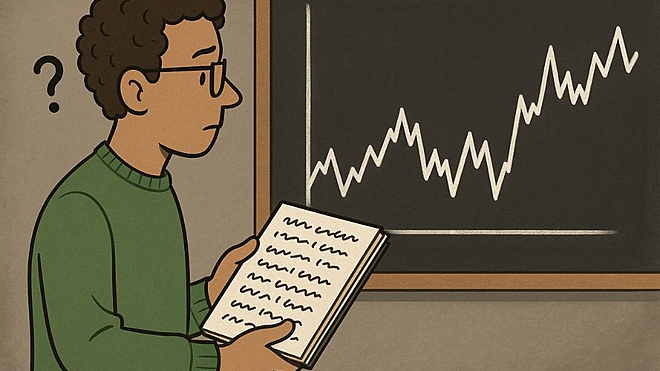
 AI-generated image


During a lecture at Yale University, distinguished physicist Ramamurti Shankar offered his students a remarkably honest take on quantum mechanics: "Richard Feynman, one of the big figures in physics, used to say, no one understands quantum mechanics." Then came his delightful punchline: "Right now, I'm the only one who doesn't understand quantum mechanics. In about seven days, all of you will be unable to understand quantum mechanics. Then you can go back and spread your ignorance everywhere else." You can watch it here.
This self-deprecating wisdom from a brilliant physicist resonates deeply with investing. Like quantum mechanics, the financial markets operate in ways that often defy intuition and straightforward explanation.
Suggested read: Mea culpa investing
Scroll through financial news channels, and you'll encounter countless experts who confidently explain market movements with absolute certainty. Even now, in the midst of war, the market is on two different roller coasters simultaneously. These explanations sound plausible until you notice how frequently they contradict one another or get revised as new data emerges.
What if we approached investing with the same intellectual honesty as Professor Shankar approaches quantum physics? What if we acknowledged that markets are complex adaptive systems influenced by millions of participants making decisions based on incomplete information, varying time horizons, and emotional responses?
Suggested read: Not just the day's numbers
Let's put aside the last few days' events, even though I do not agree that these were a black swan. A terror attack by Pakistan and a strong response from India is at best a light grey swan-it's always on the cards.
Consider how often the financial industry's most confident predictions fall short. Remember the certainty that certain pandemic-era consumer behaviours would become permanent, only to see rapid reversals? These weren't mere outlier errors-they represent the fundamental challenge of forecasting in complex systems. Yet the investment industry continues selling certainty. Fund managers promise outperformance through superior stock selection. Technical analysts identify patterns that supposedly predict future prices. Economic forecasters project growth rates to decimal precision. And ordinary investors are expected to navigate this landscape with confidence.
Suggested read: How has Sensex performed in previous India-Pakistan clashes?
A more honest approach would be to design investment strategies that acknowledge our inability to predict market movements consistently. Rather than attempting to outsmart the market through constant activity, we might focus on enduring principles: diversification across genuinely different asset classes, minimising unnecessary costs, understanding our risk tolerance, and avoiding concentration in areas we don't understand.
Some of history's most successful investors have embraced this philosophy of humility. They've succeeded not through perfect foresight, but by establishing robust processes, recognising their limitations, and being willing to change their minds when evidence contradicts their beliefs. They understand that protecting against permanent loss often matters more than capturing every potential gain.
Suggested read: Ignore it all
For most investors, this approach means developing an investment philosophy that doesn't depend on accurately forecasting next quarter's GDP growth or identifying which technology will dominate a decade from now. It means constructing portfolios that weather various economic scenarios rather than betting everything on a single prediction.
This doesn't mean abandoning active decision-making entirely. It means approaching those decisions with appropriate humility. When evaluating investments, consider potential returns and what might go wrong. Ask yourself: "If my thesis proves incorrect, how much could I lose?" Often, avoiding catastrophic losses proves more valuable than chasing outsized gains.
Suggested read: How to be one up
The financial industry rarely promotes this perspective because uncertainty doesn't sell well. Customers want confidence and precision, and financial media need dramatic narratives and actionable advice to maintain viewership. But acknowledging uncertainty doesn't mean abandoning discipline or analytical rigour. Rather, it means applying that rigour to understanding the range of possible outcomes rather than trying to predict a single result.
Like Professor Shankar's students spreading their "ignorance" of quantum mechanics, perhaps investors would benefit from spreading a healthy scepticism about market predictions. This doesn't mean rejecting all expert analysis, but consuming it appropriately and contextually.
So the next time someone confidently explains why markets will behave in a particular way, remember the quantum physicist's wisdom. Markets, like quantum particles, don't always follow intuitive patterns. The wisest approach might be building resilient financial plans, acknowledging this fundamental truth rather than pretending we can consistently predict the unpredictable. If brilliant physicists can admit the limits of their understanding, investors should consider doing the same.
Also read: The futility of market timing
Ask Value Research 

 New episodes every Friday











 New Process Alert
  Seems like you've uploaded a wrong QR code. Please upload the QR code downloaded from MF Central platform.


