




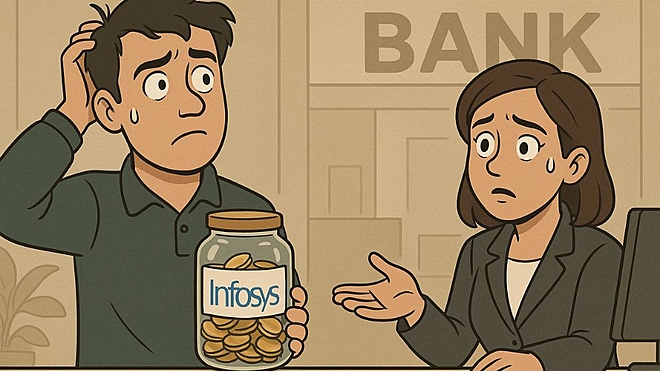
 AI-generated image

In March 1999, Infosys became the first Indian company to list on the NASDAQ. What followed was nothing short of spectacular - during the dot-com frenzy, Infosys's share price rocketed from around ₹24 to ₹217 within a year, a nearly 10x return.
But by March 2000, its valuation had entered fantasy land, trading at a P/E ratio of over 500.
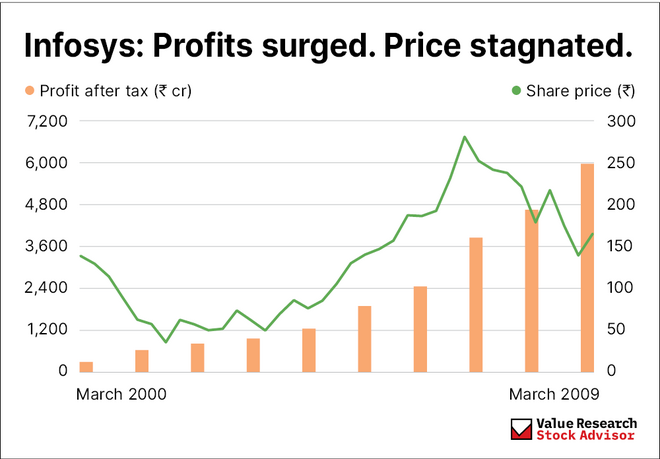
The result? The stock price went nowhere over the next nine years, even though profits grew more than 20x — from ₹286 crore in FY2000 to ₹5,988 crore by FY2009.
Investors who held on at the peak waited nearly a decade to recover, not because Infosys failed, but because the stock had run too far ahead of fundamentals.
That was a moment when Infosys, despite being a great company, was a screaming sell.
Not just Infosys: HUL and Reliance did it, too
The Infosys case isn't rare. Several other top-tier companies have delivered flat returns for years when investors ignored valuation.
- Hindustan Unilever (HUL): From 2000 to 2011, despite consistent profit growth, its stock barely moved. Investors saw zero capital gains for more than a decade.
- Reliance Industries: Investors who bought at its 2008 peak waited until 2017 to break even, even as profits doubled. It was a nine-year freeze.
These are quality businesses. But even the best stocks fail to deliver when bought or held at inflated prices.
Why valuation and timing matter
Paying too much is the most common investing mistake.
Even if the company does everything right, the stock can become worthless if the market has priced in too much growth.
Benjamin Graham said best: "The price you pay determines your return." If you overpay, you underperform — it's that simple.
Infosys was priced as if it would dominate the world overnight in 2000. When reality set in, the price took years to catch up with fundamentals.
So, don't confuse a great business with a great stock, especially when prices are disconnected from value.
Four clear signals that It's time to sell
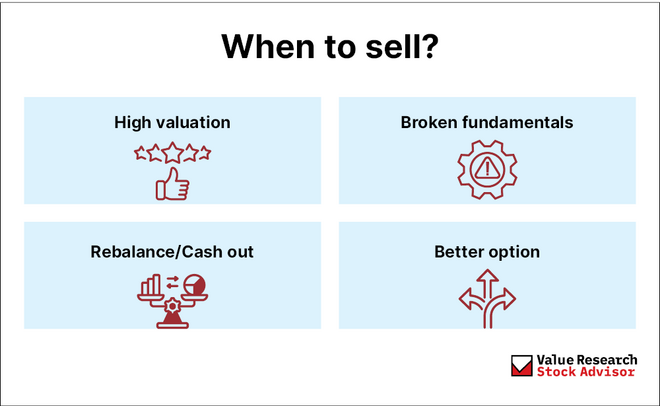
Selling isn't guesswork when you follow a system. Here are four clear signals that can guide your decision:
1. Valuation is irrational or target is met
Consider booking profits if a stock's price has run far beyond its intrinsic value or has exceeded your target. Infosys at 500+ P/E was exactly this situation.
2. Fundamentals have deteriorated
Has the company lost its growth, seen management issues, or drowned in debt? If the business case has weakened, it's time to move on.
3. You need to rebalance or redeem
If one stock dominates your portfolio, trim it. Or if you're near a financial goal — buying a house, funding education — use the money. That's what investing is for.
4. Better opportunities emerge
Sometimes another stock offers better risk-reward. Free your capital and reinvest where the potential is higher.
Don't let emotion cloud your exit
Many investors hold on because of FOMO or loyalty to the company.
But hope is not a strategy. Waiting for "just a little more upside" can turn gains into regrets.
Infosys, HUL, Reliance — these stories aren't just market trivia. They're powerful reminders that long-term investing needs rational exits.
Staying invested in an overvalued stock can lock up your capital and cost you years of potential compounding elsewhere.
Discipline beats emotion. Always.
How Value Research Stock Advisor helps
Value Research Stock Advisor does the heavy lifting on your behalf.
We not only recommend stocks to buy — we also:
- Track fundamentals and valuations continuously
- Reassess investment theses regularly.
- Alert you when a stock becomes overvalued or the story weakens.
- Label them as "Sell", "Hold - Expensive", or re-rate when needed
This ensures you're not caught off guard when something changes. You stay ahead, not behind the news.
It's like having a research partner whispering, "Time to move on," when the market is still celebrating.
The bottom line: Selling is strategy, not panic
Selling doesn't mean giving up. It means acting smart.
It's how you protect gains, avoid drawdowns, and stay agile in a fast-changing market.
Infosys showed us that a good sell decision can save you a decade of waiting.
And with a trusted research team by your side, you can invest — and exit — with confidence.
Ready to sell smart?
Great investing is not just about what to buy. It's also about when to exit.
Let Value Research Stock Advisor help you with both. Know when to Buy, Hold, or Sell — without stress, emotion, or confusion.
Subscribe to Stock Advisor today, and take the guesswork out of your portfolio.
Suggested read: 5 stocks that paid dividends for 20 yrs and beat the market
Ask Value Research 

 New episodes every Friday








 New Process Alert
  Seems like you've uploaded a wrong QR code. Please upload the QR code downloaded from MF Central platform.


