




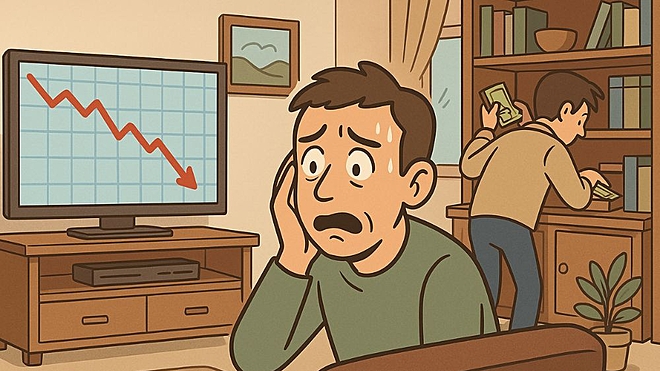
 AI-generated image
Most people think markets are moved by data. By quarterly numbers, GDP projections, or interest rate decisions. But more often than not, they are moved by people and people are wonderfully, reliably irrational.
You don't need a finance degree to understand the market. You need an understanding of human behaviour. And no one captured this better than Carlo Cipolla, an economic historian, in his book 'The Basic Laws of Human Stupidity'. What started as a tongue-in-cheek essay now reads like an operating manual for modern investing.
His five laws, originally written about society, map perfectly onto financial markets. Especially if you have ever wondered why seemingly smart people make terrible decisions or why the crowd so often moves in the wrong direction.
Let's walk through each of these laws and what they reveal about how to think and invest with clarity.
The first law of stupidity
What Cipolla says: Always and inevitably, everyone underestimates the number of stupid individuals in circulation.
Investing corollary: We always underestimate how many stupid investors are out there.
Every time I think we have hit peak irrationality, the market surprises me. The mistake most investors make is assuming others are thinking clearly. That there is some grand wisdom in price movements. But every cycle proves otherwise.
You will see people buying into fads with no revenue, no business model, and no logic. You will see panic-selling of fundamentally strong businesses based on headlines. There is no shortage of bad decisions masquerading as strategy.
As an investor, the quicker you accept this as part of the landscape, the better you will navigate it.
The second law of stupidity
What Cipolla says: The probability that a certain person is stupid is independent of any other characteristic of that person.
Investing corollary: Intelligence, education, or experience don't protect you from stupidity.
This one stings. I have read about and seen fund managers with top-notch degrees fall for the hype. I have seen engineers, doctors, and bankers buy stocks they didn't understand just because they were trending. Plenty of high achievers make poor decisions in the market. It is because the tools of investing (annual reports, financial statements, ratios, etc.) are simple, but the discipline to apply them consistently is rare.
The truth is that behaviour trumps intelligence. You can be clever and still fall for greed. You can be successful and still follow the herd. The real advantage lies in staying grounded when others aren't.
The third law of stupidity
What Cipolla says: A stupid person is a person who causes losses to another person or to a group of people while deriving no gain and even possibly incurring losses themselves.
Investing corollary: A stupid investor hurts others while gaining nothing.
Some investors lose money quietly. Others do it loudly and bring a crowd along for the ride. They spread fear in downturns and euphoria in bubbles. They chase noise, ignore fundamentals, and then shout their regret across group chats and social media.
They are not malicious. But they are harmful. And in a connected world, their reach is wide. Be careful whose emotions you absorb.
The fourth law of stupidity
What Cipolla says: Non-stupid people always underestimate the damaging power of stupid individuals. In particular, they constantly forget that at all times and places, and under any circumstances, to deal and/or associate with stupid people always turns out to be a costly mistake.
Investing corollary: Smart investors constantly underestimate stupid ones.
This one should be tattooed on your desk. You may spend weeks building a thesis, backing it with hard numbers, and building conviction in the fundamentals. And then, just like that, the price moves 15 per cent because of sentiment.
This is where theory meets reality. Markets don't reward precision in the short term. They react to crowd psychology. And until that gap closes, you need the patience to sit through chaos without doubting your process. Underestimating the crowd's ability to behave irrationally and influence price is a rookie error, even for veterans.
The fifth law of stupidity
What Cipolla says: A stupid person is the most dangerous type of person. A stupid person is more dangerous than a bandit.
Investing corollary: Stupid investors are more dangerous than dishonest ones.
The dishonest ones, Cipolla calls them 'bandits', have a motive. They want your money. However, with a bit of caution, you can avoid them. But stupid investors? They mean no harm yet wreak havoc. They buy high, sell low, and then tell everyone else to do the same. They act with confidence, spread their views, and leave damage in their wake. You can't predict them, you can't reason with them, and you certainly can't follow them.
These are the people who say things like, "Just buy it. Everyone else is," or, "This can't go down any further." They are not trying to mislead you. But if you are not careful, they will.
So what does this mean for you?
It's simple but not easy. Avoid drama. Ignore the hype. Build a system you trust, and stick with it. The goal is not to outsmart everyone, it's to not get dragged into their mistakes.
The best investors are not always the most brilliant. They are the ones who stay calm when others don't, who understand that long-term returns are a function of temperament, not just talent and that, in the end, avoiding stupidity is often more powerful than chasing brilliance.
And most importantly, don't assume the market is a rational place. It's a theatre. Some are acting. Some are watching. And many, unfortunately, have no idea why they are there in the first place.
Learn to spot them. Learn to avoid them. And whatever you do, don't be one of them.
Also read: Same funds, same time. Yet one portfolio did better. How?
This article was originally published on April 01, 2025.
Ask Value Research 

 New episodes every Friday











 New Process Alert
  Seems like you've uploaded a wrong QR code. Please upload the QR code downloaded from MF Central platform.


