




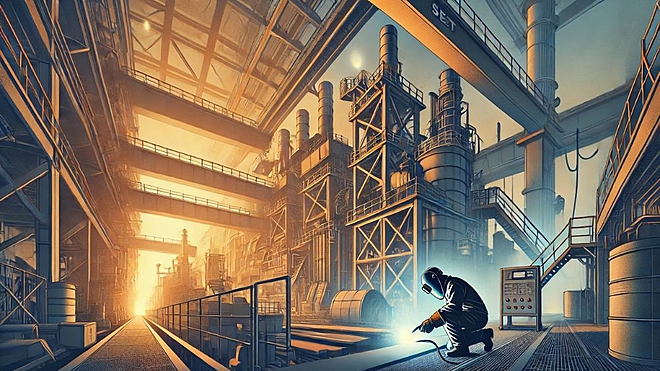
 AI-generated image

Graphite electrodes don't make for glamorous headlines like lithium or semiconductors. But without them, the steel industry would be a bit rusty. They're critical to modern steelmaking, used in cleaner electric arc furnaces (EAFs), which use electricity to melt scrap steel. In this niche market of only four to five major players globally (outside China), one of them is from India. Noida-based HEG is among the largest graphite electrode manufacturers in the world which makes nearly 70 per cent of its business from exports.
The company is betting big on an industry shift—steel production is moving away from traditional blast furnaces to EAFs that use graphite electrodes in what's a cleaner and more sustainable steelmaking process.
In theory, this should boost demand for both EAFs and graphite electrodes. But the trends so far have been disappointing. The global graphite electrode market has been in a funk. Since the pandemic, EAF adoption has slowed. China, once expected to lead the charge, saw fewer usage of EAFs. As a result, the country flooded the global market with surplus electrodes, lowering prices from $3,000-$4,000 per tonne to just $2,000. Adding to the pressure, global steel production itself is slowing, stalling growth in electrode demand.
Global steel output, China's EAF-based output stuck in stagnation
| (in mn tonne) | China EAF steel output | Global steel output |
|---|---|---|
| 2022 | 97 | 1,888 |
| 2021 | 98 | 1,952 |
| 2020 | 98 | 1,878 |
| 2019 | 103 | 1,874 |
| 2018 | 99 | 1,808 |
| 2017 | 81 | 1,675 |
| 2016 | 51 | 1,606 |
| 2015 | 47 | 1,620 |
| 2014 | 48 | 1,670 |
| 2013 | 48 | 1,649 |
| Note: 2023 and 2024 numbers for China's EAF production are not available. But they have largely remained flat while global steel production has fallen | ||
But a recent 95 per cent anti-dumping tariff on Chinese electrodes by Japan has sparked optimism that the excess Chinese supply may get arrested, sending HEG's stock, along with that of its peers' Graphite India, on a steep climb recently. But the question investors need to ask is whether HEG can really create real, sustained value in a market still grappling with oversupply and weak demand?
Scaling while peers retreat
The slowdown in the market is having no effect on HEG's optimism. At a time when other global peers are pulling back, HEG has ploughed ahead, investing heavily in its operations. From FY14 to FY24, HEG invested around Rs 2,100 crore in expanding its operations, while Graphite India had been selling off assets during this time. Other global peers have also seen plant closures as rough market conditions made operations unfeasible .
As a result, the sluggish demand has led to a decline in global graphite electrode capacity (excluding China), shrinking from 9 lakh tonnes in 2014 to 7 lakh tonnes today. Utilisation rates have dropped from 87 per cent in 2017 to a mere 65-70 per cent in 2024, a sign of widespread distress.
As global capacity faltered, HEG raised its own
| 2014 | 2024 | |
|---|---|---|
| Global capacity (Th tonne) | 900 | 700 |
| HEG's capacity (Th tonne) | 80 | 100 |
| Th tonne is thousand tonne | ||
And yet, HEG's expansion, contrary to the industry, is placed on the hopes that this gradual supply tightening by others can be beneficial for the company. How? It's positive that the demand for EAFs, currently accounting for 28 to 30 per cent of global steel production, will see significant growth in the long term as opposed to the existing slow pace. Something that it hopes to capitalise on as peers cut back on supply due to their loss-making operations.
What adds to the optimism is that with the expansion, HEG now has the world's largest single-location graphite electrode plant as opposed to its competitors' scattered operations. This massive scale gives it a competitive edge, driving cost efficiencies and better profit margins over peers.
How the top players stack up
| Capacity (in Th tonne) | 2024 EBITDA margin (%) | |
|---|---|---|
| GrafTech | 178 | -2.1 |
| Tokai Carbon* | 72 | 10.6 |
| Graphite India** | 80 | 7.8 |
| HEG** | 100 | 11.2 |
|
*Tokai Carbon's data based on its graphite electrode segment **Data for Graphite India and HEG based on 12 months ending December 2024 |
||
In line with its expansion, HEG also recently acquired an 8.23 per cent stake in GrafTech, a fully integrated US-based graphite electrode manufacturer. This strategic investment could ensure greater raw material security for HEG and foster long-term synergies. However, it's important to note that GrafTech is currently loss-making mainly due to the weak graphite electrode market, and it's far from a sure bet.
Risks to the core business
Despite its aggressive strategy, HEG isn't immune to the sector's risks. Global steel demand remains weak and overall production has declined 3.6 per cent from 2021 to 2024, limiting any short-term upside. The closure of plants and reduction in capacity across the industry highlights structural issues that could dampen price recovery.
Further, even Japan's Tokai Carbon, another global leader, has voiced concerns about excessive supply from not just China but also India that could further derail price recovery. In short, if electrode prices don't bounce back, HEG's hefty investments over the last decade may struggle to deliver meaningful returns.
The next growth driver: Graphite anodes for EVs
To hedge its bets, HEG is now targeting the booming electric vehicle (EV) market. The company has committed Rs 1,000 crore to build a 20,000-tonne per annum graphite anode plant for lithium-ion batteries, a key component for EVs. With India pushing to localise its EV battery supply chain, HEG could capitalise on this burgeoning market.
This move is particularly clever. HEG already has the necessary infrastructure to produce artificial graphite—key to anode production—so it can maintain cost efficiencies that new entrants can't match. Consider competitor Epsilon India, for example, who's setting up similar plants, but at nearly double the cost.
But competition is fierce. Graphite India could also enter the anode market. Since the company is further integrated into needle coke production-the primary raw material for artificial graphite electrodes. Given its stronger integration, it may prove to be a formidable challenger. And then Chinese suppliers dominate the space globally. HEG will need to scale quickly, meet global standards, and stay competitive on price if it wants to win in this fast-growing space.
A calculated risk
HEG is debt-free and cash-rich, allowing it to make bold investments in both its core graphite electrode business and new ventures like anodes. This strategic diversification could pay off if the graphite electrode market recovers and the anode opportunity materialises as expected.
For long-term investors, HEG offers a mix of defensive balance sheet strength and uncertain future growth. Given that the graphite electrode business is facing structural headwinds and the anode venture is still in its infancy, a lot will have to go right for the company's strategy to yield the desired results.
Also read: Avanti Feeds: Chasing growth beyond shrimp dominance
This article was originally published on March 29, 2025.
Ask Value Research 

 New episodes every Friday




 New Process Alert
  Seems like you've uploaded a wrong QR code. Please upload the QR code downloaded from MF Central platform.


