




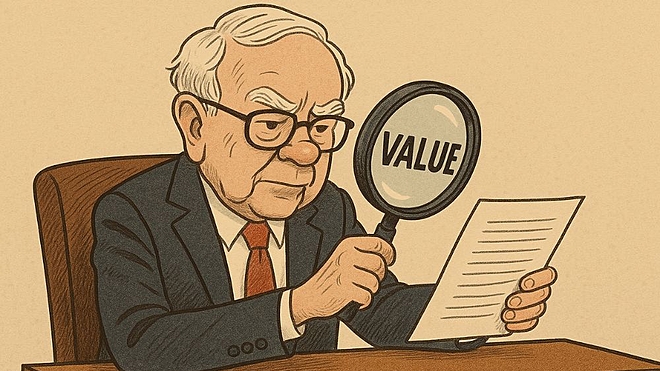
 AI-generated image

Investing isn't just a numbers game. It's a mindset, one that cuts through flashy headlines, quarterly hype, and spreadsheet clutter to get to the heart of what really matters: preserving value. Back in 1983, Warren Buffett dropped some cardinal lessons on how to truly evaluate a business, from assessing competitive advantages to accounting goodwill. This story, part of our series , unpacks Buffett's timeless insights shared in his 1983 letter to Berkshire shareholders.
When appraising a business, start with one simple question
Buffett has a knack for boiling down complex ideas into practical questions. His approach to business appraisal starts with a simple question: "If I had ample capital and skilled personnel, how would I like to compete with this business?"
It's a clever litmus test. Instead of just analysing balance sheets and revenue growth, Buffett's focus is on assessing competitive advantage. If you believe you could easily replicate a business' success with sufficient resources, that's a business you should avoid. It means the company likely lacks a durable moat—something that sets it apart from competitors.
Think of it this way: if you were to start a new business today, would you want to go head-to-head with Coca-Cola or Apple ? Probably not. Their strong brands, established networks, and customer loyalty create formidable barriers to entry. In contrast, businesses that rely on undifferentiated products or low margins are much easier to challenge and disrupt.
Before diving into a company's financials, ask yourself whether it would be tough to compete with this business if you had all the resources in the world? If the answer is yes, you might be looking at a strong contender for long-term investment.
Look beyond short-term results
One of the most common investing mistakes is judging a company's performance based on short-term results. Buffett cuts through this misconception with a brilliant analogy: "Why should the time required for a planet to circle the sun synchronise precisely with the time required for business actions to pay off?"
In other words, one-year results are often meaningless. They might reflect transient issues or short-lived successes rather than fundamental performance. Instead, Buffett suggests using a five-year rolling average as a rough yardstick for assessing economic performance. If the average annual gain over five years falls well below the return on equity (ROE) achieved by the broader market, it's likely not a solid investment.
Buffett is essentially warning that if an investment's five-year average annual return is lower than the average ROE of the broader market, it may indicate that the investment is underperforming relative to what could have been achieved by simply investing in a diversified portfolio of average Indian businesses (i.e., a broad-market index fund or ETF).
Given that the average ROE of Indian companies is around 11 per cent, there are 82 companies (with a market cap of at least Rs 1,000 crore) that fail to clear this test.
Underperformers that fail the Buffett test
Companies with five-year returns below 11 per cent pa
| Company | 5-year return (% pa) |
|---|---|
| MAS Financial | 11.00 |
| Petronet LNG | 10.95 |
| Nestle India | 10.84 |
| Rupa & Company | 10.30 |
| Procter & Gamble Health | 10.23 |
| La Opala RG | 9.93 |
| Nilkamal | 9.90 |
| Bayer Cropscience | 9.72 |
| Atul | 9.72 |
| Indoco Remedies | 9.38 |
| Data as of March 25, 2024. For the complete list, click here. | |
Think of it like a marathon. Judging a business based on one-year performance is like picking the winner after just one kilometre. You need the full race to understand who truly has the endurance to win.
Book value and intrinsic value: How they are different
People often mix up book value and intrinsic value, but Buffett is quick to point out that they are fundamentally different.
-
Book value
is an accounting measure that shows how much money has been put into a business through capital contributions and retained earnings.
- Intrinsic value is an economic concept that estimates future cash output discounted to present value.
Buffett uses a great analogy to make this clear. Imagine you spend the same amount of money educating two children. The book value of that education is the same. But the intrinsic value, or the economic payoff, might vary drastically between the two. One might become a successful entrepreneur, while the other might struggle to find steady work. The input was the same, but the output is vastly different.
Similarly, two businesses can have the same book value but wildly different intrinsic values. A business with a high intrinsic value is one that consistently generates cash and grows without needing constant capital infusions.
So don't get hung up on book value alone. Think critically about how much cash the business can realistically generate in the future.
Goodwill and its real value
Goodwill can be one of the most misunderstood aspects of business valuation. To most people, it's just a line on a balance sheet. But according to Buffett, what really matters isn't the accounting treatment, it's the economic power behind that goodwill. He draws a distinction between accounting goodwill and economic goodwill.
- Accounting goodwill is what shows up when a company acquires another business for more than the value of its net assets. That extra premium, often for brand value, customer loyalty, or strategic advantage, is recorded as goodwill.
- Economic goodwill , on the other hand, is the real-world ability of a business to earn high profits without needing to keep pouring in fresh capital. It's not about what's written down, it's about what the business actually delivers over time.
Take See's Candies, for example. When Berkshire acquired it in 1972, the company had $8 million in tangible assets but earned $2 million a year—a 25 per cent return on tangible assets. That kind of performance didn't come from just physical assets, but largely from intangibles like loyal customers and a beloved brand name.
Berkshire paid $25 million, far more than the asset value. Why? Because the real value lay in its ability to keep generating strong returns. This purchase price reflected the economic goodwill created by See's strong brand.
Here's where it gets interesting. Even though traditional accounting would have said that goodwill should go down over time (via amortisation), the real-world economic value of See's actually went up. Its brand got stronger. Its customer base grew. Its returns stayed robust.
Today, accounting rules have changed. You no longer amortise goodwill but test it for impairment. Still, the underlying lesson stays the same: great businesses build value in ways accounting can't fully capture.
True economic goodwill, the kind that comes from customer loyalty and brand strength, can grow even when accounting goodwill remains constant in the books. So don't just look at the number, look at what's behind it. If a company earns well on a modest asset base and keeps customers coming back, that's economic goodwill in action and it can be worth every rupee.
In short, don't let accounting standards mislead you. Focus on the real economic value that a business builds over the years.
Think like Buffett, not like an accountant
The 1983 letter is a powerful reminder that investing isn't just about looking at numbers, it's about understanding what those numbers really mean. Buffett challenges us to think beyond standard accounting metrics and focus on long-term economic realities.
-
Prioritise competitive advantages when appraising businesses
-
Judge economic performance over multi-year periods, not single-years
-
Understand the difference between book value and intrinsic value
- Recognise that true economic goodwill can grow even if accounting rules don't reflect it
Buffett's timeless wisdom boils down to one principle: be rational, be selective, and always focus on sustainable long-term value. Let the market obsess over short-term gains while you build wealth that truly lasts.
Also read: Want a multibagger? Sunil Singhania reveals what to look for
This article was originally published on March 27, 2025.
Ask Value Research 

 New episodes every Friday











 New Process Alert
  Seems like you've uploaded a wrong QR code. Please upload the QR code downloaded from MF Central platform.


