




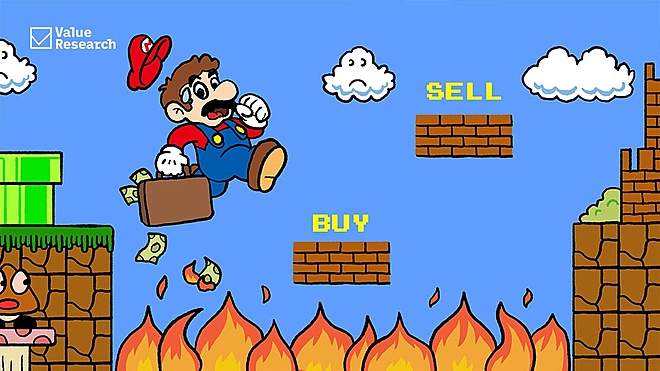
 Illustration: Anand Kumar


"Time is the friend of the wonderful business, the enemy of the mediocre." If we replace business with an investor in what Warren Buffet said there, it would be of greater relevance to us today.
As the stock market swings between dramatic highs and lows, many investors are feeling that familiar itch - the urge to time the market. It's not every day that we have the thrill of thousands of points of movement within weeks (sometimes days). At this time, it's tempting to think we can outsmart the market by buying at the bottom and selling at the peak. This age-old temptation becomes particularly acute when we see the market making sharp moves like the recent surge after the Maharashtra election results.
But here's the sobering reality: market timing is just as dangerous today as it has always been, perhaps even more so given the complex factors driving current market movements. While the Sensex's sharp recoveries might make timing appealing, they highlight why it's such a risky strategy.
Consider the recent market behaviour. Investors who panicked during the dips in October and November 2024 might have missed the subsequent sharp recovery. This pattern has played out repeatedly over the past six months, with the index showing multiple sharp drops followed by equally dramatic recoveries. Each of these swings represented a potential trap for market timers.
The challenge isn't just predicting market movements - it's about understanding the increasingly complex web of factors influencing them. Today's markets respond to domestic economic indicators, global geopolitical events, policy changes, and institutional money flows. Even seasoned market experts struggle to predict how these factors interact to move the market accurately.
Suggested read: Pay less attention
The speed of market movements makes timing particularly dangerous in the current environment. The digital age has accelerated the pace of information flow and market reactions. When you think you've spotted a trend, the market has often already priced it in. Those who attempt to time these movements frequently buy high and sell low - the exact opposite of their intention.
Instead of trying to time these volatile markets, investors would do better to focus on time-tested principles:
First, maintain a disciplined, long-term investment approach. The market's journey over the years shows that the long-term trend has been upward despite short-term volatility. Second, use SIPs in mutual funds to average your purchase prices over time. This approach automatically takes advantage of market dips without requiring you to predict them. Finally, focus on asset allocation rather than market timing to ensure your portfolio's risk level matches your investment horizon and goals.
The psychological benefits of these systematic approaches cannot be overstated. With a well-structured investment plan, market volatility becomes less emotionally taxing. You're no longer caught in the exhausting cycle of trying to predict market movements or lying awake at night wondering if tomorrow is the day to buy or sell. This emotional stability is particularly valuable in markets like today's, where news-driven volatility can test even the most seasoned investor's resolve. Moreover, a systematic approach frees up your mental energy to focus on more productive aspects of financial planning, such as tax efficiency, estate planning, or identifying long-term investment opportunities in emerging sectors.
Remember, successful investing isn't about predicting the market's next move. It's about staying invested through market cycles, maintaining discipline when others are panicking, and letting the power of compounding work in your favour. The current market volatility might make timing seem attractive, but it's precisely during such periods that sticking to your long-term strategy becomes crucial.
As Warren Buffett famously observed, the stock market transfers money from the impatient to the patient. In today's volatile market environment, this wisdom rings truer than ever. The real question isn't "When should I buy or sell?" but "Am I invested in line with my long-term goals?"
For most investors, the answer to market volatility isn't timing - it's time itself. Let your investment horizon, not market movements, dictate your strategy. In the end, time in the market beats timing the market, regardless of how tempting those sharp market swings might appear.
Also read: Keep calm and invest on
Ask Value Research 
 New episodes every Friday









 New Process Alert
  Seems like you've uploaded a wrong QR code. Please upload the QR code downloaded from MF Central platform.


