




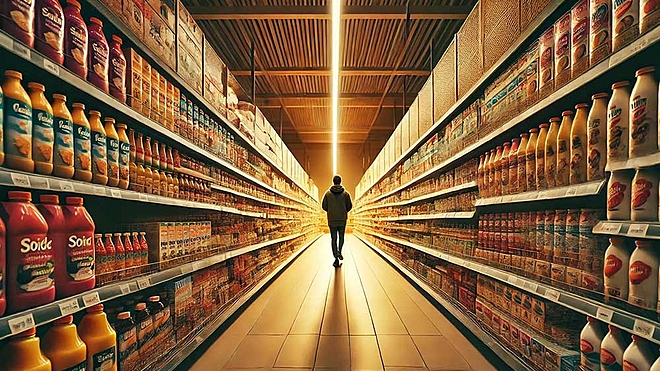
 AI-generated image

India's fast-moving consumer goods (FMCG) companies have been shunted to the slow lane owing to weakening urban demand.
Gone are the sunny days of 2022 and 2023 when FMCG companies outgunned the Sensex - a proxy for Indian markets - by a wide margin. Fast-forward to today, this sector is trailing the Sensex by 10 per cent as of November 13, 2024. If that wasn't bad, the sector has redlined in the last three months, contracting 7 per cent.
Dud demand
So, what's dragging the FMCG sector? In short, low consumer demand. Rising food inflation and commodity prices have put a squeeze on household budgets.
Although FMCG companies previously thrived despite wrestling with poor rural demand, the sudden recent slump in urban areas has been a body blow, especially as it comprises two-thirds of their total sales.
In this quarter (July to September 2024) alone, urban volume growth has slowed to 2.8 per cent from 11 per cent in its year-ago period.
Impact on the biggies
Consider Britannia . Although the Kolkata-based company's metro category grew 15 per cent in the first three months - April, May and June - of this financial year, its biscuit has crumbled in the current quarter, growing at a measly 2 per cent.
ITC's feathers have been ruffled, too. From just looking at the results, ITC seems to be in tip-top shape, but a closer study suggests otherwise. The tobacco-to-toothpaste conglomerate achieved a double-digit growth this quarter mainly due to its agriculture and hotel businesses. During the same time, its FMCG segment grew just 5.4 per cent.
HUL also attributes its slackening pace to poor urban sales.
To add salt to injury, the upstart new-age companies are eating into their market share, especially in the premium segment.
That said, Varun Beverages has been an outlier, with its high double-digit revenue and profit growth being driven by increased product penetration and expansion in international markets.
Slim pickings for FMCG companies
Barring Varun Beverages, most of the bigwigs' frontline numbers are either contracting or growing in low single-digit figures
| Companies | Market cap (Rs Cr) | Revenue YoY | EBIT (ex other income) YoY | PAT YoY |
|---|---|---|---|---|
| ITC | 6,00,778 | 15.6 | 3.9 | 1.80 |
| Hindustan Unilever | 5,89,395 | 2.0 | -1.6 | -0.02 |
| Nestle India | 2,18,661 | 1.3 | 0.7 | -0.01 |
| Varun Beverages | 1,91,123 | 25.2 | 25.8 | 22.30 |
| Britannia Industries | 1,30,678 | 5.3 | -11.7 | -9.60 |
| Godrej Consumer | 1,31,027 | 1.8 | 11.8 | 13.30 |
|
Companies above Rs 1 lakh crore market cap These numbers are of Q2 FY25 EBIT is earnings before interest and tax PAT is profit after tax |
||||
What lies ahead
Let's start with the dark clouds. The sustained rise in raw material prices is expected to hammer consumer goods companies. Expect their sales to grow in the low single digits in the near term.
The only silver lining is the growth in demand for premium products. As per a report by NielsenIQ, premium brands are growing at nearly twice the rate of their non-premium counterparts in the FMCG sector, driven by an expanding base of aspirational consumers. This sentiment was echoed by Rohit Jawa, the MD & CEO of Hindustan Unilever, who also felt that "the premiumisation trend is secular".
Disclaimer: This is not a stock recommendation. Investors should do their due diligence before making any investment decision.
Also read: Zomato vs Swiggy: Who serves up the better investment recipe?
Ask Value Research 
 New episodes every Friday











 New Process Alert
  Seems like you've uploaded a wrong QR code. Please upload the QR code downloaded from MF Central platform.


