




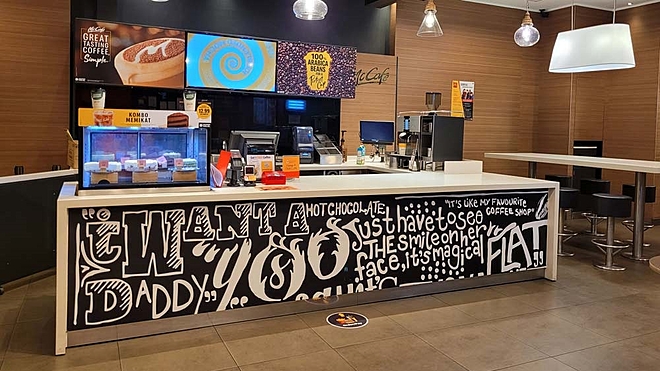

Even though the QSR (quick service restaurant) space is currently grappling with high inflation, waning post-Covid demand and competition from regional players, Westlife Foodworld - the operator of McDonald's franchises in Southern and Western India - remains resilient.
Burger joints stand tall
Westlife has posted the most resilient performance in the first nine months of FY24, compared to established peers
| Company | YoY revenue growth (%) | YoY operating profit growth (%) |
|---|---|---|
| Sapphire Foods India (Pizza Hut & KFC) | 15.0 | -13.0 |
| Devyani International (Pizza Hut & KFC) | 12.0 | -29.0 |
| Jubilant FoodWorks (Domino's) | 5.0 | -26.0 |
| Restaurant Brands Asia* (Burger King) | 19.0 | 11.0 |
| Westlife Foodworld (McDonald's) | 14.0 | -7.0 |
| *The company witnessed a decrease in losses (at both operating and net level). | ||
Westlife Foodworld: Once bitten
Westlife, operating in India since 1996, hasn't always been immune to weakening demand.
Back in FY13, the company's financials were hammered by rising inflation, weak consumer sentiment, and, consequently, lower footfalls on high streets and malls. These resulted in lower output from its stores and turned the company operationally loss-making.

However, the company embarked on a strategic turnaround in 2016. It executed various strategies to revive its flagging business by reimagining store layouts, introducing new products and making off-premises sales.
Below are the strategic initiatives it undertook:
-
McCafe revolution:
Inspired by its global success, Westlife introduced McCafe in India in 2013. It is a premium (and a higher-margin) beverage brand, offering speciality coffee, ranging from cappuccino, latté, iced mocha to frappe, among others.
In addition, the company also added a variety of desserts to its menu, further increasing its high-margin product portfolio.
This move diversified its menu and attracted new customers. Further, it helped increase the share of desserts and beverages (including McCafe) in total revenue from 11 per cent in FY14 to 27 per cent in FY23.
In terms of operational efficiency, McCafe delivers around 12 per cent of a store's sales while requiring just 5 per cent of a store's capex. -
Embracing digital:
The rise of online food delivery platforms proved to be a boon to Westlife and the entire restaurant space. Through its McDelivery service and tie-ups with various online food delivery platforms, the company witnessed a whopping 51 per cent average store sales growth from FY16 to FY23.
It also introduced self-ordering kiosks inside the stores. This initiative offers a smooth customer experience and contributes to increased sales due to increased orders. Westlife's management stated that this segment generates a 30-35 per cent return on incremental invested capital. -
The southern refocus:
The southern states of India (where McDonald's operated its franchises) were lagging in generating business for the company. To tackle this problem, Westlife introduced chicken meals to cater to the predominantly non-vegetarian population in the region.
It launched Fried Chicken, which increased the sales in the southern region by 8 per cent. The company's management believes, going forward, it can grab a good piece out of the Rs 4,000-5,000 crore fried chicken market in the south.
These combined efforts helped Westlife recover from its struggling state and sustain its performance in today's environment.
Westlife's back
How the company's strategies have helped it bounce back in recent years
| Metric | FY16 | FY23 |
|---|---|---|
| Revenue (Rs cr) | 830 | 2278 |
| Store count | 236 | 357 |
| Last 5Y average SSSG (%) | 0 | 22.8 |
| ASS (Rs cr) | 3.9 | 6.6 |
| Operating profit margin (%) | 1.8 | 9.7 |
| Profit after tax (Rs cr) | -20* | 149 |
| ROE (%) | -3.8* | 20 |
| *excluding exceptional gains; SSSG: Same store sales growth; ASS: Average store sales | ||
The anti-thesis
But it's not all blue skies and green grass for Westlife.
Another fast food joint has been slowly emerging: Restaurant Brands Asia , formerly known as Burger King India. Ironically, this young QSR chain, which started operations in 2014, has recorded impressive same-store sales growth and per-store operating margin by replicating some of Westlife's strategies.
The young beats the established chains
Burger King has stolen the march over its peers by leading in the per-store metrics
| Brands | Same store sales growth (%) | Change in restaurant operating margin (%)* |
|---|---|---|
| McDonald's (Westlife Foodworld) | 0.0 | -0.3 |
| Domino's (Jubilant FoodWorks) | -1.8 | (2.7)** |
| Pizza Hut (Devyani International) | -9.8 | -8.1 |
| KFC (Devyani International) | -3.9 | -1.4 |
| Pizza Hut (Sapphire Foods) | -16.0 | -7.1 |
| KFC (Sapphire Foods) | -1.0 | 0.5 |
| Burger King (Restaurant Brands Asia) | 3.2 | 2.4 |
| Data for H1 FY24. *Post Ind AS 116; **EBITDA margins used as insufficient data available to calculate restaurant operating margin | ||
Also, Westlife's royalty payments are set to increase by 50-75 basis points annually starting from FY26 (current levels stand at 4.5 per cent on sales), which can dent the company's margins. The company aims to wrestle this by increasing focus on cost savings and improved operating leverage.
Regardless of the looming headwinds, Westlife's turnaround story is a hat-tip to the power of strategic planning.
Also read: A soaring high Angel
Ask Value Research 

 New episodes every Friday













 New Process Alert
  Seems like you've uploaded a wrong QR code. Please upload the QR code downloaded from MF Central platform.


