




From the pandemic to the Russia-Ukraine conflict, the oil refinery industry has not had it easy. India's only pure-play listed refineries, Mangalore Refinery and Petrochemicals (MRPL) and Chennai Petroleum, were no exception and witnessed a slowdown in their earnings. However, FY23 turned out to be a miracle year, marking an interesting comeback story.
So, let's dive deep into what unfolded and how these refiners managed a well-oiled comeback. But before that, it is important to understand why geopolitical conflict and volatile oil prices impact these industries. Let's have a look.
The challenges of refining oil
Oil refining companies, simply known as oil refineries, purchase crude oil from producers. They then manufacture various byproducts, such as diesel, kerosene, petroleum, etc., and sell them in the market.
While the process sounds easy, refineries face several hurdles. For starters, they cannot maintain reserves for more than a few months. Hence, if there is a sharp drop in crude oil prices, the refineries will be forced to sell their inventories at a loss.
Another challenge that refineries have to grapple with is maintaining a consistent supply. The events of the last few years, such as the COVID-19 pandemic and the ongoing Russia-Ukraine war, have affected crude oil supply chains, leading to shutdowns. Moreover, switching suppliers on short notice is not easy because of the different types of crude oil in use.
Now that you have an overview of the nature of the industry and the hurdles, let's get into the intricacies of how the comeback story unfolded.
Upheavals in the crude oil industry
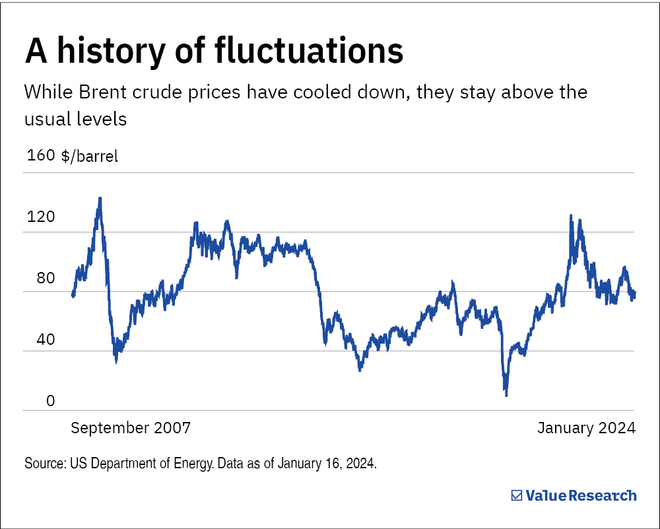
Crude oil prices have seen significant ups and downs in the past decade. For instance, the Global Financial Crisis of 2008 pushed down rates from $140 to $40 per barrel. Two years later, the unrest in the Middle East and North Africa caused crude oil to jump to $100 per barrel.
However, an increase in shale oil production by the US again caused a slump, leading to crude oil selling at $30 per barrel. Finally, the COVID-19 pandemic saw something unprecedented - crude oil rates went into the red in the futures market.
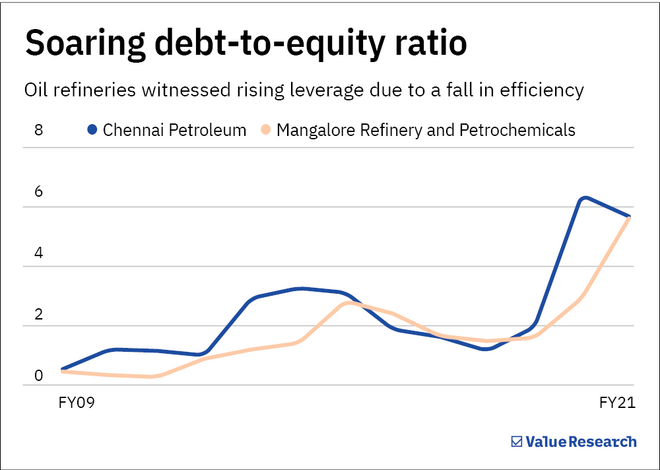
How did these disruptions impact oil refineries? The graph below shows that refining companies reported exorbitant debt-to-equity ratios due to crude oil price volatility.
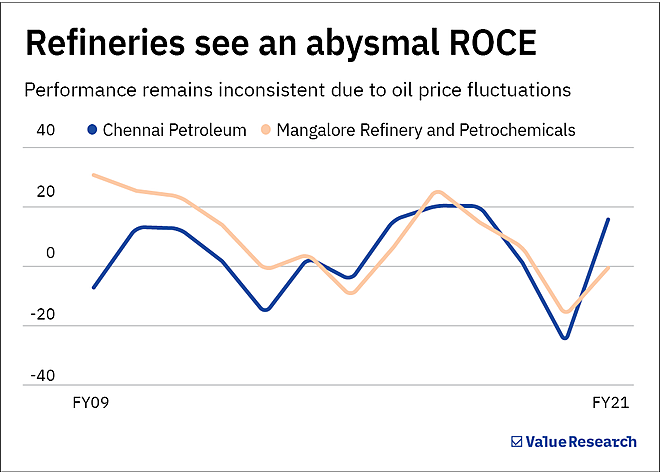
A decline in ROCE (return on capital employed) further led to a downfall in financial performance, which sunk to negative levels between FY19 and FY21.
But as you might have heard, there is light at the end of the tunnel. This is what happened after the pandemic. The refinery companies were about to see the most profitable period in their history.
How it unfolded
As per the International Energy Agency's Global Energy Review 2021 report, the COVID-19 pandemic eroded global crude oil consumption by around 9 per cent. As a result, many refineries paused operations, some even shutting down permanently.
However, what was not foreseen was the strong comeback in demand. While investments were increasingly being poured into the renewable energy segment, the Russia-Ukraine conflict brought it to a standstill. Sanctions imposed on Russia by the US created a supply shortage of crude oil, causing its prices to skyrocket.
Yet, this was short-lived since global supply chains changed trading routes, with the Middle East supplying to Europe and Russian crude making its way to Asia. Subsequently, oil prices corrected to pre-war levels but continued to remain elevated.
What happened next?
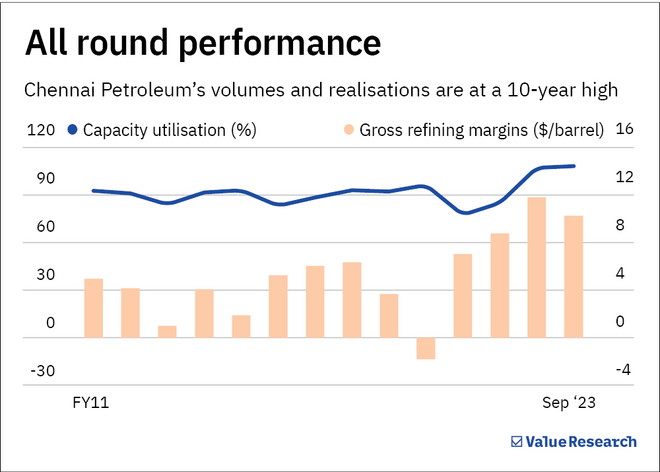
Due to inflated prices and lower production capacities, capacity utilisations of existing oil refineries exceeded 100 per cent. As odd as it may sound, refining companies can extend production beyond their nameplate capacities through upgrades.
Not only did production volumes increase, but realisations also climbed. In the world of the refinery business, this is termed GRM (gross refining margin). GRMs, after staying at a level of around $4 for the last decade, crossed the $10 mark and have sustained it till now.
Russian oil, used to meet European demand, was in oversupply as Europe supported the US sanctions. Taking advantage of such a situation, Asian buyers started purchasing it at a discount ranging from $3 to $8.
The result? MRPL and Chennai Petroleum posted record high revenue, profits and margins, with an ROE (return on equity) of 75 per cent and 31 per cent in FY23, respectively.
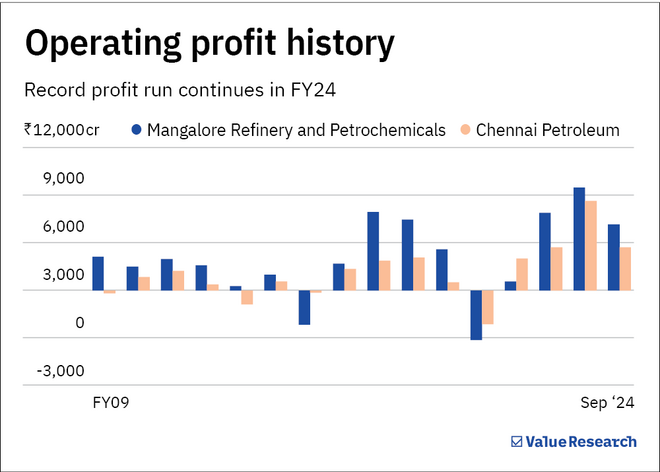
To give you perspective, MRPL's chairman once talked about the impact of a $1 increase in GRMs, which led to a 25 per cent change in their EBITDA (earnings before interest, tax, depreciation and amortisation) numbers. This whole situation has resulted in record profits for this sector with their share prices delivering handsome returns in the past few years.
A word of caution
Although oil refineries are currently riding high on elevated crude oil prices, keep in mind that they operate in a cyclical industry. As a result, they might trade at low P/Es (price-to-earnings ratios) during periods of upcycle. While there have been very few additions to refining capacities, this trend may change soon.
As new entrants slowly enter to gain from the higher margins, the profits of existing players may start narrowing down.
Though crude prices are currently at elevated levels, the true picture of these refineries will be uncovered only when there is a downturn. If a $1 increase in GRMs can positively impact EBITDA by 25 per cent, the same goes for the downturn.
Also read: Five companies that suffered a quality dip
Ask Value Research 

 New episodes every Friday











 New Process Alert
  Seems like you've uploaded a wrong QR code. Please upload the QR code downloaded from MF Central platform.


