






ETFs, or exchange-traded funds, have made quite a name for themselves.
(For the uninitiated, ETFs are a type of mutual funds that are listed and traded on the stock exchanges. Click here to learn more about them).
Therefore, it's no surprise you plan to invest in them too.
But before you do, let us warn you that the pricing dynamics of ETFs can be wild, even for seasoned investors. Let's understand why.
Understanding the pricing disparities in ETFs
ETFs, touted as a cost-effective alternative to traditional mutual funds, are designed to simply mimic an index, such as Nifty and Sensex.
Yet, as it turns out, the world of ETFs isn't always as straightforward as it seems.
That's because, every now and then, ETF trading prices sometimes exhibit significant deviations from their NAVs due to demand and supply in the market. And this difference can have a tangible impact on your returns. Let us show you how.
Case study
Let's consider the
IDBI Gold ETF
.
| Scheme name | Date | NAV (₹) | Closing price (₹) | Price - Nav (₹) |
|---|---|---|---|---|
| IDBI Gold ETF | 11/04/2023 | 5561.08 | 5725.1 | 164.01 |
| IDBI Gold ETF | 08/05/2023 | 5635.35 | 5596.05 | -39.3 |
Trading at a premium
On April 11, 2023, the fund's NAV stood at Rs 5,561.08, but its closing trading price for the same day was Rs 5,725.10. That's a significant difference of Rs 164 between the two figures.
Therefore, if you had purchased units of this fund on that specific day, you would have effectively paid a premium of Rs 164, consequently impacting your profits when you sold that fund later.
Trading at a discount
Let's move forward to May 8, 2023. The situation changes here. On this date, the difference between the NAV and the closing price of the IDBI Gold ETF was -Rs 39, meaning it was available at a discount.
While the discount may have benefitted you at the time of buying, there is no guarantee that even though its NAV rises later, you wouldn't sell it at a further discount. That's because the NAV data is only available the following morning!
Put simply, ETF investors didn't have a clear picture as to whether they were buying and selling ETFs at a premium or a discount, impacting their overall returns until recently...
What you can do
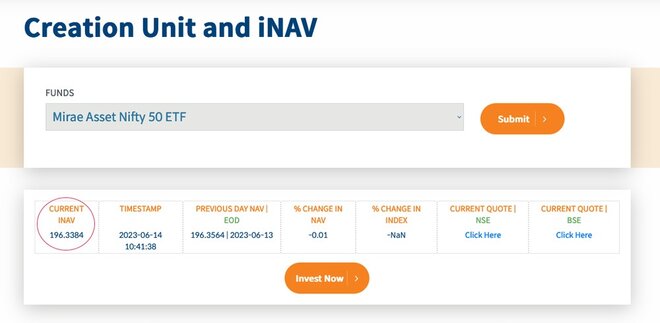
Since July 2022, the Securities and Exchange Board of India (SEBI) has introduced a knight in shining armour: intra-day net asset value (i-NAV).
Through i-NAV, investors can swiftly determine whether an ETF is trading at a premium or discount to its NAV.
With updates every 15 seconds or so during the trading day, i-NAV ensures investors know whether they are buying/selling ETFs at a premium or a discount.
So, where can you find the i-NAV of ETFs?
Visit the particular fund house's website. For example, if you are planning to invest in Mirae Asset Nifty 50 ETF, we'd suggest you visit Mirae's website to figure out the i-NAV, as shown in the screenshot below.
The last word
There you go. Before investing in an ETF, we'd urge you to check the i-NAV. It will help you make smarter investment decisions.
Suggested read: The one thing you must know before investing in ETFs
Ask Value Research 

 New episodes every Friday




 New Process Alert
  Seems like you've uploaded a wrong QR code. Please upload the QR code downloaded from MF Central platform.


