





It's vroom vroom time for exchange-traded funds (popularly known as ETFs) in India. The total market value of its investments has grown five-fold, swelling from Rs 1 lakh crore in 2020 to Rs 5 lakh crore as on March 2023.
Another stat: the number of equity ETFs has nearly doubled from 66 to 131 between March 2020 and March 2023. Much of it is due to the serious attention they are receiving from Indian investors.
Makes sense, too, because they are available at a low cost.
But does that jump head-long into the world of ETFs?
No. While, in theory, ETFs can be bought and sold during market hours, it can be tricky in the real world.
Consider this stat compiled up to March 16, 2023: Of the 131 equity ETFs in India, almost one-fifth have not been bought or sold in 50 per cent of the trading days since January 2022. Worse, 12 of them have never even been traded once. Never!
Now, imagine if you ended up buying one such ETF. You would either be forced to sell your investment at a discount due to low demand (few number of buyers) or not be able to sell it at all, even if you are in dire need of money.
Understanding ETF liquidity
For the uninitiated, liquidity refers to how easy it is to buy or sell a particular investment. If there aren't enough buyers or sellers, what's the point in dabbling in such investments?
Hence the importance of looking at an ETF's liquidity before investing.
The most accessible checkpoint is to look at the daily traded volume.
Look at ETFs with an average daily trading value above Rs 25 lakh. (Trading volume is readily available on NSE and BSE websites). This is an important figure because as of March 16, 2023, only 44 per cent of equity ETFs have touched the Rs 25 lakh threshold over the last three years.
However, although daily traded value tells you the average number of ETFs bought and sold in a single day, it doesn't reveal the entire story.
To get a wholesome picture, you need to look at the nature of investments made by the ETF. Here's how you can do so:
Asset classes
ETFs that invest in equities and fixed-income bonds are generally more liquid.
Those that invest in real estate can be avoided. We all know buying or selling a house can take months, if not years.
Type of index
ETFs that track popular market indices - such as Nifty50 and Sensex - can generally be bought and sold quickly.
But trading ETFs tracking some niche, narrow-focused indices can be challenging.
Profile of companies
ETFs that track prominent, higher-cap companies are often more tradeable.
Other points to remember
In addition to checking an ETF's liquidity, we'd also suggest a couple of other pointers:
- Don't invest in a freshly-issued ETF. Give it some time to see how accurately it is able to track the index. (While it's true ETFs can't be 100 per cent accurate when tracking an index, the error should be as minimal as possible).
- Only consider ETFs that can be bought and sold on most trading days. Maybe you can go with a 90 per cent criteria when assessing ETFs.
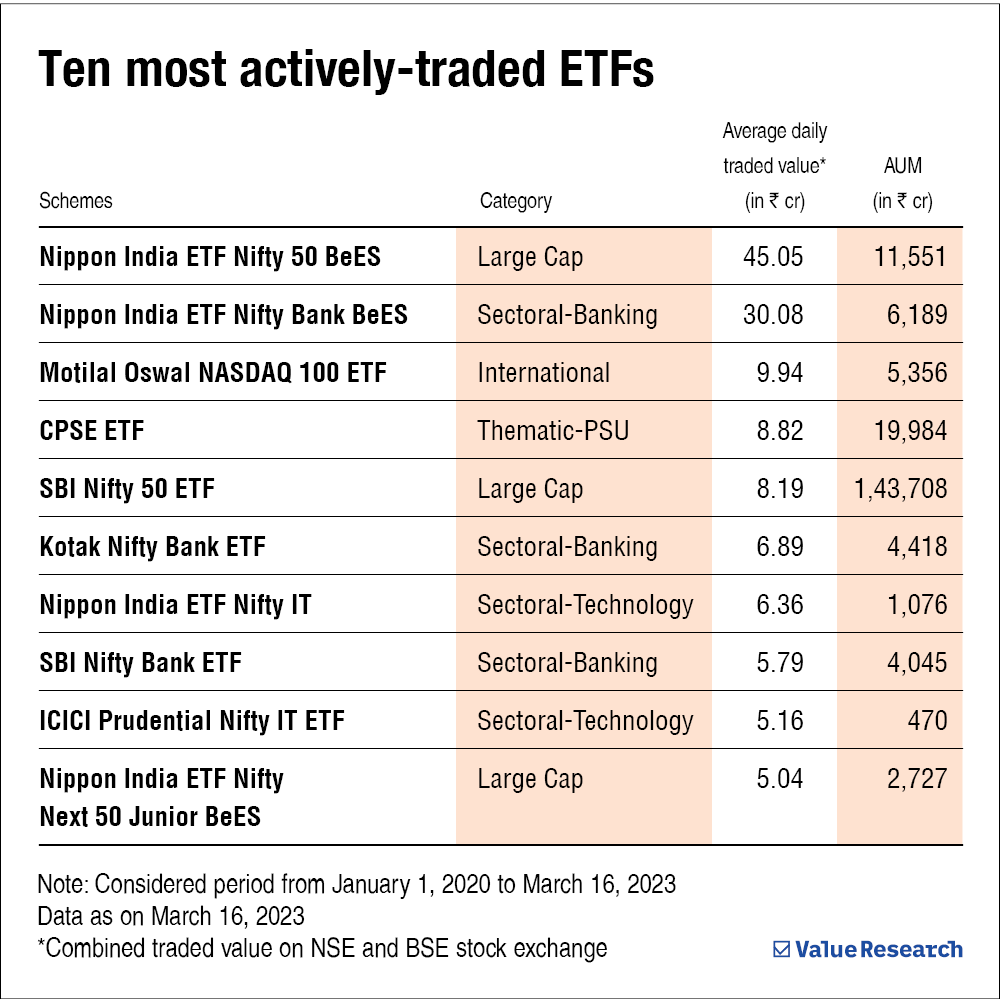
To simplify your life, we have listed India's ten most popular equity ETFs. But then again, many track niche, hyper-focused indices, such as banking, technology and PSU. Remember what we said about narrow-focused indices? You can check 'Type of index' if you don't.
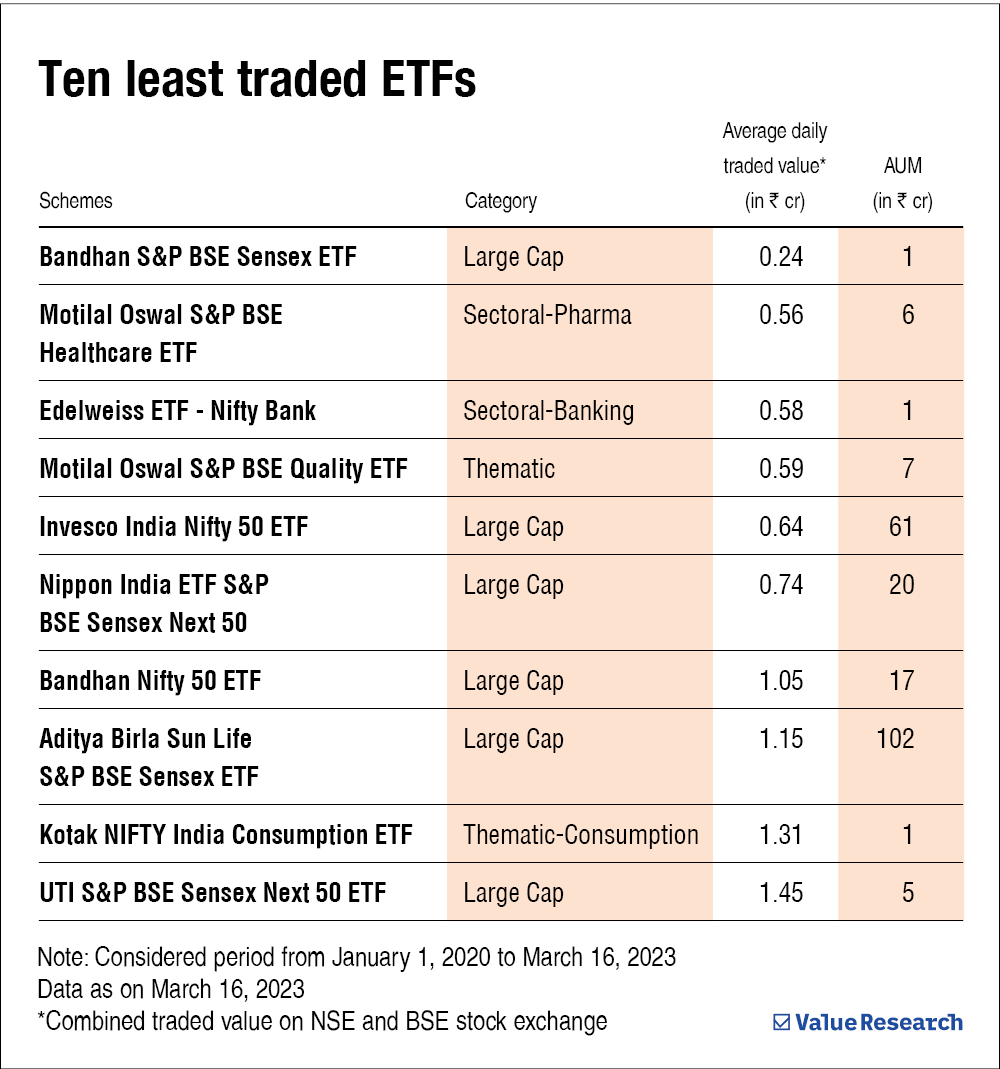
We have also listed ten equity ETFs that are traded the least.
Also read:
How are ETF split units taxed?
Silver funds' pomp and show fails to glow
Ask Value Research 
 New episodes every Friday






 New Process Alert
  Seems like you've uploaded a wrong QR code. Please upload the QR code downloaded from MF Central platform.


