






We are living in times of high-interest rates. Last year, the Reserve Bank of India upped the borrowing rates by 2.25 per cent to tame inflation, the highest hike since 2011. As a result, loans became expensive, our investments got a little nervous, and the media liberally splashed news to feed our fear.
However, a high-interest rate regime is not as bad as it is made to be - especially if you are a debt fund investor.
Let's understand why.
How debt funds work
Debt funds primarily invest in bonds.
Bonds are debt securities and are issued by governments and companies to borrow money from people like us. In exchange, they pay interest.
Let's say the government wants to clean Ganga. To finance this operation, they may raise funds from us in the shape of bonds and pay interest to us in return.
It's similar to how we go to banks, take loans and pay interest to them.
Relationship between bonds and high-interest rates
When the RBI raises interest rates, new bonds start offering higher interest coupons. As a result, the existing bonds that provide lower interest become less attractive. Hence, reduced demand leads to a fall in existing bond prices.
Relationship between debt funds and high interest rate
Scenario 1: If you plan to invest in a debt fund
The best time to invest in a debt fund is when the rates are going up. That's because debt funds would start investing in the newer bonds offering a high interest coupon.
Scenario 2: If you are an existing debt fund investor
When interest rates rise, prices of old bonds fall. At this point, you may witness a slight decline in your debt fund returns, especially if you look at the longer-duration funds. In the graphic titled 'NAV of ICICI Prudential Bond Fund - Direct Plan' here, you can see how this debt fund's value slumped around May 4-5, the day when RBI announced its first rate hike.
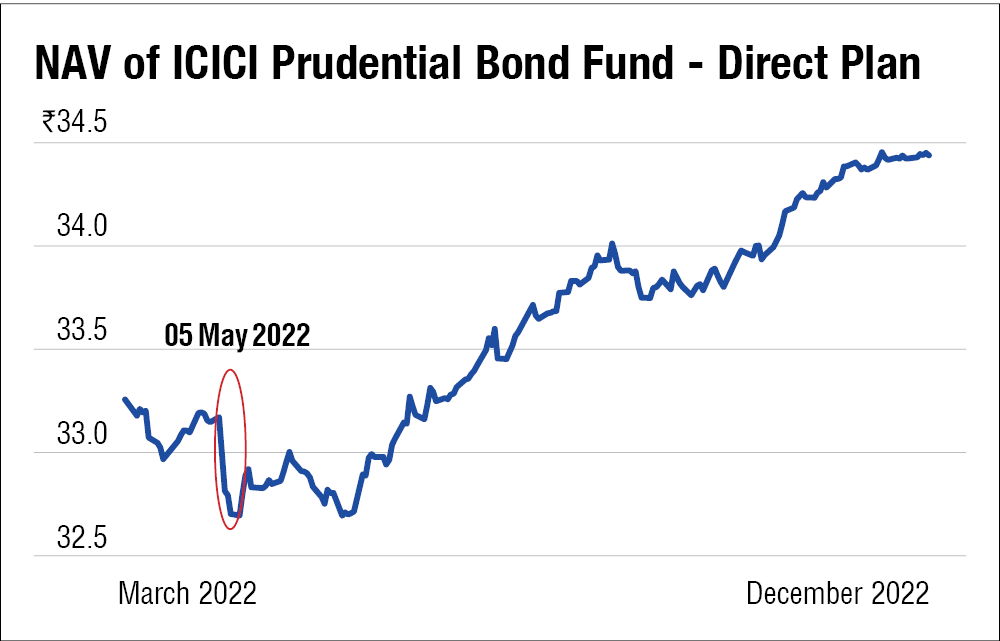
But that's a temporary hiccup.
Debt funds eventually stand on their feet because they start purchasing newer bonds that offer higher returns. In fact, if you are patient and ride over the short-term performance, these funds' indicative yield-to-maturity increases in the long run, as can be seen in the graphic titled 'Yield-to-maturity of ICICI Prudential Bond Fund'.

In a nutshell, this is a good time to invest in debt funds and if you already are, hang in tight as the indicative returns will keep climbing in a rising rates climate.
While other fixed-income securities like fixed deposits (FDs) also look attractive during such times, we feel there is still room for its returns to go up. Hence, we recommend not to park your funds in a long-term FD.
Suggested watch: What to do in a rising interest rate environment?
Ask Value Research 
 New episodes every Friday


 New Process Alert
  Seems like you've uploaded a wrong QR code. Please upload the QR code downloaded from MF Central platform.


