 Widely read:





In an earlier story, we had given a measure of assessing the capital allocation skills of the management. Here is another way of assessing the same by taking the market performance into account. This is important because, over long periods of time, good fundamental performance should translate into good market performance.
It is the $1 test that Warren Buffett wrote about in his 1983 shareholder letter. He said,
"We test the wisdom of retaining earnings by assessing whether retention, over time, delivers shareholders at least $1 of market value for each $1 retained."
Simply stated, this means that Re 1 of profit that a company retains should, over time, translate into at least Re 1 of market value. Buffett applies this on a five-year rolling basis.
Here is an example comparing two companies:

As can be seen, Balkrishna Industries retained a cumulative EPS of Rs 165 over FY17-21. This has translated into a share price change of Rs 1,068 over July 2018-2022. Thus, the value comes out to 6 (i.e., 1,068 divided by 165). This means for every Re 1 retained by Balkrishna, the company delivered Rs 6 of market value.
However, with JK Tyre & Industries, the story is different. With a cumulative EPS retention of Rs 38 over FY17-21, the company did not manage to deliver an equivalent amount of market value to its shareholders. In fact, for every Re 1 retained by JK Tyre, its shareholders got nothing.
Use the two measures (one from the earlier story and Buffett's $1 test) while analysing a company's capital allocation ability.
Now, as with any metric, there are some pitfalls.
- It doesn't tell you whether the company will continue to allocate capital well.
- A good value on this metric doesn't mean that you should invest in the company. This is not an investment evaluation metric.
- Bunching earnings over five years might allow companies with volatile earnings to report a strong value on this metric. So, keep an eye out for that as well.
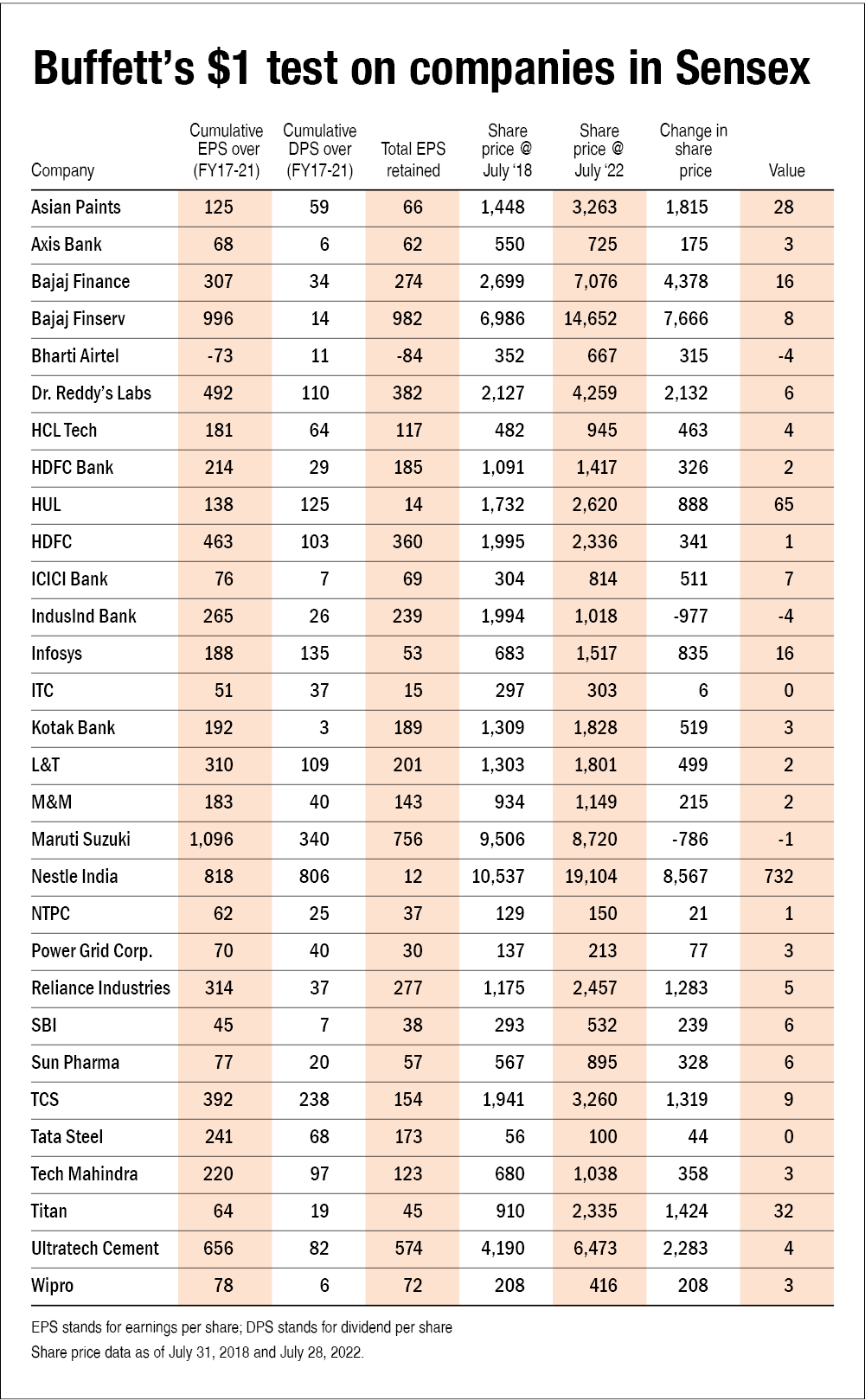
We applied Buffett's $1 test for companies in the Sensex as well. Here is how they fared.
Suggested read:
A simple measure to judge capital allocation
Six parameters to look for in a company before investing
Ask Value Research 

 New episodes every Friday












 New Process Alert
  Seems like you've uploaded a wrong QR code. Please upload the QR code downloaded from MF Central platform.


