




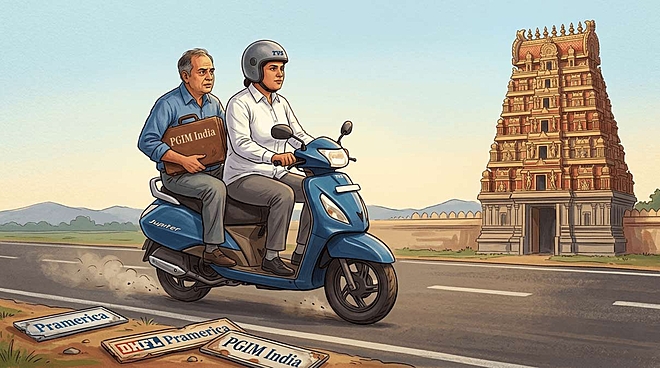
 Aman Singhal/AI-Generated Image

Summary: DLF. Then DHFL. Then PGIM. Now TVS. One mutual fund house, four owners, 19 years. Each chapter taught it something. What happens next is the first genuinely interesting question.
TVS Venu Group will acquire Prudential Financial’s entire stake in PGIM India Asset Management. The deal, announced April 2 and subject to regulatory approvals, hands the Chennai conglomerate a mutual fund business managing over Rs 30,000 crore across 25 schemes. If you are a PGIM India investor, this will be the fourth time the nameplate on your fund house changes.
The name trail
Prudential Financial of the US (not the UK’s Prudential plc) came to India through a joint venture with DLF in 2007. It could not use its own name here because ICICI Prudential had already claimed it, so the Indian entity became “Pramerica.” The fund obtained its SEBI registration in May 2010, with Prudential Financial as the sole sponsor, and launched quietly. Nobody paid much attention. One thing worth noting: Prudential was the sponsor from day one. DLF and later DHFL were JV partners, not sponsors. The fund house was not orphaned between unrelated owners, the way the name changes might suggest.
By 2013-14, DLF was in trouble and exited. DHFL stepped in. The fund became DHFL Pramerica Mutual Fund in October 2015, and almost immediately acquired Deutsche Bank’s Indian asset management business for about Rs 400 crore. Deutsche had over Rs 25,000 crore in AUM, mostly debt. Overnight, DHFL Pramerica went from being one of the smallest AMCs to managing Rs 25,400 crore. Global parent, local partner, inherited Deutsche debt portfolio. It looked like something could be built here.
Then DHFL fell apart
The IL&FS collapse in 2018 triggered a liquidity crisis in the NBFC sector, which ultimately hit DHFL as well, compounded by issues of fund diversion. The rest is well known.
Prudential, to its credit, moved fast. In December 2018, before the worst had played out, it announced a buyout of DHFL’s 50 per cent stake. By July 2019, DHFL Pramerica had become PGIM India Mutual Fund. The fund house lost Rs 2,200 crore in AUM in one quarter as investors ran from the DHFL name, but the AMC was never at risk. Mutual fund assets sit in a separate trust.
Seven years, no scale
Under full PGIM ownership, the fund house stabilised. It did not grow. AUM stayed around Rs 27,000-30,000 crore, roughly where the combined business had been a decade earlier. After-tax losses crossed Rs 23 crore by March 2025. Meanwhile, the industry crossed Rs 80 lakh crore. PGIM India ranked around 25th.
I have been tracking this fund house for years. At Value Research, we rate only one of their 25 schemes five stars: the Liquid Fund, ranked 3rd out of 32. Five funds carry a “Sell” from our analysts, including the Large Cap (63rd of 67 over three years), the ELSS Tax Saver (33rd of 34), and the one-star-rated Small Cap. Look at where the money actually sits. The Midcap Fund, Rs 10,877 crore, ranks 34th of 35 over three years. The Flexi Cap, Rs 6,004 crore, ranks 51st of 59. Two funds, two-thirds of the equity corpus, are in the bottom quartile. The Ultra Short Duration Fund (1st of 11 over ten years) and the Flexi Cap’s ten-year rank of 6th of 29 suggest a longer record that recent years have undone, but the broad picture is of a fund house where distribution never reached critical mass and equity performance did not give investors a reason to stay.
To be fair, the equity AUM story is not all bleak. Equity assets grew from just Rs 958 crore in March 2020 to over Rs 23,000 crore by April 2026. Investors did come in. The problem is that most of that money went into the Midcap and Flexi Cap, which now sit in the bottom quartile of their categories. These categories themselves have gone through a challenging phase. The fund house attracted capital during the boom. It has not yet shown it can keep it through a difficult stretch.
No surprise that Prudential hired EY in January 2026 to find a buyer. Groww and Edelweiss were among the bidders.
A new kind of owner
TVS Venu Group is Venu Srinivasan’s conglomerate. TVS Motor Company, India’s third-largest two-wheeler maker. TVS Credit Services, already a sizeable NBFC. An asset management licence is the logical next step. What matters to me is that TVS brings something none of PGIM India’s previous partners ever brought: permanence. This is a century-old industrial family. Venu Srinivasan sits on the board of Tata Sons and is vice-chairman of Tata Trusts. This is not a partner that will default on its bonds or sell the family silver to meet repayment obligations.
What should you do?
If you hold PGIM India funds, nothing changes right now. Your units, NAV, folio: all stay as they are. Once SEBI approves, TVS takes over as the sponsor, and the schemes are renamed. Again.
Will the new owners invest in distribution? Will they keep the investment team? Will they have the patience to build scale where four predecessors could not? I don’t know. These things get answered over three to five years, not in a press release. But for the first time in this fund house’s history, the new owner is not a partner of convenience, a distressed seller, or a global giant with one foot out the door. That counts for something.
The mutual fund industry moves fast. Ownership changes, rating shifts, fund manager exits. Staying on top of what it means for your portfolio takes more than following the news. For insights that cut through the noise, keep reading Value Research Online.
Ask Value Research 
 New episodes every Friday










 New Process Alert
  Seems like you've uploaded a wrong QR code. Please upload the QR code downloaded from MF Central platform.


