





This renewable fuel, made from sugar, sugarcane, molasses, maize and damaged food grains, has been under the government's consideration for over 15 years. With the launch of the Ethanol Blended Petrol (EBP) programme back in 2003, the government wanted to reduce its dependence on crude oil and lower carbon emissions. The programme aimed at a blending target of 5 per cent, which means mixing 5 per cent ethanol with 95 per cent petrol.
Although the government's focus has remained on electric vehicles (EVs), it will take some more years to replace the internal combustion engine (ICE) with EVs. Hence, the government has planned to ramp up ethanol production. Later, with the launch of the National Policy on Biofuels, the government increased the blending target to 10 per cent now and 20 per cent by 2025. At present, the blending rate in India is pegged at 8.5 per cent, wherein 332 crore litres of ethanol is blended and this is set to increase to 1,016 crore litre by 2025-26.
In line with the growing demand for ethanol, the government has been offering various incentives for higher ethanol production. These include a price hike for ethanol procurement and a reduction of the GST rate on ethanol used for blending from 18 per cent to 5 per cent. As estimated by the government, a successful E20 program (blending 20 per cent ethanol) can save Rs 30,000 crore in import bills.
In focus: Praj Industries
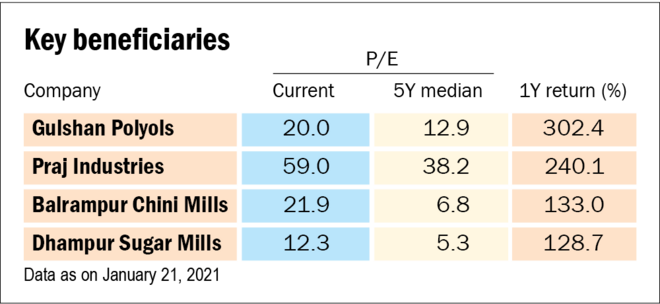
The growing demand for ethanol has paved the way for sugar companies to capitalise on this opportunity. Besides, some other companies, for example Praj Industries, are likely to benefit from this trend. Established in 1984, the company is involved in providing technologies and solutions that are used for the production of biofuels, such as ethanol, biodiesel, compressed biogas (CBG) and other biofuels.
A leader in its industry, Praj Industries commands a market share of 60 per cent. Its product portfolio comprises bio-energy plants, high-purity water systems, zero-liquid discharge plants, breweries for alcohol, among others. It is one of the few companies in the world that develops second-generation ethanol technology. This technology primarily uses rice and wheat residues, cotton stalks and cane trash for the production of ethanol.
Apart from domestic clients, the company has customers in more than 75 countries and its technologies are used to produce 8 per cent of the global ethanol production. At present, India's capacity to produce ethanol is pegged at 784 crore litre, which is expected to double in the next five years to cater to the growing ethanol demand. All these are likely to increase the demand for the company's products and services.
Besides, ethanol blending has also been mandated in many countries, including Brazil, the US, the European Union, China and Thailand, to name a few. So, there has been a consistent uptick in the inquiries and order intake for the company. In Q2 FY22, the company reported its highest ever order backlog and order intake of Rs 2,235 crore and Rs 735 crore, respectively. With a high order backlog, the company has guaranteed its revenues for the next few years, which will translate into higher profitability aided by operating leverage.
Also in our 'Top trends to profit from in 2022' series:
Top trends to profit from in 2022: Return to normalcy
Top trends to profit from in 2022: Clean energy & pollution control
Top trends to profit from in 2022: PSU divestment
Top trends to profit from in 2022: China plus one
Top trends to profit from in 2022: Digital disruption
Top trends to profit from in 2022: Electric vehicles
Top trends to profit from in 2022: Artificial intelligence and machine learning
Top trends to profit from in 2022: 5G & Telecom revival
What to avoid in 2022: Cryptocurrency, NFTs and Blockchain
Ask Value Research 

 New episodes every Friday













 New Process Alert
  Seems like you've uploaded a wrong QR code. Please upload the QR code downloaded from MF Central platform.


