





Over the last few weeks, in every market around the globe, we have seen stunning volatility. Often when people use the word 'volatility', they mean 'decline' but what we are seeing are wild swings, with both days when the markets fall violently and then the very next day, rise ferociously. This is a clear symptom of the underlying condition - the economic impact of the COVID-19 disease is a complete unknown at this stage and will probably remain unknown for quite a while.
Of course, the overall direction is strongly downwards. Since January 2, 2020, around the time the sharp virus-related market turmoil really started, the Sensex is down 25.74 per cent (as on April 21, 2020) and the average multi-cap fund has lost 22.20 per cent. Elsewhere in the world too, markets have been impacted. On Wall Street, the Dow is down 19.34 per cent and the NASDAQ 100 is down 3.78 per cent. Moreover, the uncertainty of the overall economic impact will last for a considerable time. While the growth phase of the disease is over in China, the impact on the Chinese economy and global supply chains won't be known for many months to come.
At this stage, the bigger worry is that in India and elsewhere in the world, the disease spread is just beginning. What will happen is still a complete unknown. The impact could be deep but short, or it could be long and shallow, or anything in between. Some industries will experience one kind of impact, some another. For example, it's pretty clear that travel and passenger transport will be in bad shape. Some industries will have supply shocks, some demand shocks and some both. Some will recover quickly. There could be some positives too eventually. For example, if India escapes the brunt of the virus, then global companies that wish to diversify from overdependence on Chinese supply chains may shift some business to India. Even so, at this stage, many investors are close to panic. No one likes uncertainty, and this looks like a bad case indeed.
So what should an investor do? How can we make sense of all this? The answer is that you don't need to. Here's why.
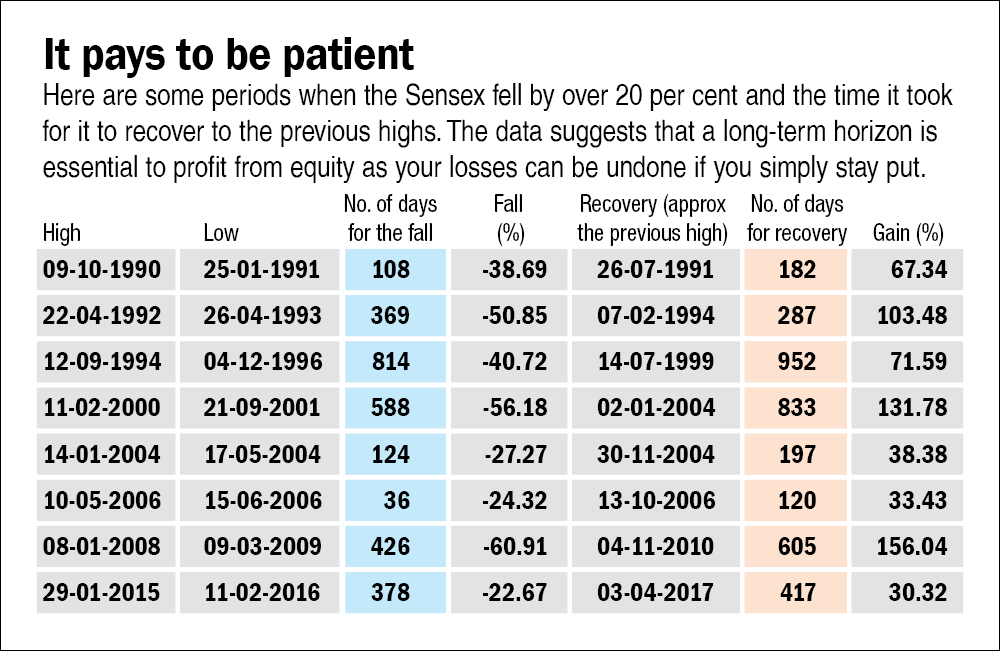
For the moment, put aside the actual cause of this particular decline. The fact is that for some reason or the other, we have had plenty of sudden and sharp declines in the equity markets over the decades. There is always something happening and equities are reacting to it. Look at just the last two decades - the dot-com crash and the 2007-09 global financial crisis are just the two big ones. There have been a total of 17 occasions since October 1990 when the Indian equity markets have fallen by about 15 per cent or more within a week (five trading days). In any case, even before virus fears hit the financial markets, Indian markets were grappling with the NBFC crisis, with IL&FS, DHFL and its many other aspects. Yes Bank also added fuel to the virus fire.
There's nothing abnormal about this. It's the normal state of things in equity investing - if it's not one thing, then it's the other. And that's fine. If there's a moral in this story, it's that the markets always come around and investors who keep a cool head always get good returns, provided they keep their emotions in check, their instincts bottled up and act rationally.
The rationality checklist
Here's a list of biases that you must keep under control if you are to come out of this crisis - or any other crisis - with your savings and investments in good shape.
Loss aversion: Seeing your portfolio go down provokes an instinctive response: 'let me sell out to avoid more losses'. This results in your paper losses turning into real losses. If you had sold out your fund during any of the market corrections described earlier, you would have surely missed the wealth-creating opportunity that later unfolded. Loss aversion has a dual impact. Once you have sold out, you don't feel confident enough reentering the market later, thus resulting in lost opportunity.
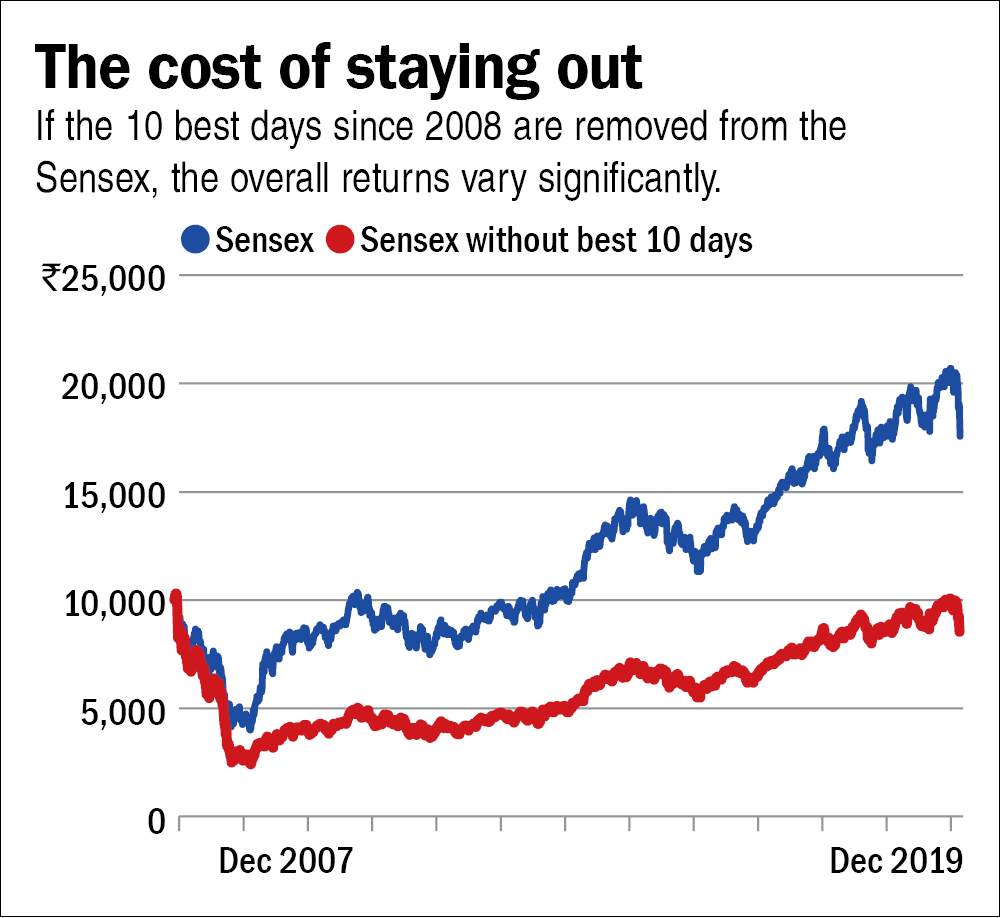
Bandwagon effect: Bandwagon effect follows from the notion 'if everyone's doing it, let me also do it'. So when everyone seems to be selling, you also sell out. Following the crowd gives instinctive, instant relief but it can cost you in the long run. The markets often sharply rebound after a correction. If you have sold out, you won't be able to take advantage of the sharp rise. This can impact your overall returns over the long run. The graph below depicts that if you had stayed out of the market on the 10 best days for the market since 2007, your overall returns would have been significantly lower.
Short-termism: Equity investing entices some investors because they want to make a quick buck. If the markets are falling, such investors sell out to avoid any losses. They again try to time the market as it begins to rise. Such timing is not just difficult but it can cause more harm than good.
Value Research has long maintained that equity investing is for the long term, that is five years and above, and the secret of success in equities is to be patient. See the table below
'Smart' switching: When the markets fall, some investors tend to convert their otherwise long-term investments into cash or invest them in safer avenues such as FDs and debt funds. They think that when the fall has been arrested, they can enter the market at lower levels, thus boosting their returns. What seems like a 'smart' move in the short run often results in a lost opportunity.
Illusion of control: Many investors find it difficult to digest the fact that their 'well-picked' funds are now falling. Investors ask us how a top-rated fund can fall so much. This makes them lose confidence in their funds. This doesn't have to be so. Markets are volatile by nature and no one can avoid that volatility. Just because your fund has fallen doesn't mean there is some problem with it.
Your panic-control action plan
Step 1: Manage your emotions
The worst mistake you can currently make is act in haste. Don't sell out just because the market is falling. Understand that volatility is a part and parcel of the market and it is there to stay. It is this volatility that boosts your long-term returns.
Step 2: Continue with your investments
Don't stop your systematic investment plans (SIPs). SIPs do best when the market falls and then rises. The SIPs that you do now will help you bring down your overall cost of investment, thus boosting your returns.
Step 3: Stick to your asset allocation
Your asset allocation is your lighthouse. Stick to it. Rebalance your portfolio according to it. Don't shun equity. Shift from debt to equity as per your asset allocation. If you have mid- and small-cap funds in your asset mix, don't quit investing in them just because they appear riskier in the current phase.
Step 4: Don't go overboard
Don't make the mistake of going overboard with your investments. While it's true that market corrections provide you an opportunity to average your investment cost, this should be done as per a preset plan and asset allocation. Getting too excited can result in disproportionate allocations, greater anxiety and missed opportunity should the market fall further.
Step 5: Avoid exotic/ fancy investments
Stay away from sectoral/thematic funds or any other investment that seems to appeal in the current scenario. Many market fads become popular from time to time, but their appeal diminishes soon. It's best to stick to plain-vanilla multicap funds and allocate a portion to mid- and small-cap funds if your asset allocation permits you to.
Step 6: Don't ignore your overall financial plan
Your financial plan has many pillars; investments in mutual funds are just one of them. Don't compromise on the other elements of your financial plan. Maintain a sufficient emergency corpus. Get adequate health insurance for yourself and your family. Buy a good term plan. If you already have them in place, ensure their continuity.
This article was originally published on April 24, 2020.
Ask Value Research 

 New episodes every Friday










 New Process Alert
  Seems like you've uploaded a wrong QR code. Please upload the QR code downloaded from MF Central platform.


