





Market moods hinge much on investors' sentiments and expectations, which are largely influenced by various economic events and news. If studied closely, a classic investor behaviour is to curtail investments in the volatile market. For example, the current market - marred by a lot of red flags in terms of credit blowup, downgrades and declining macro-economic situation - has put investors in a dilemma.
Even back in 2018, investors faced the same sort of dilemma when the reintroduction of the LTCG tax in equity mutual funds in the first half of 2018 led to a knee-jerk reaction in the market. Adding to the stress was the NBFC (non-banking financial company) crisis in the latter half of 2018, which saw a build-up of liquidity and credit issues following the default of the IL&FS (Infrastructure Leasing & Financial Services) group. This event resulted in investors reducing their investments.
The following graph depicts these two incidents. The grey bars represent the gross lump-sum inflows into equity-oriented mutual funds. The reintroduction of the LTCG tax led to a fall of as much as 50 per cent in gross contributions from lump-sum investors. These contributions further halved during the NBFC saga in the last quarter of 2018.
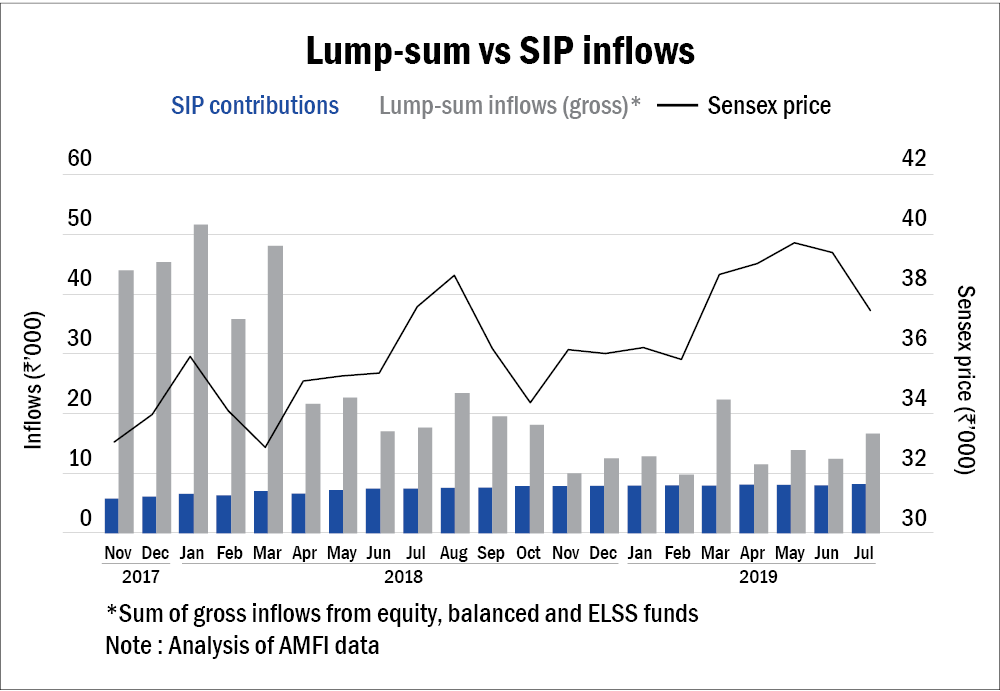
Undoubtedly, 2018 was a volatile year, while 2017 was unusually calm. Cut to 2019, the market has been swinging wildly against the backdrop of the ongoing US-China trade war. Also, other domestic events like FPIs (foreign portfolio investors) withdrawals because of tax surcharge and scanty growth and poor corporate results are unfolding. Given all these, market uncertainty is less likely to subside in 2019.
Then, is there any strategy to benefit from the market volatility? Yes, there is and it is none other than good-old systematic investment plans (SIPs). The latest data by the Association of Mutual Funds in India (AMFI) underlines the growing faith of SIP investors in equity markets (look at the blue bars in the above-mentioned graph). On the other hand, lump-sum investors are staying out of the market, while the market is presenting opportunities to invest for subsequent gains.
With a total of Rs 8,324 crore contributions to SIPs in July 2019, SIP investors have remained unfazed by the current market gymnastics. More so, monthly inflows from mutual fund SIPs have continuously risen despite the ongoing correction in the markets.
SIPs help you navigate your way, as they provide you with the well-known benefit of rupee cost averaging. As an investment strategy, rupee cost averaging helps you eliminate the risk of rising or falling markets. It ensures that you accumulate more units of an investment when the markets fall and less when they rise; thereby averaging your purchase costs over a period of time.
Continuing with your SIP for long eases the impact of volatility on returns. Besides, an SIP comes with several other benefits, which boost the confidence of retail investors - as seen in the mounting SIP inflows.
For investors, SIPs are the most efficient and convenient way to invest in equities. As an investment tool, they seamlessly fit into the earning cycle of a retail investor, thereby enforcing discipline on investing. Spreading investments over a period of time, SIPs also help investors avoid the possibility of catching the market high.
Although buying low and selling high is an appealing investment strategy, one cannot always time the market and predict the future in the long run. This is where SIPs fit into investors' requirements. Over a long period of time, they help you leverage the volatility by investing across all market phases. All you need to do is to have patience to stay invested even during market uncertainty. It will ultimately help you achieve your long-term goals.
So, if you haven't started your SIP yet, the time is now!
Ask Value Research 

 New episodes every Friday









 New Process Alert
  Seems like you've uploaded a wrong QR code. Please upload the QR code downloaded from MF Central platform.


