




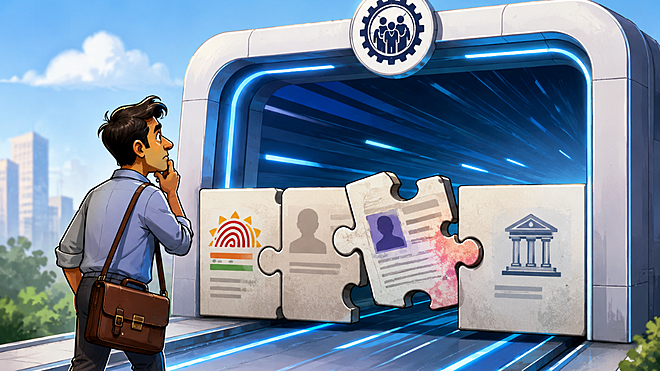
 Khyati Simran Nandrajog/AI-generated image

Summary: EPFO's headline promise of instant PF withdrawals comes with a catch that most coverage has missed, and the reason many claims fail has nothing to do with speed. This piece sorts the announcement into signal and noise, and lays out the one thing every PF member should do before the facility goes live.
If you have money in the Employees’ Provident Fund (EPF), here is what matters. A faster way to withdraw is coming, and it is useful. It is not live yet. There is no launch date and no withdrawal limit of its own. Most failed PF claims fail because the member’s records do not match, and a new button will not change that.
The most useful step available today is to get your records to agree. Nothing else is required until the facility launches.
In one line: Faster withdrawal is coming, but a claim will clear only if your name, date of birth, Aadhaar, PAN and bank details match. Check them now.
What EPFO 3.0 is
The Employees’ Provident Fund Organisation (EPFO) holds the retirement savings of more than 30 crore members in a system dating back to the paper era. Member data is stored in regional offices rather than in a single central database, so transfers and claims move slowly and portal errors are common. EPFO 3.0 replaces this with a single, banking-style platform.
Most of what was announced is back-office work: one system across offices, a new employer return, a central pension payout. None of it needs anything from you. Two changes affect you directly.
Signal and noise
The same news, sorted by whether it changes anything for you.
| The change | What it means for you | Signal or noise? |
|---|---|---|
| Withdraw via UPI or a PF-linked ATM card | Take eligible PF money out quickly, paid into your bank account, with no office visit. | SIGNAL, once live |
| Auto-settlement limit raised to Rs 5 lakh | More eligible claims clear on their own, in days, with no manual handling. | SIGNAL |
| Unified IT (CITES) and central pension (CPPS) | Should make transfers and pension payouts faster in time. Nothing for you to do. | BACKGROUND |
| The word ‘instant’ in the announcements | No launch date, no separate UPI or ATM limit, and the old withdrawal rules still apply. | NOISE, for now |
How the faster withdrawal works
You confirm your identity with an Aadhaar-linked one-time password (OTP), choose UPI or an ATM, and the eligible amount reaches your bank account. The rail uses the NPCI network, the same infrastructure behind everyday UPI. The facility has two limits.
- You can draw only on the eligible share of your balance. A floor stays locked, so your retirement savings cannot be emptied in one go.
- EPFO has not set a separate per-transaction limit for UPI or ATMs. Until it does, the existing rules decide how much you can take, and for what.
The second point is missing from most reports. Fast access applies only to money you can already withdraw. The facility does not relax the withdrawal rules.
The problem a button does not solve
The announcements are about speed. Most claims do not fail for lack of speed. They often fail because EPFO cannot match the member to the record.
EPFO’s own annual report shows the scale. In 2024-25, members filed about 796 lakh claims and close to 174 lakh were rejected, one in five. Over the five years to 2024-25, the rejection rate averaged about 26 per cent. It peaked near 29 per cent in 2021-22 and has eased since, to about 22 per cent in 2024-25, but remains well above levels seen in the mid-2010s.
Complaints to EPFO’s online grievance system crossed 17 lakh in a single year. Nearly half were in four areas: transfers that do not go through, final withdrawals, KYC problems at the PF office, and unsettled advances.
Why claims fail: A leading cause is a small mismatch in the member’s data, such as a name spelt differently across documents, a date of birth that does not match Aadhaar, an unverified bank account, more than one UAN or an exit date an old employer never marked. A new interface changes none of this. The fix is in your own record.
Why you will see two very different rejection numbers
You may also read that rejections have fallen to under 1 per cent. The two numbers count different things. EPFO’s low figure covers a narrow slice, claims bounced at the employer or office stage in a recent window, and reflects auto-settlement, under which eligible claims now clear in three days. The one-in-five figure covers all claims over a full year, including rejections and returns.
Auto-settlement is real progress, and the trend is improving. A claim with mismatched records will still be rejected.
What to do now
Before launch, make your records agree. The checks take a few minutes on the member portal.
- Activate your UAN (Universal Account Number). Confirm you have only one. Extra UANs are a common, fixable cause of failure.
- Match your KYC (Know Your Customer) details. Name, date of birth, and father’s name should match across Aadhaar, PAN, and EPFO.
- Verify your bank account and IFSC code on the member portal. Keep your mobile number linked for the OTP.
- Check the exit date for any old job is marked by that employer. An unmarked exit blocks transfers and withdrawals.
Do these four and you are ready on the day UPI withdrawal starts in your region. Leave them undone and the same mismatches will hold up your claim.
Also read: EPFO 3.0: The ATM revolution that isn't
This article was originally published on July 02, 2026.
Ask Value Research 

 New episodes every Friday








 New Process Alert
  Seems like you've uploaded a wrong QR code. Please upload the QR code downloaded from MF Central platform.


