


 Anand Kumar/AI-Generated Image
Summary: NSE’s newest index hands stock pickers a ready-made list of fast-growing companies, and its rules make sure a rising share price alone can’t get a business in. But one question never makes it into the scoring, and the bigger a company gets in the index, the more that question matters.
NSE launched the Nifty500 Growth 50 on August 26, 2026. While funds tracking it are yet to be launched, a stock investor can use it today: it is a ready-made list of 50 fast-growing Nifty 500 companies. It comes with one catch. On October 30, the index traded at 38.5 times its companies’ earnings. The Nifty 500 traded at 21.
How a company gets in
Each company is scored on three factors: sales growth over three years, profit growth over three years, and the share’s return over the past year, adjusted for price swings. Companies in the bottom quarter for either sales or profit growth are excluded, so a rising share price cannot carry a slow-growing business.
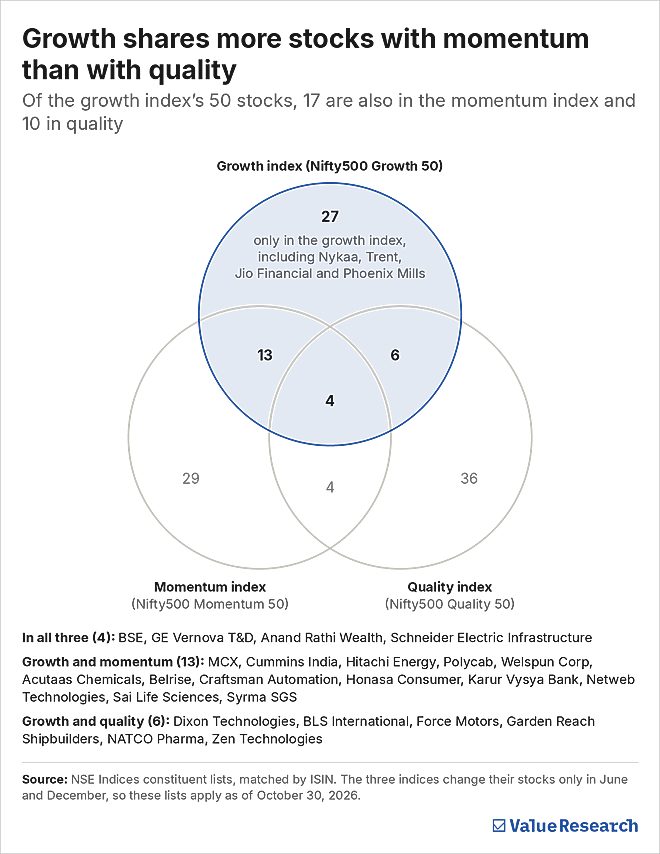
It does help, though. Seventeen of the 50 stocks are also part of NSE’s Momentum 50, which picks on price alone. If the two lists were unrelated, you would expect about five in common. Only ten are in the Quality 50.
Two kinds of business fill over half the index: capital goods makers (27.7 per cent) and financial firms (27.4 per cent), both close to the 30 per cent cap on any one sector. The financial names are not the big banks. HDFC Bank and ICICI Bank are absent; in their place are two stock exchanges, a broker, a wealth manager and smaller lenders. Both groups have had the capex cycle and the trading boom behind them, and cycles turn.
What it never checks
Nothing in the score looks at valuation. And because each stock’s weight depends on its market value as well as its score, the more the market pays for a company, the more of it the index holds. Its largest holding, Nykaa, trades at 391 times earnings.
The last column of the table turns that into a number you can use. It shows how many times a company’s profit must multiply, with the share price unchanged, for its P/E to fall to the Nifty 500’s 21. Nykaa’s profit has to grow about 19-fold. Lloyds Metals is nearly there. For the index as a whole, profits must rise 83 per cent.
What the price asks for
The ten largest holdings, ranked by P/E
| Company | Weight (%) | P/E | Sales growth (% a year) | Profit growth (% a year) | Profit must multiply by |
|---|---|---|---|---|---|
| Nykaa (FSN E-Commerce) | 5.95 | 391 | 25 | 102 | 18.6x |
| Trent | 4.88 | 85 | 35 | 64 | 4.0x |
| Jio Financial Services | 4.47 | 82 | n.m. | n.m. | 3.9x |
| GE Vernova T&D India | 4.27 | 79 | 31 | n.m. | 3.8x |
| Phoenix Mills | 4.48 | 55 | 19 | 2 | 2.6x |
| Multi Commodity Exchange | 5.76 | 53 | 65 | 108 | 2.5x |
| Cummins India | 4.23 | 52 | 16 | 24 | 2.5x |
| BSE | 4.79 | 51 | 77 | 129 | 2.4x |
| Dixon Technologies | 4.91 | 36 | 59 | 86 | 1.7x |
| Lloyds Metals and Energy | 3.93 | 22 | 72 | 148 | 1.0x |
| P/E is trailing 12 months, as of October 30, 2026, on results published by that day’s close. Weights from NSE as of October 30, 2026. Growth is compound annual, consolidated except GE Vernova T&D (standalone), over the three years to March 2026. “Profit must multiply” is P/E divided by 21, the Nifty 500’s P/E on October 30. n.m.: not meaningful. Jio Financial Services was demerged from Reliance Industries in 2023; GE Vernova T&D made a loss in 2022-23. Source: NSE Indices, Value Research. | |||||
Using it
Treat the Growth 50 as a shortlist, not a buy list. For any name on it, ask the three questions the index doesn’t. Did the growth start from almost nothing, as GE Vernova T&D’s did after a loss in 2022-23? Will the cycle behind it last? And how many times must profits multiply before today’s price looks ordinary?
Also read: Low volatility didn't protect
Ask Value Research 







 New Process Alert
 Seems like you've uploaded a wrong QR code. Please upload the QR code downloaded from MF Central platform.


