


 Anand Kumar/AI-Generated Image
Summary: If you have held the Nifty 50 for five years, your return probably feels thin. Yet the companies inside the index kept up their end of the deal. So where did the gains go? The answer sits in a number most investors never check before they start, and it changes what your SIP is buying today.
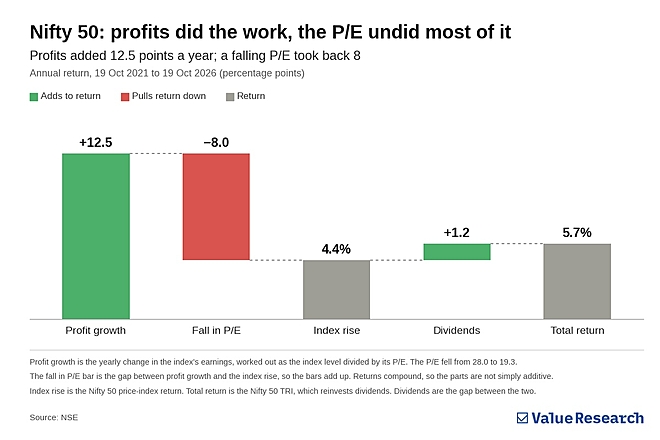
If you put money in the Nifty 50 five years ago, you have earned 5.7 per cent a year. That is a poor return. But the companies in the index did not let you down. Their profits grew 12.5 per cent a year. What hurt you was the price you paid for those profits in October 2021. That price is now a lot lower.
On 8 October 2026, the Nifty fell to 22,180, its lowest level in a year. On 19 October, you could buy it for about 19 times what its companies earn in a year. Over the last five years, the usual figure has been about 22.
Profits did the work. The price you paid undid most of it
Your return from an index like the Nifty comes from three things. First, how fast the companies’ profits grow. The second is how much investors will pay for those profits. This is the price-to-earnings ratio, or P/E: the rupees you pay for every rupee of yearly profit. The third is dividends, the cash companies hand out.
Here is how the three worked out from 19 October 2021 to 19 October 2026. Profits grew 12.5 per cent a year, or 80 per cent in all. But the P/E fell from about 28 to about 19. In October 2021, you paid Rs 28 for every Rs 1 of profit. Now you pay about Rs 19.
That fall wiped out 8 of the 12.5 points of profit added. The Nifty itself rose just 4.4 per cent a year. Dividends added another 1.2 points. Put them back in, and you get 5.7 per cent a year.
October 2021 was an expensive time to start
These five years begin a day after the Nifty’s highest close up to that point. Prices were high, and so was the P/E.
When you pay 28 times profits, the companies have to do two jobs for you. They have to grow. They also have to hold up a price that has little room left to rise. When the P/E fell, most of the profit growth went into making the index cheaper, not into your pocket.
SIP investors felt this too. Rs 10,000 a month for these five years, Rs 6 lakh in all, is worth about Rs 6.8 lakh today. That is 4.9 per cent a year.
A cheaper start helps. It is not a promise
Starting at 19 times profits removes one big drag on future returns. If the P/E just stays where it is, your return will roughly match profit growth plus dividends.
This tells you where you start, not where you end. Profits can grow more slowly. The P/E can fall further, as it has for most of this year, from about 22 in January. No one, including us, knows which way it will go.
What the last five years do not show is a broken index. The companies did well. The poor return came from the high starting price.
Your SIP is now buying at a lower price
An SIP started in October 2021 needed profits to do double duty. At today’s price, it does not. Each instalment now buys the same companies for about 30 per cent less per rupee of profit.
That is a reason to keep your SIP going, not to stop it. Just don’t expect the next five years to look like the last five, good or bad.
Also read: The index next door
This article was originally published on October 23, 2026.
Ask Value Research 












 New Process Alert
 Seems like you've uploaded a wrong QR code. Please upload the QR code downloaded from MF Central platform.


