


 Anand Kumar/AI-Generated Image

Summary: Low-volatility index funds promise a calmer ride when markets turn rough. This year put that promise to the test. The rule that picks their stocks looks at one thing and ignores a lot else, and that gap says more about these funds than their name does.
Low-volatility index funds are sold as a smoother way to own shares. This year, they were not. The two indices that choose stocks only for low volatility lost as much as, or more than, the markets they track.
The low-volatility indices fell further than their markets
Down 11.6 and 9.8 per cent from their peaks; their markets, 10.9 and 8.7
| Index | Fall from peak (%) | One-year return (%) |
|---|---|---|
| Nifty100 Low Volatility 30 | 11.6 | −9.6 |
| Nifty 100, the market it picks from | 10.9 | −9.3 |
| Nifty500 Low Volatility 50 | 9.8 | −8.1 |
| Nifty 500, the market it picks from | 8.7 | −7.2 |
| Nifty Alpha Low-Volatility 30, which also picks recent winners | 10.5 | −8.8 |
| Nifty 50, for reference | 12.5 | −10.9 |
| Peak is each index's highest close in the 12 months to 21 October 2026, reached in January or February 2026. Fall from peak and one-year return are both measured to 21 October 2026 and include dividends. | ||
We look closely at only two indices for a reason. Eleven index funds and exchange-traded funds follow them, and both pick stocks for low volatility alone. NSE has other indices with low volatility in the name, but only one, the Nifty Alpha Low-Volatility 30, has funds tracking it. It also looks for stocks that recently beat the market, so it is not a pure test. As the table shows, it held up a little better than the Nifty 100. No fund in India follows NSE's other low-volatility indices. BSE has its own version, which three funds follow; this story sticks to NSE.
The rule looks only at last year's prices
Both indices pick stocks by one measure: how much their prices swung over the past year. The Nifty100 Low Volatility 30 takes the 30 steadiest stocks in the Nifty 100 and gives the steadiest the biggest weight. It reviews the list every quarter. The Nifty500 Low Volatility 50 picks 50 from the Nifty 500 and changes its list every June and December.
Neither rule checks what a company earns or what its shares cost. A stock that was steady last year gets in, whether or not it stays steady.
Steady consumer stocks had the worst year
The rule loaded the Nifty100 Low Volatility 30 with companies that make soap, biscuits and cigarettes. People buy these in good times and bad, and their shares had moved little. At the end of September 2025, ITC, Hindustan Unilever, Britannia and Nestle India made up 15.3 per cent of the index. Consumer companies like these were 7.7 per cent of the Nifty 100. The chart shows how far the index's mix differed from the market's.
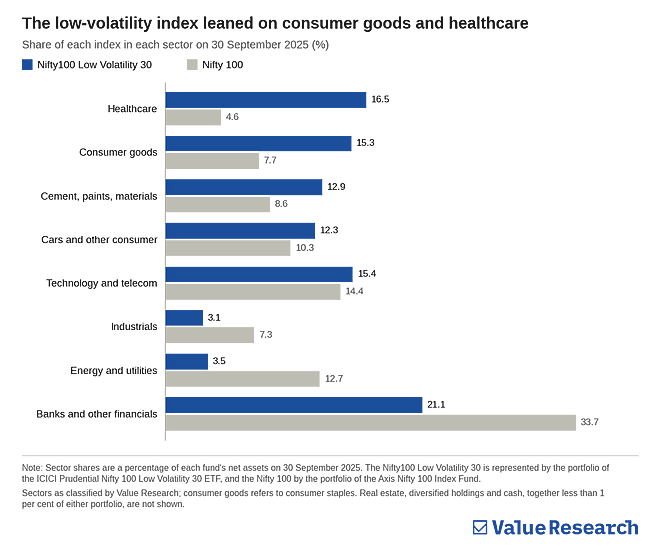
That bet went wrong. The Nifty FMCG index, which tracks such consumer companies, lost 22 per cent over the year, more than twice the Nifty 100's fall. ITC's shares fell 36.6 per cent and Britannia's 22.8 per cent.
The index also held more healthcare stocks, 16.5 per cent against 4.6 per cent in the Nifty 100, and the Nifty Healthcare index rose 3.6 per cent. That helped, but not enough to keep the index ahead. Its smaller share of banks and other financial companies made little difference, as the Nifty Financial Services index fell about as much as the Nifty 100.
The name describes last year, not the next fall
The label tells you how a fund's stocks behaved last year. In 2026, consumer goods, one of the groups the rule favoured, had the worst year of any major sector.
If you hold one of these funds for a smoother ride, check its monthly portfolio. The sectors it holds say more about how it may hold up in the next fall than its name does.
Also read: Cheap isn't enough
This article was originally published on October 28, 2026.
Ask Value Research 












 New Process Alert
 Seems like you've uploaded a wrong QR code. Please upload the QR code downloaded from MF Central platform.


