 Widely read:




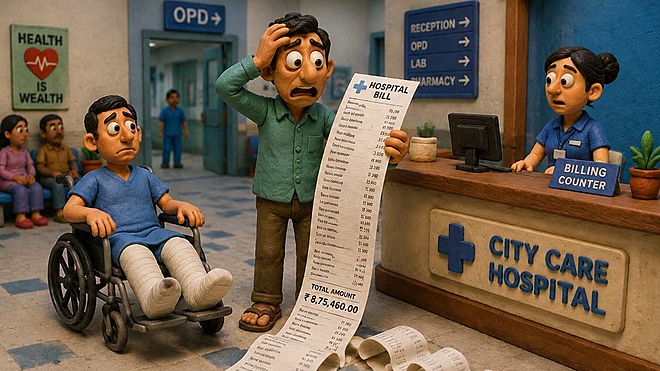 Anand Kumar/AI-Generated Image

Summary: Most people discover how their health insurance actually works at the worst possible moment. A new model promises to fix that. The conflict hasn't been eliminated. It's just moved somewhere you can't see it.
Most people discover how their health insurance actually works at the worst possible moment. A relative in the hospital bed. A bill being trimmed at the counter. And an insurer somewhere in the chain looking for reasons to pay less.
That moment arrived for thousands of families in August 2025, not because of a claim dispute, but because of a contract one. The Association of Healthcare Providers of India, which represents over 20,000 hospitals, told north India members to stop cashless treatment for Bajaj Allianz over frozen rates and unpaid deductions. A truce came within days. But the lesson stayed. The cashless facility most of us assume is guaranteed can disappear between buying a policy and needing it.
This is the system working as designed.
A fight built into the system
The conflict is structural, not accidental. Insurers earn by paying less. Hospitals earn by billing more. They fight over every line item, and you stand between them at the moment you can least afford to. According to IRDAI's 2024-25 annual report, insurers rejected about 8 per cent of the 3.26 crore health claims they handled, roughly one in 12. Of every rupee claimed, about 71 paise is paid out. A family can win the argument over admission and still lose nearly a third of the bill.
And you pay for the fight twice. At the counter, and again at renewal. Health insurance premiums rose about 9 per cent in 2024-25. But most of that rise came from higher prices, not new buyers. So you are paying more each year for cover that is harder to use.
The potent solution?
This is the gap the managed care model is designed to fill. Rather than refereeing the conflict between insurer and hospital, what if the same company ran both?
Aditi is a health insurance plan from Narayana Health Insurance, the insurance arm of Dr Devi Shetty's hospital chain. It covers surgeries up to Rs 1 crore and non-surgical treatment from Rs 5 lakh to Rs 20 lakh, depending on the variant you buy.
The logic turns the old model on its head. A conventional insurer treats your claim like a fire insurance payout, something unlikely to happen, to be denied where possible. The managed care model assumes the opposite. Over a lifetime, illness is a certainty. The company is paid to expect it, not avoid it. Its incentive is to keep you well and treat you efficiently inside its own network, where your claim is not contested because there is no one to contest it with.
What is the catch?
It is a clever answer to a real problem. But the conflict has not been eliminated. It has been relocated.
With a conventional policy, the hospital pushes to do more and the insurer to pay less. That tug-of-war is ugly. But it is also a natural check. It ensures treatment is adequate and costs are scrutinised. When one company is both your insurer and your hospital, the same tension survives. It is just settled internally, between your treatment and the company's margin, out of your sight. That raises a legitimate question about whether treatment decisions get shaped by cost considerations you will never see.
The network constraint matters too. The promise of frictionless care holds only inside the network, which today means primarily Narayana's own facilities in select cities. Step outside—for a specialist, an emergency, or because you live somewhere the network does not reach—and ordinary rules apply. You are back where you started.
Should you buy it?
Managed care is worth watching. For the right person, the appeal is real.
It works well if you live near a network hospital, dread claim paperwork and want predictable care for a generally healthy family. It works less well if you live outside the serviceable cities, want to choose your own hospital or specialist, travel frequently or manage a condition that needs a particular centre of excellence.
One rule holds regardless of which plan you choose. Do not drop a conventional health policy for a network plan. A low-friction product is not a complete one. This model fixes the friction you can see. Whether it actually serves you will show up in the claims data over the next few years. That will take time to read.
Also read: Investing for the long term on a salary of 35k
This article was originally published on June 18, 2026.
Ask Value Research 


 New episodes every Friday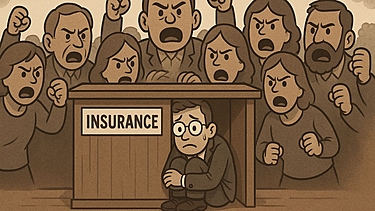










 New Process Alert
  Seems like you've uploaded a wrong QR code. Please upload the QR code downloaded from MF Central platform.


