




 VRO Team
Summary: Three years after HSBC bought L&T Mutual Fund for Rs 3,200 crore, CEO Kailash Kulkarni answers hard questions on lost market share, a struggling Small Cap fund and middling debt performance, while laying out how HSBC differentiates in a crowded industry and its ambition to break into the top 10.
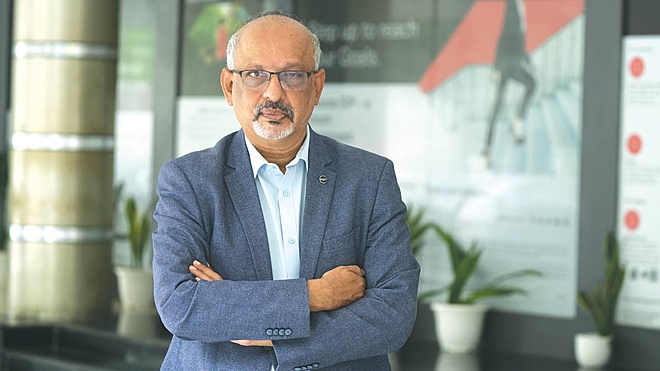
Kailash Kulkarni, the then CEO of L&T Mutual Fund, then took charge of HSBC Asset Management’s mutual fund business here. Three years after India’s largest fund house acquisition, the CEO of HSBC Asset Management India answers for the scorecard: the lost first year, the small-cap stumble, the middling debt funds, and a stated ambition to break into the top 10.
In December 2021, HSBC Asset Management agreed to buy L&T Mutual Fund for $425 million, about Rs 3,200 crore. It is one of the largest acquisitions in Indian mutual fund history. Twenty-five lakh folios changed hands, 25 schemes were merged or renamed and a fund house managing over Rs 72,000 crore ceased to exist.
Kailash Kulkarni ran that fund house as CEO. He had built it through two acquisitions of his own, DBS Chola in 2010 and Fidelity in 2012. Then he sold it, and then became chief executive of HSBC Mutual Fund. He’s the only person in Indian asset management to have been on both sides of a fund house sale, three times over.
Three years after the merger, Dhirendra Kumar spoke to him about what has been built since: what investors who stayed actually got, how the combined house runs today, how a distinct product gets made in a commoditised industry and where HSBC Mutual Fund intends to stand five years from now.
Edited excerpts.
L&T Mutual Fund bought Chola Mutual Fund in 2010 and Fidelity Mutual Fund in 2012, built L&T Mutual Fund to Rs 72,000 crore and sold it to HSBC Asset Management. Give us the whole journey. Why did the sale happen, and what does it take to fold 50 schemes and two investment teams into one fund house?
I could possibly be the only person who has done three acquisitions and seen them from different sides of the table. In any such deal, three things matter. First, people. At its core, the mutual fund business is about people. Beyond fund performance, everything rests on the teams, so taking care of people comes first. Second, operations. The customer must not feel any change.
The deal is done at the corporate level, and the customer will rightly ask why they should be impacted for it. Seamlessness is the test. Third, communication: explaining what will remain the same, what will change and how it benefits them. Get these three right, and the rest follows. When L&T Mutual Fund bought Fidelity Mutual Fund, it was the exact reverse. L&T Mutual Fund was about Rs 3,400 crore, and Fidelity Mutual Fund was nearly three times its size. A smaller fund house bought a bigger one. This time, the bigger group was the buyer.
Three acquisitions, seen from every seat at the table. What do sellers get wrong, what do buyers get wrong and what should an investor do the day her fund house is sold?
I do not think sellers get it wrong. There can be structural reasons, global reasons. What matters is the buyer getting it right. If the next decade or two belongs to India, you must decide how fast you want to scale, and acquisition is one way. When L&T AMC wanted to exit, HSBC AMC saw the right fit. The move complemented HSBC’s ambitions for the asset management business and gave it the scale, reach and capabilities to capture India’s growing asset management market. It was a win-win.
As for clients, and I count distribution partners as clients too, they want to know three things: Will there be continuity? Will the teams managing the fund remain? Will the house’s philosophy change? That is why communication is critical. We could demonstrate that much would remain the same. Look at the redemptions; there were hardly any exits. People paused initially, until they saw that things were exactly as we had said.
Start with the investor who held both fund houses in 2022 and did nothing. Three years on, is the investor better off than if the merger had never happened?
Most investors are better off in fund performance, in value proposition and in the number of differentiated products we have brought to the table. Since the merger, we are nearly 1.9 times larger in assets. More importantly, we have grown our client base.
Your AUM has doubled, but the industry grew faster. HSBC’s market share is lower today than the two funds’ combined share in 2022. You bought scale and lost share. What went wrong?
After an acquisition, the transition usually takes time to adjust before you scale up. For instance, the distribution partners associated with L&T AMC had to re-establish themselves in the joint entity. The people, the products, the processes were the same. However, sufficient time has to be given to ensure seamless integration. Did it take a long time? The answer is yes. But the conviction built over that period is showing now. Over the last year, our market share of net sales has grown much faster than the industry’s.
The funds investors love in your stable today – Midcap, Value, Multi Cap, Equity Savings, ELSS – are all L&T funds with new nameplates. What has HSBC Asset Management added?
Look at what we have launched since the acquisition: a multi-asset fund, a multi-cap fund the India Export Opportunities Fund, the first of its kind, a differentiated financial services fund and now our SIF. Our ability to use HSBC’s global strength to design differentiated products is the addition. And it shows in the existing funds too.
Something tangible. Name one fund where the HSBC AMC process demonstrably improved outcomes after the merger.
It is not one fund. Understand the process today. Say a conflict breaks out somewhere in the world that touches minerals and metals, and I want to know how that supply chain will affect India. I don’t rely on a third party; I reach out to our analyst in that region. The equity team has structured fortnightly and monthly calls with the global team. The fund manager is responsible for the final portfolio, but today’s input quality is global.
Let us get specific about a star. Small Cap was the jewel of the stable. It lost 10.6 per cent in 2025 and sits in the bottom quartile over three years. Size problem, process problem or market problem?
We remain true to the SEBI categorisation for all our funds. Regulations permit some variations, but would you want your fund to look like what it says on the label, or not? We prefer to be true to the label. You may take the brunt for two or three quarters, but the recovery, when it comes, is just as fast. In the last six months, as the broader market recovered, we are right in the top quartile. From 2012 to 2026, we have had 11 good years. We remain confident in our style of investment strategy.
And size is not a concern. Rs 17,800 crore would have worried me 10 years ago. Today, small caps start where mid caps used to start. The universe itself has grown.
Your debt funds are almost all middle of the pack, and our analysts rate Medium Duration an ‘Exit’. Has the fixed-income engine changed, or just the names?
Our investment philosophy remains unchanged, and so does our rigorous investment process. While fixed income markets have been very choppy and volatile through this calendar year, our focus has been on limiting downside risks given the heightened geopolitical uncertainty.
The majority of our funds have, over the years, been positioned as very high credit quality funds, with 100 per cent AAA / Sov exposure, and that remains unchanged. Our aim is to consistently be in the top half versus peer groups over time, which, if we achieve, we believe will make us a top quartile performer. Some investors chase yield; others chase quality. The quality chasers stay with us.
Who runs the money today, and what has actually changed in how it is run?
We have an experienced fixed income investment team, with an in-house macroeconomist, experienced credit team, portfolio management and dealing team. We continue to maintain the same high standards in terms of our core investment philosophy, true-to-label fund positioning and management and, most importantly, a rigorous credit research process backed by our own internal ratings for every name in our universe.
On equity, the CIO leads the team, but each fund manager has their own decision-making path and is evaluated accordingly. Four principles. We are true to label. We refuse to be a me-too player. We do not hug the benchmark; we hold plenty of stocks outside it. And we are bottom-up stock pickers who believe in the India structural story, so we sit heavier on mid and small caps than most. The aim is the top two quartiles consistently, not top-decile performance. Consistency is the bigger win for the client.
AUM has always been an output and never an input. If you do the right things, AUM will happen. MFDs will continue to have a very large role. Assets that come through a distributor stay longer, because there is handholding when times are rough.
The prize in this deal was distribution: 55,000 distributor relationships across 58 cities. How many are active and producing today?
We have added another 10,000 distributors since, so it is nearly 65,000 now. Our overall reach has also increased since the acquisition.
Is the MFD your growth engine, or is digital eating it?
MFDs (mutual fund distributors) will continue to have a very large role. Assets that come through a distributor stay longer, because there is handholding when times are rough, and SIP stoppages are lowest in that channel. The pure digital channel has far more transactions, but the money is younger and smaller, and it stays about a third as long. Both channels will grow. Whoever adds more value wins.
Three years in, what’s the one metric on your dashboard that tells you this merger is working: flows, share, performance or something else?
Performance is basic hygiene. Without it, even your best sales and service teams will fall short, so I don’t count it in the evaluation. What matters to me is whether the number of clients is rising. AUM has always been an output and never an input. If you do the right things, AUM will happen. So, my dashboard is the number of distributors, the investor count and how efficiently we handle customer queries.
Now to the arena itself. There are 1,500 funds, and every category has 20 to 80 near-identical ones. In a commoditised business, what makes a product genuinely distinct, and how do you build one?
You have touched the topic closest to my heart. We do far fewer NFOs than most fund houses. In India, NFOs collect a lot of money, but we do not believe that is the way to do it. If you do an NFO, do it differently. Three examples. The BFSI index is split 50-50 between lending and capital markets. We believe the capital markets were growing faster. So, we launched at 80-20 in favour of capital markets. It has more allocation to non-lending themes such as capital markets, mutual funds, insurance, wealth management, depositories and does not necessarily follow a benchmark-hugging strategy to create a differentiated portfolio. With this approach, we are outperforming the other BFSI funds.
Second, exports. Two years ago, the government was signalling free trade agreements. We defined an exporter to capture this growth trend by investing in export-oriented companies having export revenue of more than 20 per cent. The universe shrinks to only those companies, across sectors and across market caps. We launched; the tariffs came, the whole pack fell, and the recovery in the last year and a half has been very strong. We are still the only fund in the category.
Third, our SIF. If it is a me-too copy, we are just adding to the clutter. We are not going to add to the clutter. We have a differentiated strategy where we combine fixed income with equity arbitrage, REITs and INVITs. Our focus remains on maintaining a measured approach to risk while seeking to generate consistent risk-adjusted outcomes across market cycles. And recently, we crossed the Rs 1,000 crore AUM, which demonstrates the confidence investors have placed in us.
Your SIF takes no direct equity, runs arbitrage, REITs and bonds and promises an FD-plus return with equity taxation. If its main edge is its tax label, what happens when the tax law changes?
The Redhex hybrid long short SIF invests across multiple asset classes, viz. equity arbitrage, REITs, INVITs, government securities, bonds and securitisation, with the aim of providing more stable returns, with less sensitivity to broader equity markets.
Tax efficiency is just one more advantage of this category that all hybrid SIFs benefit from, rather than the main reason. In fact, our SIF crossed Rs 1,000 crore in August, within just two months of the NFO, clearly showing that investors and advisors appreciate the unique positioning of this fund.
Every global name before you left India: Fidelity, Morgan Stanley, Goldman Sachs, JPMorgan, Deutsche, ING. You bought one of those exits yourself. What makes HSBC’s commitment durable, and what protects the Indian investor if the head office changes its mind?
The answer lies in how critical India is to HSBC. Outside our two home markets, the UK and Hong Kong, the group has named four priority geographies, and India is one of them. India is among the top contributors to group profit. If you observe closely, the historically laggard states are now growing faster than the national average. Some of our global products that invest in India have grown three-fold in three and a half years, right through the headlines about FII selling. Some of the marquee names that left are already rumoured to be planning a return.
Where does HSBC Mutual Fund stand five years from now? Give us a number you are willing to be measured against.
Everyone tracks AUM, and our intent is clear: we want to be a top-10 player in India. The gap is significant, but we are moving in the right direction. We still have a lot to bring here. Globally, we have other strategies that we could bring. We are barely in passives, with four index funds and a gold ETF, so that is open space. And GIFT City will also be a big opportunity for us.
We don’t like where we are today. We want to climb the charts.
Is there another L&T-style consolidation coming in Indian asset management, and would you bid?
We are focused on growing organically, while we will remain open to opportunities.
SIPs have crossed record levels while returns have disappointed.
What breaks the SIP habit, and what are you doing before that day comes?
About 50 per cent of new SIPs enter the industry through fintech or digital broking platforms, so you must engage there with education and analytics. What matters is the quality of the SIP; you do not want it stopping after six months. Our own SIP book has doubled in the last three years, though we remain a small share of the industry’s book.
Three years from the merger: one thing you got right, one thing you would do differently and one promise honoured.
The promise first. We promised every investor a seamless experience, whether they came from HSBC MF, L&T MF or both, and we delivered. Nobody asks us who we are any more when we travel the country.
I feel what we could have done better is tell the larger population of partners and investors who we are and what our funds have done. What we got right is performance and service. Most of our schemes are in the top two quartiles over three years, and large partners rate us among the top for service standards.
Ask Value Research 


 New episodes every Friday











 New Process Alert
  Seems like you've uploaded a wrong QR code. Please upload the QR code downloaded from MF Central platform.


