




 Ujjal Das/AI-Generated Image
Summary: A man who once certified his net worth at Rs 40,562 crore settled claims of Rs 22,006 crore for Rs 6.5 crore. The headline number is misleading. The vote that approved it, and who cast those votes, is the more instructive story.
On Tuesday, the National Company Law Tribunal allowed Subhash Chandra, who invented Indian satellite television and once certified his net worth at Rs 40,562 crore, to settle claims of Rs 22,006 crore against him for Rs 6.5 crore. The "99.97 per cent bank haircut" circulating since is a misreading. The order settles one man's estate, and what it shows about the estate, the voters and the law is stranger than the headline.
Chandra borrowed none of this money in his own name. The claims rest on personal guarantees he signed for Essel group borrowings, and the case began with one of them, a facility of about Rs 170 crore that Indiabulls Housing Finance had extended to a company called Vivek Infracon. Indiabulls moved the tribunal against the guarantor in 2022. The Supreme Court froze all personal-guarantor cases for two years while it examined the law; the petition was admitted in April 2024, and then every lender holding a Chandra signature joined the queue. The queue reached Rs 22,006 crore.
The order prices his estate, and only his estate. The borrowing companies remain liable for their loans, and by Chandra's own account, roughly Rs 43,000 crore of the group's Rs 45,000 crore of borrowings has been repaid since January 2019. Under the approved plan, creditors share Rs 6.25 crore, and the process costs another Rs 25 lakh. LIC Housing Finance, with an admitted claim of Rs 1,322 crore, is slated to receive Rs 38 lakh. Three paise on the rupee, from a man the tribunal accepts is today worth Rs 31.79 crore, most of it one mortgaged house in Mumbai.
The vote deserves more attention than the haircut. The plan passed on 1 November 2024 with 80.8 per cent of the votes cast. Read the yes column. World Crest Advisors, 28.5 per cent of the voting share. Lemonade Capital, 16.9. A CINDA fund voting through Catalyst Trusteeship, 11.9. Corpcall Capital, 10.3. Veena Investments, 5.0. Direct Media Distribution, 1.2. Veena is controlled by the wife of Chandra's brother Jawahar Goel, and World Crest and Direct Media sit in the same family tree. The banks told the tribunal that five of these names were associates of the debtor whose votes should never have counted. The no column, with Axis, HDFC, Canara, RBL, Union Bank's UK arm, LIC Housing and Franklin Templeton's trustee, mustered about 19 per cent. Indiabulls, which started the case, voted yes with its 1.98 per cent.
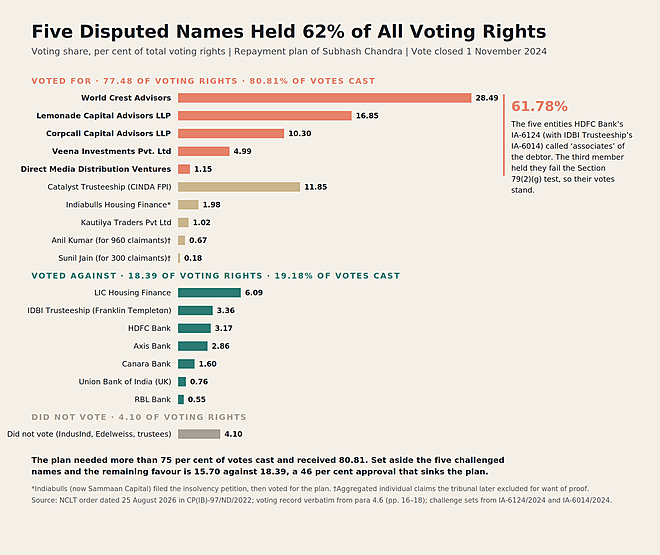
The bench itself split, one member for the plan and one against, so the tribunal's president sent the file to a third judge, Nilesh Sharma, whose 144-page opinion decided the matter on August 25. His central holding reads Section 79(2)(g) of the Insolvency Code exactly as the legislature wrote it. An "associate" is a person the debtor controls or majority-owns. Family proximity and commercial entanglement do not qualify. The statute won over the smell test, and every promoter-guarantee file in the country now carries that precedent.
On the wealth question, the order is candid. A certificate given to RBL Bank in 2017 put Chandra's worth at $7.17 billion. One given to Canara Bank in 2018 put it at Rs 40,562 crore. The estate before the tribunal in 2024 came to Rs 31.79 crore. The judge wrote that the collapse "raises a question", found no proof of concealment, and held that the Code nowhere makes a forensic audit a precondition for approving a plan. Chandra said at a press conference on Friday that the old certificates counted the group's market value as his personal wealth, and that his Rajya Sabha declaration of 2016 showed about Rs 39 crore. He asked the finance minister to appoint an independent auditor of the group's borrowings and repayments. He added that he flies to Switzerland in a week or two to meet a friend who invests.
There was theatre too. On Thursday his office blamed vested media houses for sensationalising the order. By Friday he was naming Mukesh Ambani and Network18, saying he had called, written, and got nowhere, and that he has "nothing left to lose". Reliance replied through the stock exchanges the same evening, in the tone of a man declining a duel. It was dismayed; the remarks were baseless, its media brands have never been used to attack anyone, and it holds Chandra in high regard and wishes him well.
The lesson for investors sits below the noise. In 2017 and 2018, lenders accepted a signature because a signature was cheap, and they never took charge of the assets behind it. A personal guarantee without a lien is priced on the day it is signed and paid on the day it is tested. This week the country saw the test. HDFC Bank is examining an appeal at the NCLAT, so the litigation may run on. The price of the signature has already been set: Rs 38 lakh against Rs 1,322 crore.
Ask Value Research 

 New episodes every Friday






 New Process Alert
  Seems like you've uploaded a wrong QR code. Please upload the QR code downloaded from MF Central platform.


