




 Anand Kumar/AI-Generated Image

Summary: A great business is only half of an investment decision. The other half is often overlooked, especially when excitement is high. This piece examines why paying the wrong price can undo even the strongest business story.
Everything a shareholder could have hoped for went right this year. The American law meant to hand Indian drug-makers a decade of Western work passed. Rival contract manufacturers rose as much as 54 per cent. Anthem itself, the company many called the best of the lot, delivered a record quarter and grew profit more than 30 per cent. And its stock did almost nothing.
That is the puzzle worth sitting with, because it has a clean answer and a lesson. Rs 1 lakh allotted in the IPO and sold on listing day became about Rs 1,27,000. Held to the anniversary, it is worth about Rs 1,30,700. But most retail buyers never got an allotment; they bought at the listing-day close, and their Rs 1 lakh is now about Rs 1,03,000. A Nifty index fund would have left them with Rs 97,000. Against the market, then, Anthem did no harm. Against its own soaring sector, it missed almost everything. And nothing went wrong to cause it.
A lab and factory for hire
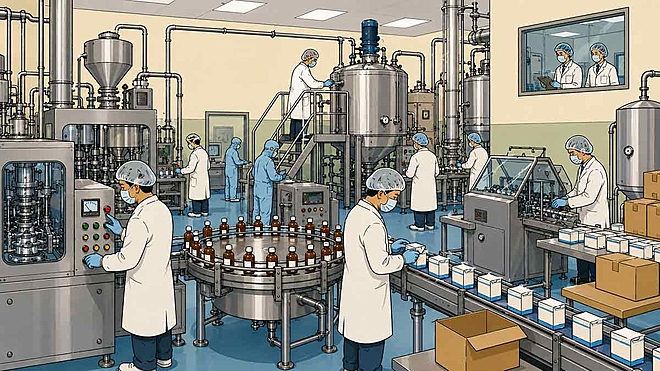
Anthem is a CRDMO, a contract research, development and manufacturing organisation, the outsourced lab and factory that global drug firms use instead of building their own. A biotech arrives with a molecule; Anthem helps discover it, makes the trial batches and, once it clears approval, manufactures it at scale, across both chemical and complex biological drugs. Services are 83 per cent of revenue, and most of the money comes from the West, with Europe about 55 per cent of services revenue and North America about 26 per cent.
Hold that business in mind, because the rest of this story is about what it was worth, and what an investor paid for it.
The price had already banked everything
Here is the answer to the puzzle. Anthem did not list cheap and fail to run. It listed expensive and had nowhere left to run. It came to market at about 70 times trailing earnings and, within weeks, traded near 90. At that price, the market was not mispricing the company. It was paying, in full and in advance, for the theme, the elite margins and a pipeline of blockbuster drugs that had not yet arrived.
The best returns in the room and priced like it
Anthem leads every peer on return on capital, at 22 per cent, and trades at a rich multiple too
| Company | Return on equity, FY26 (%) | Price to earnings (times) |
|---|---|---|
| Anthem Biosciences | 22 | 73.4 |
| Syngene | 7.7 | 46.3 |
| Divi's Laboratories | 16.2 | 74.2 |
| Sai Life Sciences | 14.9 | 77.5 |
| Cohance Lifesciences | 5.4 | 94.1 |
| Price-to-earnings on a trailing basis. | ||
Other high-quality names carried similar multiples, but each had a reason the price could keep climbing or the earnings could sprint to meet it. Sai Life was early in its margin ramp, its profits still racing to catch a high price. Laurus Labs, in an earlier re-rating, watched its multiple expand as its contract-manufacturing mix climbed from a tenth of revenue towards a third. Anthem had no such runway. It arrived already at the top of the theme's enthusiasm, with best-in-class margins that left little room to surprise and no re-rating left to fire.
The clearest proof came on the day of that record March quarter. Net profit more than doubled from a year earlier. The stock barely moved. When good news cannot lift a price, it was already in the price.
And the business really is that good
The trap is that everything the price had banked is true. Anthem is, on the evidence, a superb business. Revenue rose about 15 per cent in FY26 to Rs 2,124 crore, below the 20 per cent management wanted, yet operating and net profit both grew more than 30 per cent, because the margin keeps widening for a structural reason. Anthem makes more of its own raw materials each year, has cut a key intermediate out of China entirely, and now leans on around 900 domestic suppliers. Every input it brings in-house lifts the margin and loosens its grip on the Chinese supply chain its Western clients are trying to leave.
Lumpy quarters, a record spike
A soft December gave way to the best-ever March
| Quarter | Mar-25 | Jun-25 | Sep-25 | Dec-25 | Mar-26 | Jun-26 |
|---|---|---|---|---|---|---|
| Revenue (Rs cr) | 483 | 540 | 550 | 423 | 611 | 418 |
| Operating profit margin (%) | 40.4 | 35.4 | 39.6 | 37.1 | 43.7 | 36.1 |
| Profit after tax (Rs cr) | 83 | 136 | 173 | 118 | 190 | 120 |
It also wins customers in a way larger rivals cannot copy. Rather than chase Big Pharma, through its US partner DavosPharma, it signs small biotechs while their drugs are still in the lab, with 89 American customers so far. When one of those drugs works, a global drug-maker usually buys the biotech, and Anthem keeps the job of making the ingredient. Five of its clients have been acquired this way in three years. That is how a mid-size Indian company ends up supplying the world's biggest pharma names without ever pitching to them, and it already makes the ingredient for four blockbuster drugs.
And it funds its own growth. Its Unit IV project, Rs 1,200 crore in the first phase alone, will roughly double custom-synthesis capacity by 2028, more than Units I, II and III combined, and it is being built without debt. Net cash rose to nearly Rs 1,000 crore by September 2025 even as the company spent heavily. Paying for expansion on that scale out of its own cash flow is the surest sign the quality is real, not a story.
So why the wait
If the business is this good, why should a patient shareholder not simply be rewarded soon? Because the growth, though real, arrives slowly, and the stock has already been paid for it. Anthem earns a fixed manufacturing fee per batch and owns none of the drugs, so its income rises only as its clients sell more and reorder. Four of its molecules reached the market only this year and still contribute just 8 to 9 per cent of revenue; full volume is two to three years away. Every extra batch also consumes factory time and working capital, so the reward comes in slowly and at a cost.
The theme flatters it less than the headlines suggest, too. Anthem's direct American exposure is about 26 per cent of services revenue, so it gains from the world reshuffling its supply chains rather than from a wall of US federal orders, a slower and more indirect pull than a US-facing rival feels. That is a large part of why it sat out a rally that carried its peers.
One more piece of context belongs here. The IPO was entirely an offer for sale, so not a rupee reached the company; it funded exits, not growth. That matters less than it sounds, since promoters still hold about 71 per cent, down only from 76.9 per cent. And the demand was no verdict on value: the issue was subscribed 67 times, with institutions bidding 193 times their quota and retail only six, yet heavy oversubscription is social proof, not proof of price. Of the 108 companies that listed that year, Anthem has beaten only about 46 from its listing close, with nearly half the vintage still below its issue price. Even the best of a hot crop tends to land mid-pack.
The lesson that outlives the company
A theme you believe in and a business you admire can still make a poor investment if the entry price has already paid for both. That is the whole of Anthem's first year, and none of it is a stumble by the company. It was the finest business in its field, priced as if the market already knew it, so the reward for being right had been spent before the stock ever traded. Before the next hot IPO tempts you, do the hardest and least exciting thing an investor can do. Read the price, not just the story.
The hardest part of investing isn't finding a great business. It's deciding whether today's price still leaves room for tomorrow's returns. Value Research Stock Advisor looks beyond popular narratives to judge what a business is truly worth, when optimism has already been priced in and when patience is likely to be rewarded.
Know the difference between a great company and a great investment.
Ask Value Research 

 New episodes every Friday









 New Process Alert
  Seems like you've uploaded a wrong QR code. Please upload the QR code downloaded from MF Central platform.


