




 Adobe Stock
Summary: A factor score tells you one thing about a stock. It says nothing about the governance behind it, the balance sheet underneath it, or whether the trend it's riding is built on something real. That gap is where pure factor indices and rule-based smart beta funds begin to diverge.
Factor investing has brought discipline to a field long swayed by persuasive stories. Momentum can be measured through price behaviour while value can be assessed against fundamentals. Both can be tested against history. A stock no longer enters a portfolio merely because a manager has a compelling narrative.
Yet a factor score captures only one trait. It may reward a strong trend despite weak governance or treat a damaged business as merely cheap. This is where pure factor indices and rule-based active smart beta funds begin to part company.
The virtue of a narrow mandate
Pure factor indices offer transparent rules at relatively low cost. They give investors direct exposure to factors like momentum or value without relying on continuing judgement.
An index must admit any stock that meets its rules, even when the resulting portfolio looks uncomfortable. A fragile company can rank highly after a sharp rally. A cheap stock may be mispriced, though it may also reflect weakening fundamentals. Free-float market-cap weighting can tilt the portfolio towards larger companies despite weaker factor scores.
None of this makes a passive factor index defective. Its purpose is consistent factor exposure. However, investors may still prefer a wider test before admission.
Expanding the rulebook
Rule-based active smart beta funds use a broader rulebook while retaining a systematic process. In NJ’s case, eligible stocks first pass a mandatory quality screen. The process also examines forensic and governance risks, while volatility influences portfolio construction. The aim is to stop a strong signal from carrying a weak business into the portfolio.
From December 31, 2006, to April 30, 2026, the NJ Momentum Fund’s model portfolio recorded a higher annualised return with much lower volatility and probability of loss over a three-year period. The table “Same factor, fewer rough edges” shows a similar risk advantage for the NJ Value Fund’s model portfolio.
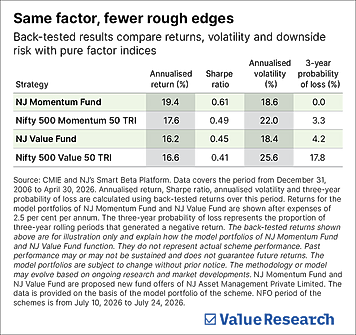
During the period studied, the additional filters materially changed the risk borne in pursuit of the factor premium. Both NJ model portfolios also recorded higher Sharpe ratios than their corresponding pure factor indices.
That matters because investors tend to abandon strategies after an unpleasant stretch. Lower volatility may make the journey easier to endure. A lower incidence of loss over three-year periods may improve the odds that investors remain invested long enough for the factor exposure to matter.
A quality filter has no sense of occasion
A broader rulebook creates tracking error. An index constituent may be excluded after failing the quality screen while a shared holding may receive a different weight. During some phases, that divergence will hurt performance.
In 2021, the NJ Momentum Fund’s model portfolio returned 58 per cent, while the Nifty 500 Momentum 50 TRI gained 76.86 per cent. The NJ Value Fund’s model portfolio outperformed strongly in 2020 (21.44 per cent versus 8.14 per cent), then returned -2.37 per cent in 2022 as the Nifty 500 Value 50 TRI gained 23.16 per cent.

Such gaps are inevitable. A pure index can benefit when speculative companies rally or when larger stocks lead the market. The cost of exclusion can appear before its value becomes apparent.
Consequently, annual outperformance is a poor test of a filtered portfolio. The intended effect lies in the distribution of outcomes over time. Some upside may be forgone during an exuberant phase if the same rules reduce volatility and other risks elsewhere.
The differences also appear in the holdings. The NJ Momentum Fund and NJ Value Fund model portfolios had overlaps of 47.48 and 23.71 per cent, respectively, with their corresponding factor indices.
Low overlap carries no merit by itself. Its relevance lies in the source of the divergence. Here, different eligibility rules and weighting methods produce distinct portfolios.
That matters for investors who already own diversified equity funds. Adding another portfolio filled with familiar holdings may increase complexity without improving diversification. A factor allocation has a stronger claim on portfolio space when its return drivers are genuinely distinct.
The price of greater control
Pure factor indices retain the simpler proposition. Their fees are lower and their exposure is easy to understand. That may suit investors who want an unfiltered expression of a factor.
Rule-based active funds apply a broader standard before allowing that signal into the portfolio. The relevant test extends beyond headline returns to volatility, downside risk and portfolio overlap.
Only then does the difference between a useful signal and a usable portfolio become clear.
Also read: Separating wheat from chaff
Ask Value Research 

 New episodes every Friday












 New Process Alert
  Seems like you've uploaded a wrong QR code. Please upload the QR code downloaded from MF Central platform.


