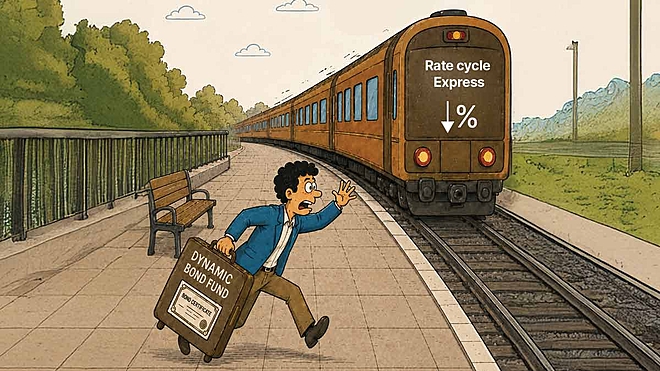
Aprajita Anushree/AI-Generated Image
Summary: Dynamic bond funds promise to do the rate-timing for you. The record shows they have mostly done it late, raising duration after rates fell and cutting it after they rose. The flexibility is real. The timing rarely is.
Dynamic bond funds make a tempting pitch: leave the interest-rate calls to the fund manager. Unlike short-, medium- or long-duration funds, they are free to move across maturities, buying longer-dated securities when rates are expected to fall and shifting to shorter-maturity paper when rates look set to rise. That flexibility should make them one of the smarter corners of the debt-fund market.
In practice, the record is less flattering. The category has struggled to keep pace even with short-duration funds, the plain-vanilla anchor of many debt portfolios. Over the last three years, a stretch that covers nearly the full leg of falling rates, only four of 23 dynamic bond funds beat the average short-duration debt fund. Over five years, the underperformance largely holds. And over the recent one-year period, even the best dynamic bond fund barely edged an ordinary short-duration fund.

Why the underperformance
A dynamic bond fund has one job. It adjusts the portfolio’s duration, its sensitivity to rate moves, ahead of the rate cycle.
The fund aims to hold longer-maturity bonds before interest rates fall because falling rates lift bond prices of longer-dated bonds and, therefore, the NAV. Before rates rise, it does the opposite: cut duration and move into safer shorter-maturity instruments to protect the NAV from sharp declines. But getting the timing right is often tricky.
The chart ‘Late at every turn’ makes it clear. In the last cycle, the category should have ideally raised portfolio duration before the market started pricing in lower rates. Instead, the shift happened after the fall had begun. So when the 10-year bond yield was still above 7 per cent in early 2024, the category’s median duration was about six years. It rose later, touching over eight years, only after the yield had already started coming down. So the typical fund did catch a part of the bond rally. But it was not early to it.

The 10-year yield then reached a bottom of 6.2 per cent by May 2025. The median duration at this point should have been lower before yields could begin to rise. But it was still high at 7.3 years. In other words, the category was slow to shift toward shorter-duration bonds. So by the time the duration sharply came down to 3.9 years by March this year, 10-year G-sec yields had already risen sharply. The move came after the damage was already done. The category, therefore, has been reacting to the market, not leading it. That explains why its flexibility has not translated into superior returns.
Some schemes show this more starkly. Bandhan Dynamic Bond Fund had a duration of around 12 years until June 2025 and then sharply down to just 1.1 years by February 2026, a violent late swing rather than a timed one.
On the other hand, ICICI Prudential All Seasons Bond Fund, the category’s largest scheme at 44 per cent of assets, kept duration in a more restrained three-to-five-year range. It is, thus, one of the four funds that beat the average short-duration fund over three years.
The good and bad
Dynamic bond funds do offer something useful: flexibility. They can move across maturities, buy longer-maturity bonds before a falling-rate phase and cut duration when rates are expected to rise. In theory, this can save investors the trouble of switching between debt-fund categories themselves.
But that same promise is also the risk. The fund manager has to get the interest-rate cycle right. If the fund carries high duration when rates and long-term yields rise, the fund’s NAV may reflect that badly. If it cuts duration after the interest rate market has moved, it can miss the rally or suffer the decline. That makes returns less predictable than in short-duration funds, which mostly hold shorter-dated securities and are therefore less sensitive to rate-cycle swings.
What you should do
Judge a dynamic bond fund by what it has delivered across a full rate cycle, not by the flexibility of its mandate. Pull up your fund’s duration and lay it against actual rate moves. If the duration consistently trails the market, the “dynamic” label is costing you money.
The rewards of duration timing have rarely justified the risk. For most investors, the fixed-income part of a portfolio is best served by short-duration funds.
Also read: The fall your SIP didn’t feel