




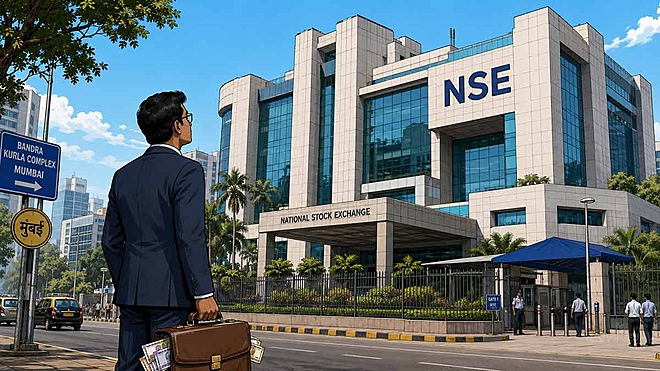
 Anand Kumar/AI-Generated Image

Summary: NSE’s IPO has been nearly a decade in the making. In that time, the exchange has become bigger, richer and more dominant. But the engine that powered it is directly in SEBI’s line of fire.
NSE filed for an IPO in 2016. The sale never happened. A scandal over unfair access to trading froze the plan for years. Then came a decade of waiting. This time the IPO is sized at about Rs 30,000 crore, the largest share sale in Indian history. The record-size headlines will skip that decade. It is the part you should read before you decide whether to buy or not.
What stopped it in 2016
The roadblock was co-location. Between 2010 and 2014, certain brokers connected first to a backup server inside NSE’s data centre. That gave them market data milliseconds ahead of everyone else. In high-frequency trading, milliseconds are money. A forensic audit confirmed the pattern. SEBI opened an investigation, and when NSE filed its prospectus in 2016, the case was still wide open, with no end date. That uncertainty was enough for the market regulator to halt the listing.
What followed was a decade-long grind through SEBI penalties, tribunal battles, and the Supreme Court. The saga is in its final chapter with NSE having proposed a revised Rs 1,491-crore settlement with SEBI, which is reportedly near resolution.
That backdrop explains how Ashish Chauhan’s arrival in 2022 proved instrumental. A member of NSE’s founding team who later led BSE’s 2017 listing, he returned and helped restore regulatory credibility and put the long-delayed IPO back on track.
What it built in the last decade
Here is the part most coverage will miss. The 10 years during which NSE could not list became the 10 years it grew most aggressively.
A giant leap
| FY16 | FY26 | |
|---|---|---|
| Revenue from operations | Rs 1,863 cr | Rs 16,601 cr |
| Adjusted profit after tax | Rs 975 cr | Rs 9,101 cr |
| Registered investors | 2 crore | 12.9 crore |
| Market cap of listed companies | Rs 93 lakh cr | Rs 411 lakh cr |
| Revenue from derivatives | Rs 900 cr | Rs 11,478 cr |
| Profit figures are adjusted for exceptional and one-off items. | ||
Profit figures are adjusted for exceptional and one-off items.
Revenue grew roughly nine times. The mix shift inside those numbers is more telling. Exchanges make money mainly by charging a transaction fee every time an investor trades, plus listing fees, data services, and technology offerings. In FY16, transaction charges made up 49.5 per cent of NSE’s total income. By FY26, that share had risen to 78.7 per cent, primarily led by derivative trading, options in particular, which has seen explosive retail-led growth in recent years. NSE simply grew by going deeper into the one business expanding the fastest. The result is that options generate roughly 60 per cent of operating revenue, the largest in the mix.
When strength becomes the weak spot
SEBI’s own data showed that 91 per cent of futures & options retail traders suffered net losses in FY25 alone, collectively losing about Rs 1.1 lakh crore. The regulator has thus been intent on slowing the segment down. From 2024, it changed many rules on equity derivatives, including reducing seven weekly expiry events across both exchanges to one weekly index expiry: NSE’s Nifty on Tuesday, BSE’s Sensex on Thursday. SEBI also raised contract sizes and imposed extra margins near expiry.
FY26 was the first full year for NSE under those rules. Revenue from operations fell about 3 per cent year on year. Adjusted profit after tax came in at Rs 9,101 crore, down 17 per cent from Rs 10,978 crore in FY25. More importantly, NSE’s market share of equity options fell from 97 per cent in FY24 to 75 per cent in FY26. The hit on profitability is also because no other part of the business is large enough to absorb the shortfall from options.
The other 21 per cent of top line, from data feeds, listing fees, index licensing, and co-location charges, is recurring, less volatile and growing. Because derivatives printed money for a decade, NSE never needed to optimise pricing elsewhere. Cash-market charges stayed low. Listing fee sits below global peers. Those levers remain largely unpulled. They will not replace a sharp fall in options, but they could narrow the gap.
Rivalry from BSE has raised the heat
The 10-year annualised profit growth is nearly similar: NSE 30 per cent, BSE 28 per cent. The same number conceals two different businesses. In the first five years, NSE grew from near-total dominance in derivatives, while BSE had no meaningful derivatives franchise and its profits actually shrank between FY16 and FY21. The decade-long parity exists entirely because of what BSE did in the last four years.
Two exchanges, one decade
| Profit after tax (Rs cr) | NSE | BSE |
|---|---|---|
| FY16 | 654 | 205 |
| FY21 | 3,729 | 156 |
| FY26 | 9,101 | 2,475 |
| CAGR, 10 years (%) | 30.1 | 28.3 |
| CAGR, 5 years (%) | 19.5 | 73.8 |
| Profit after tax excludes exceptional and one-off items and is stated on the reported entity basis, so the FY16 figure differs from the Rs 975 crore adjusted-consolidated number in the table above. CAGR is compounded annual growth rate. | ||
The five-year profit growth figure shows that. BSE compounded at 73.8 per cent, NSE at 19.5. The catalyst was the same regulatory restructuring that hurt NSE. It handed BSE an opening in index options it had never held before. FY26 makes it visible: NSE's profit fell, BSE's rose 88 per cent. BSE trades at 64 times earnings because the market expects it to keep taking share from a low base. NSE is compounding from the top of a market it already owns.
A quality business whose price will warrant scrutiny
Still NSE is a toll booth on India’s financial highway. Every trade executed, every contract settled, every passive fund benchmarked to the Nifty, NSE collects something. That shows up in how it earns money with rare consistency. In FY26 it posted a 51 per cent profit margin, paid out 84 per cent of profit as dividend, and still held Rs 64,771 crore in treasury investments. The business generates far more cash than it needs to run or grow, a defining characteristic of quality.
However, the regulator controls the road. SEBI decides which contracts NSE can offer, at what size, on which days, with what margins. In FY26 it slowed traffic on NSE’s most profitable lane, and the fall passed straight to profit. And this demands that its IPO valuation, when declared, be scrutinised accordingly.
Its deals in the unlisted market, trading hands at Rs 1,999.36 apiece, imply a market cap near Rs 4.95 lakh crore against FY26 earnings, or about 54 times. That could be uncomfortable for a business whose most profitable product SEBI is deliberately shrinking, and which is growing from the peak of a market it already dominates. The price band, however, is yet to be declared. Once it is out, the test will be simple: does the price ask you to pay for growth NSE has already banked, or for growth that’s only realistically possible ahead?
A great business is only half the answer
At Value Research Stock Advisor, we apply the same discipline to listed stocks: business quality, growth durability, valuation and margin of safety. If you want stock ideas backed by clear reasoning rather than market noise, explore Value Research Stock Advisor.
Ask Value Research 

 New episodes every Friday







 New Process Alert
  Seems like you've uploaded a wrong QR code. Please upload the QR code downloaded from MF Central platform.


