




 Yogesh Sharma/AI-generated image
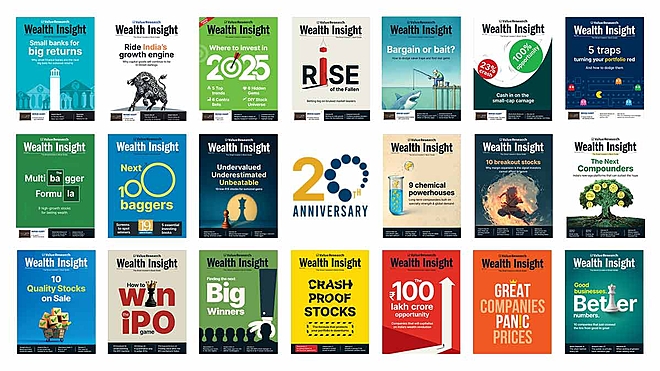
Summary: Every July for 20 years, this magazine has stopped picking stocks for one issue and asked a larger question: what does compounding actually do to a life? This is 20 lessons, one for each year, on time, selection, valuation and behaviour.
Summary: Every July for 20 years, this magazine has stopped picking stocks for one issue and asked a larger question: what does compounding actually do to a life? This is 20 lessons, one for each year, on time, selection, valuation and behaviour. Every July for 20 years, this magazine has stopped picking stocks for one issue and instead asked a larger question: What does compounding actually do to a life? What separates a business that lasts from one that flatters its investors and then breaks? Why do intelligent people repeat the same mistakes in markets, decade after decade? What is held is 20 lessons, one for each year. Read them in order, and they stop being a list. They become a way of seeing markets that does not depend on the cycle you happen to be living through. This is not a formula for picking stocks, but a temperament. They fall into four groups: time, selection, valuation and behaviour. An investor who had been reading this magazine steadily for 20 years would have collected more than stock ideas. They would have become harder to fool, including by themselves. The power of time Time is the one edge every investor shares equally, and it rewards patience more reliably than any skill could. #1 The costliest mistake is selling the right stock too early We argue endlessly about what to buy: which stock, which fund, which sector. The real money is lost on the other side of that decision, when we sell. Most investors sell too early, not because they picked wrong. A doubled stock feels like a finished job, and holding feels like greed while exiting feels like discipline. Behavioural economists call this the disposition effect, one of the most expensive habits an investor can carry. In our 13th anniversary issue titled ‘Your 10 key questions answered’, Dhirendra Kumar described a stock that he had bought at Rs 40. When the stock price increased to Rs 80 per share, his broker called, saying that the money had doubled and it was time to move. Yet, Kumar did not sell. The stock went on to become a 345-bagger, worth Rs 27.6 lakh. The business had not changed, so why should the holding? The mistake in both cases is the same. The feeling of completion overrides the logic of compounding. Compounding does not stop because a number feels round, and the discipline that matters most is not knowing when to act but rather when to wait. #2 Hold equity for 15 years and the loss disappears Every new investor is told that equity is risky. The statement isn’t entirely wrong. In the short run, equity is highly volatile: a portfolio falls 20 per cent in a bad year. Yet, here’s where the mistake is. The investor pauses and concludes equity is not for them. They are measuring the wrong thing. We calculated daily rolling returns of the Sensex across four holding periods. Over one year, 26 per cent of all periods ended in the negative. Over five years, 10 per cent. Over 10 years, 3 per cent. Over 15 years: Zero. There is not a single 15-year period in the Sensex’s history that ended in the red. Inside those windows, the market fell often, sometimes by half and whole years returned nothing. The 15-year holder still came out ahead every time. Most investors treat volatility as a risk. It is not. Volatility is the price you pay. Permanent loss is the risk, and over 15 years, time has never once allowed it. #3 A crash is a sale, and almost no one shops in it A crashing market feels like an emergency. For the investor who does not need the money soon, it is a sale. In March 2020, the Sensex fell to around 26,000 in just six weeks. Lockdowns had no end date that anyone could name, and most investors did what an emergency seems to demand: pause and wait for clarity. Our 14th anniversary issue said the opposite. The way to make money in equity is to use the bad times. Five years on, the Sensex had nearly tripled from that low. The investor who paused caught the recovery but missed buying the cheap units. The one who kept buying at 26,000, 28,000, 32,000 bought at prices that have not returned since, and those units have produced the highest returns in the history of SIPs. The panic set the price; the discipline to keep buying turned it into a return. A falling market does not ask whether you can survive it. It asks whether you can recognise it for what it is. An opportunity wears the mask of a crisis, and the two look identical until the moment has passed. Most investors recognise the chance only in hindsight, when the cheap prices are gone and the regret is permanent. The skill is not predicting the bottom but staying invested enough to act when fear hands you a discount that conviction alone could never quite have earned. #4 The second decade is where the money is Most investors leave a winner too early. Five good years feel like a completed job: take the gain, redeploy, move on. They are walking out before the main act. Eicher Motors shows it most clearly. From 2004 to 2009 the company did quiet, unglamorous work, rebuilding the ‘Royal Enfield’ name and readying new markets. The stock rose 249 per cent over those five years, enough for most holders to book it and leave. The next 15 years returned 3,554 per cent. Same company, same business. The first phase only built the platform: the Classic 350, a brand people would queue for. The second phase was that platform earning, compounding on a name that was already made. This was not the market repricing the stock, but the business growing into it. Our 19th anniversary issue found the same shape across India’s 100-baggers since 2004. Bajaj Finance built capability in silence, then climbed once its advantages matured. This is not luck; it is structure. A great business never announces its inflexion point, and by the time the turn is obvious, the market has already paid for it. Sitting through the quiet years is not waiting for the investment to work. It is the work. Waiting patiently while the business compounds quietly is what pays off. #5 Being right early feels exactly like being wrong Being right and being early feel identical. But from the perspective of your portfolio and your peers, both look like a mistake. The gap between forming a correct thesis and watching the market agree is where most investors give up. In July 2006, we published our first interview, headlined ‘All Over for Easy Money’. Sandip Sabharwal of Lotus India AMC gave it on the day the Sensex crashed more than 800 points. The index had risen 300 per cent in three years; easy money, he said, was finished. He was right, and also 18 months early. Over those months the Sensex rose another 40 per cent, and every signal said the cautious call was wrong. The answer then is to return to the analysis: if the fundamentals have not changed, the market’s disagreement is noise. The crash came in January 2008, and the Sensex lost 61 per cent. The only error available to the investor who held was impatience with his own correct judgment. Being early is not a flaw in the thesis. It is the cost of being ahead of the consensus. The investor who mistakes early for wrong abandons a corre
This article was originally published on July 01, 2026.

 New episodes every Friday











 New Process Alert
  Seems like you've uploaded a wrong QR code. Please upload the QR code downloaded from MF Central platform.


