




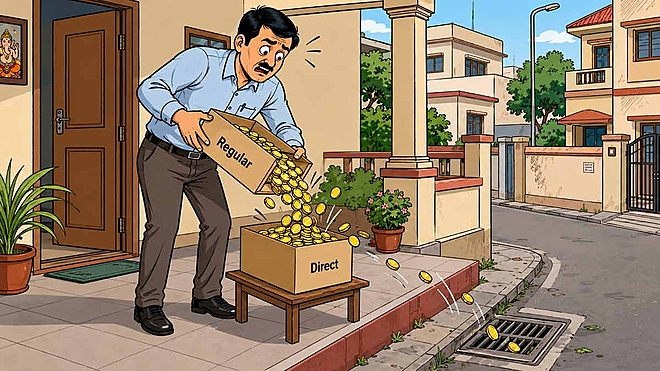
 Anand Kumar/AI-Generated Image

Reader’s question: How do I switch from a regular plan to a direct plan? I have an existing relationship with my broker/distributor. How do I manage that? - Jasmine Saklat
You have decided to switch to a direct plan. Good decision. However, one thing is worth knowing: the switch counts as a sale. Any gains you have made in the regular plan are taxable at the point of the switch. SEBI removed exit loads on these switches last year, so that cost is gone. Capital gains tax is not.
The one cost that still matters
The switch is treated as a redemption from the regular plan and a fresh purchase into the direct plan. Any gains you have made so far are taxable at the point of the switch.
For equity funds, gains on units held for more than one year are long-term capital gains. Gains up to Rs 1.25 lakh in a financial year are exempt and gains above that are taxed at 12.5 per cent. Gains on units held for one year or less are short-term capital gains, taxed at 20 per cent.
For debt funds, the holding period distinction no longer applies. All gains, regardless of how long you have held the units, are added to your income and taxed at your applicable income tax slab rate.
If your gains are significant, switch in stages rather than all at once. Spreading the switch across multiple financial years lets you use the Rs 1.25 lakh annual exemption on long-term gains each time, reducing the total tax you pay.
Four ways to make the switch
You cannot switch through your existing distributor. The transaction has to be initiated directly by you. Here are the four available routes.
The AMC's own website or app
Every mutual fund house has its own investor portal. Log in using your PAN and registered mobile number. Go to the transactions section, find the scheme you hold under the regular plan and look for the switch option. Select the direct plan of the same scheme as the destination. Submit the request and authenticate it, usually through an OTP. The transaction is generally processed within one to three business days.
If you hold investments across multiple fund houses, you will need to repeat this on each AMC's platform separately.
CAMS or KFin Technologies
CAMS and KFin Technologies are the two registrars that maintain records for most Indian mutual funds. Their portals, myCAMS and KFinKart, let you manage holdings across multiple fund houses serviced by that registrar from a single login.
Log in using your PAN. Your folios will appear. Select the regular plan holding, choose the switch option, select the direct plan of the same scheme and confirm. Since some fund houses are serviced by CAMS and others by KFin, check which registrar handles your specific fund house before logging in.
MF Central
MF Central is a joint initiative of CAMS and KFin Technologies that lets investors service their mutual fund investments across participating fund houses through a single platform.
Log in using your PAN and registered mobile number. Once your folios are linked, you can view holdings across multiple fund houses in one place. Select the regular plan holding, choose the switch option, select the direct plan of the same scheme and confirm the transaction.
Direct-investment platforms
Many platforms such as Groww facilitate investments in direct plans. If you already use one of these, check whether it supports transactions in your existing folios and allows switching from regular to direct plans. The process varies across platforms.
SIPs need a separate step
A switch transfers only your existing units. It does not move your SIP automatically.
You need to stop the SIP in the regular plan and start a fresh one in the direct plan. Do it in the right order: set up the new SIP first and confirm it is active, then cancel the existing one. This avoids missing an instalment during the transition.
Is switching always the right move?
Not necessarily.
If your distributor or adviser has helped you build an appropriate asset allocation, guided you through market downturns and provided ongoing financial advice, that relationship may well justify the additional cost. Good advice can often save investors from costly mistakes.
On the other hand, if the relationship has become largely transactional, with little ongoing guidance or portfolio review, it may be worth reassessing whether the additional expense is justified.
There is also a practical consideration. Some funds, particularly those investing overseas, have temporarily stopped accepting fresh investments because of regulatory limits. Since moving from a regular plan to a direct plan involves redeeming units and making a fresh purchase, switching may not be possible while such restrictions are in place. In such cases, investors may have to continue with their existing holdings until fresh subscriptions resume.
Switching to direct is only the first step. Knowing whether you are in the right funds to begin with, and what to do with them once you are, is where Value Research Fund Advisor comes in. It tells you exactly what to keep, what to drop and what to buy next, without a distributor in the middle.
Already on direct? Make sure you're in the right funds.
This article was originally published on July 02, 2026.
Ask Value Research 

 New episodes every Friday




 New Process Alert
  Seems like you've uploaded a wrong QR code. Please upload the QR code downloaded from MF Central platform.


