




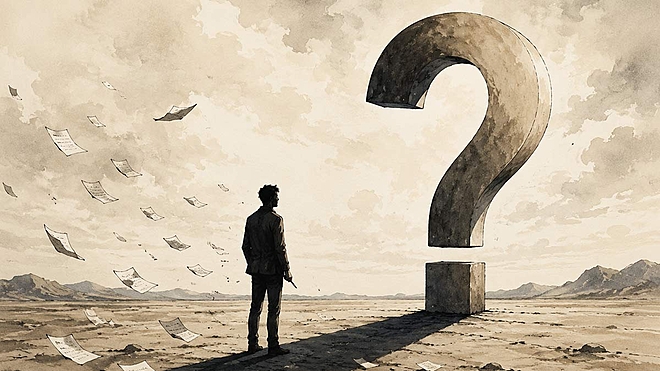
 Anand Kumar/AI-Generated Image


Last week, in this column, I broke a 30-year habit and admitted that 'this too shall pass' did not quite fit the present moment. The mailbag that followed was the largest I can remember. After enough years of doing this, one learns to read the replies as carefully as one writes the column, because the shape of a few hundred reactions usually says more than the piece that provoked them. The letters sorted themselves into four rough piles, and the piles themselves are worth a column.
A brief recap, for the reader who missed the original. Most market disruptions, I argued, are damage to sentiment rather than damage to things. Factories still stand, workers still arrive, customers still buy; what has changed is mood, and mood is cyclical. The current situation in West Asia is an unhappy exception. The damage being done to drilling, storage and refining capacity in the region is damage to steel and concrete, and steel and concrete are repaired by welding and pouring, not by a recovery of confidence. That is why 'this too shall pass' needed an asterisk for once.
The first pile was the thank-yous, and to those of you who wrote to thank me, I owe a short reply: you are welcome. There is little more to say. The job of a column is to name what is happening, and if some readers felt that someone had finally said aloud what they were already sensing, that is a fair return for a week's work.
The second pile was more interesting and more important. A great many readers wrote, in effect, to ask whether I was using restrained language to convey something far worse, whether the column was a coded distress signal from a man who knew more than he was letting on. I was not. I was being realistic, and being realistic mostly consists of saying 'I don't know.' There are genuine downside scenarios, but there are also genuine silver linings worth keeping in view. We might well see expanding refining capacity, diversifying energy supplies, and investing much more in domestic manufacturing. The pressure we are now under is exactly what tends to prompt long-postponed decisions.
The 1991 balance-of-payments crisis cleared the way for liberalisation. The 1997 Asian crisis pushed Indian companies to clean up their balance sheets. The 2008 crash forced the banking system to recognise bad loans it had spent years denying. Each one of these felt unsurvivable while it was happening, and each one turned out to be a forcing function we could not have engineered any other way.
We may yet emerge from this period with capacities we ought to have developed more quickly. To read my column as a coded warning of catastrophe is itself an instance of the very behaviour I argue against: pattern-finding where none exists. I told you exactly what I think, as I always do.
The third pile was the smallest and the most entertaining. A vocal subset of readers wrote in to register their displeasure at being offered, yet again, the boring prescription of SIPs, term insurance, and a handful of plain mutual funds. This advice, they explained, was for beginners. Sophisticated investors of their calibre required something more elaborate: currency hedges, macro frameworks, sector rotations, and AI-age portfolio theory. I have met this type of gentleman many times over the years. He is unfailingly confident, and he is also, almost without exception, the man who loses the most money in moments precisely like the present one.
In a week like this one, he is on the phone with his broker, exiting equities and 'going defensive', or rotating his portfolio into whichever asset class has performed best over the last six weeks. In a year, the data will show that this was exactly when he should have done nothing. He never reads the data.
The boring SIP investor, two decades in, is usually doing better than the gentleman with the complex spreadsheet and sleeping better at night.
Which brings me to the fourth pile, the largest by far. A great many readers wrote to ask, in one form or another, what will happen next, and what they ought to do in response. My answer must be the same as always. I do not know, and I will not pretend that I do. More importantly, anyone who claims to know with confidence is either selling something or fooling themselves, and very often both. Resist them politely.
What you can do instead is exactly what you have been doing all along: keep your SIPs running, hold the term insurance, stay diversified across asset classes, and rebalance once a year. None of this requires a forecast about West Asia or oil prices, and none of it stops working in the months when commentators do not know what comes next. The dullest possible behaviour remains, by a wide margin, the most likely to make you wealthy over 20 years.
In a season as uncertain as this one, an honest 'I don't know' is the most valuable thing a commentator can offer you, and a confident forecast is the least.
Also read: The day even HDFC said no to gold
Ask Value Research 

 New episodes every Friday




 New Process Alert
  Seems like you've uploaded a wrong QR code. Please upload the QR code downloaded from MF Central platform.


