




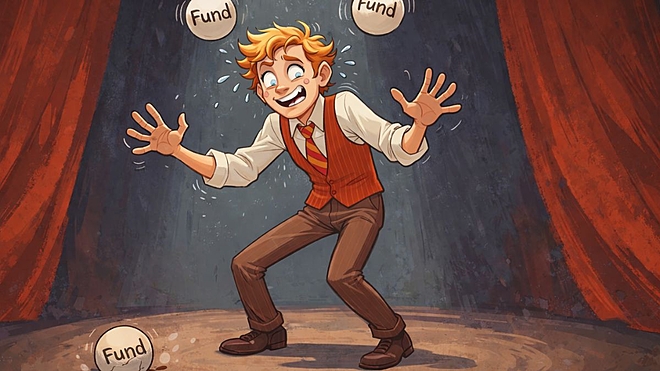
 Aditya Roy/AI-Generated Image

Summary: Many mutual fund investors obsess over choosing the best fund, overlooking the importance of time. Here’s why your investment horizon matters while deciding which equity fund to invest in.
Arnav, 23, wanted to kickstart his mutual fund investing journey. Like many first-time investors, he did what seemed logical: he searched for the ‘best equity mutual fund’. After hours of reading rankings and past-return tables, he settled on a small-cap fund.
He started investing Rs 10,000 every month through SIPs. A year later, he checked his portfolio, only to find it was down nearly 10 per cent.
“But this was supposed to be the best small-cap fund,” he thought, puzzled. “Why am I in the red, then? Maybe I should just sell.”
Arnav isn’t alone. Many investors choose equity funds largely based on past performance. That is not entirely wrong, but it misses a more important factor: time.
Equity investing does not reward short horizons. Even the best funds can deliver negative returns over one or two years. Without sufficient time for markets to recover, a good fund can quickly become a bad experience.
The table provided below illustrates this with uncomfortable clarity.
Investing in equity for the short term? You are in danger
Equity funds have a high likelihood of delivering negative returns during short periods of time
| Fund category | 1 year (%) | 3 year (%) | 5 year (%) | 7 year (%) |
|---|---|---|---|---|
| Short duration | 0 | 0 | 0 | 0 |
| Aggressive hybrid | 14.7 | 1.9 | 0 | 0 |
| Flexi-cap | 19.6 | 2.4 | 0.3 | 0 |
| Large-cap | 20.8 | 2.1 | 0.5 | 0 |
| Mid-cap | 20.2 | 3.9 | 0.6 | 0 |
| Small-cap | 26.1 | 6.5 | 0.9 | 0 |
| Data based on rolling returns on category average funds from January 2013 to February 2026 | ||||
The data above shows that equity funds have a high probability of giving negative returns during one-year periods. However, as the holding period lengthens, that probability drops sharply. By year seven, the loss incidence becomes negligible across categories.
This doesn’t mean that volatility no longer exists. Just that its ability to permanently damage outcomes does.
Drawdowns are sharper, recoveries are longer
Equity funds are inherently volatile. During market downturns, they can fall sharply and recovery may take time. The real question is not whether they decline, but how deep the fall is and how long each category takes to regain lost ground after a correction.
Consider the Global Financial Crisis of 2008. From its peak, the Nifty 100 declined by more than 61 per cent. The Nifty Midcap 150 and Nifty Smallcap 250 fell even harder, by about 73 per cent and 76 per cent respectively.
The difference became clearer during the recovery. The Nifty 100 regained its previous peak in roughly two years. Mid-cap and small-cap indices took more than five years to do the same.
This gap is not academic. It proves why equity allocation cannot be a casual debate about categories. It must reflect recovery capacity. Short horizons cannot withstand prolonged drawdowns, while long horizons, can endure deeper volatility because history shows markets have recovered, provided the investor stays invested long enough.
Now, let’s look at which mutual funds you should invest in, based on your timelines.
When the deadline is near (under three years)
If you need the money within three years, there is no room to play around. Time is critical and therefore, equity exposure should be limited.
Here, you should consider investing in short-duration funds, liquid funds and equity savings funds. Though they don’t deliver blockbuster returns like equity funds, they give steady and low-risk returns, helping protect your capital (exactly what your money needs).
When the timeline is longer, but finite (3-7 years)
Although your horizon is slightly stretched, you still have a limited window for recovery.
During this period, diversified categories such as flexi-cap funds and multi-cap funds are ideal. They blend exposures and reduce the risk that one segment’s prolonged recovery dominates the portfolio. Adding multiple mid- or small-cap allocations in pursuit of marginal return differences often increases fragility rather than resilience.
Here, simplicity is a form of risk management.
When time is an asset (Seven years or more)
Now that you have a generous amount of time, a higher exposure to mid- and small-cap funds can be considered. While they are known to deliver low or even negative returns in the near term, they perform well over time, provided there’s a sufficiently long recovery window.
With adequate runway, volatility becomes a companion to compounding rather than its enemy.
The takeaway
To reiterate, even the best equity funds can deliver poor outcomes if they are misaligned with your time horizon. Equity rewards patience, not urgency. Cut the journey short and you risk locking in losses. Give it adequate time, and volatility turns from a threat into a pathway for meaningful wealth creation.
To know which equity funds are suitable for your needs and time horizon, subscribe to Value Research Fund Advisor. Get expert-led guidance on mutual fund investing and personalised portfolio management. So that you don’t lose track of your wealth-building journey.
This article was originally published on February 19, 2026.
Ask Value Research 

 New episodes every Friday








 New Process Alert
  Seems like you've uploaded a wrong QR code. Please upload the QR code downloaded from MF Central platform.


