




 Aditya Roy/AI-Generated Image


Here's an experiment you can try right now. Go to Value Research Online and pull up a listing of stocks in the Asset Management Companies category – these are mutual fund operators. Sort the list by market capitalisation in descending order. Now, in another browser tab, do the same with Brokerage Companies.
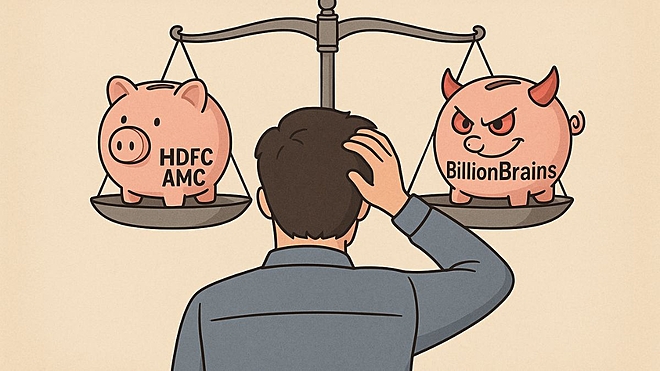
The largest mutual fund operator is HDFC AMC, with market cap of about Rs 1.15 lakh crore. The largest brokerage is Billionbrains, which operates under the Groww brand and is worth almost as much. Groww was listed just days ago and famously doubled shortly afterwards. You can go down both lists and see that the remaining companies follow roughly similar patterns. Of course, the AMC list is much smaller and doesn't have the miscellaneous players that populate the bottom half of the brokerage list.
Suggested read: Stop falling for the IPO trap
A casual observer glancing at these two lists might think: yes, of course, both types of companies help people invest and make money. Similar businesses, similar valuations. But a deeper look reveals something rather different – an irony so stark it should make every retail investor pause and think.
You see, the mutual fund list comprises companies whose customers mostly make money. I'd estimate perhaps 80 to 90 per cent of mutual fund investors achieve positive returns over meaningful time periods. The brokerage list, however, comprises companies whose customers mostly lose money. Based on SEBI's own research and industry data, perhaps 90 to 95 per cent of active traders, particularly those trading in Futures and Options, lose money.
These are not similar businesses. They are opposite in nature.
Yet the market values them similarly. Why? The answer reveals something uncomfortable about how financial services actually work. It's about the business model, not the customer outcome.
Mutual fund companies charge fees based on the amount of money they manage. As your investments grow, so does their revenue. When you make money, they make money. This alignment of interests isn't perfect; they still earn fees even when returns are poor, but there's a fundamental connection between customer success and company prosperity. A mutual fund company that consistently delivers poor returns will eventually see redemptions and declining assets.
Suggested read: The culture of commissions and why it’s a problem
Brokerages operate differently. They earn primarily from transaction fees, the brokerage on every buy and sell order. Some may also earn from account maintenance charges and margin funding. The more you trade, the more they earn. Whether you make or lose money on those trades is irrelevant to their revenue. In fact, there's a perverse incentive structure at play. Frequent trading – the kind that generates maximum brokerage revenue – is precisely the activity that causes most retail investors to lose money.
This becomes even more pronounced with derivatives trading. When SEBI examined F&O trading data, they found that 89 per cent of individual traders lost money. Yet brokerages actively promote this activity because it generates enormous transaction volumes. Extended trading hours, simplified interfaces for options trading and educational content focused on technical analysis. All of these initiatives are designed to increase trading frequency, not improve investor outcomes.
Suggested read: A black hole for your money
The market values both business models similarly because, from a pure business perspective, they're both effective at generating revenue. A brokerage that successfully encourages high-frequency trading can be as profitable as a mutual fund company managing long-term investments. Perhaps more so, given the transaction volumes involved.
But as an investor, you should care about which business model you're funding with your capital. When you invest through mutual funds, you're using a service where the provider benefits from your success. When you engage in frequent trading, particularly derivatives, you're using a service where the provider benefits from your activity regardless of outcome.
This isn't about demonising brokerages. They provide legitimate services, and some investors genuinely need trading platforms to manage their portfolios. But the similarity in valuations between these opposite business models should serve as a warning. The market doesn't distinguish between companies that help customers win and companies that profit from customer losses. The market only cares about revenue and profits.
You, however, should distinguish. When choosing how to invest, look beyond the slick interfaces and promotional offers. Ask yourself: Is this company's business model aligned with my success, or merely with my activity? The answer might save you from joining that unfortunate 89 per cent who discover too late that similar market valuations don't mean similar customer outcomes.
Also read: Beyond numbers, real wealth
Ask Value Research 

 New episodes every Friday









 New Process Alert
  Seems like you've uploaded a wrong QR code. Please upload the QR code downloaded from MF Central platform.


